


On the morning of 30 April, a piece on the historical importance of Section 235 in the South African Constitution – and the need for former President and current MK Party leader Jacob Zuma to rein in other MK Party members like MP Mzwanele Manyi who are pushing for its repeal – was published.
The piece argued that, given Zuma’s position as an elder statesman who participated in the negotiations that led to the inclusion of Section 235 in the Constitution in 1996 – as well as his September 2010 visit to Orania during which he made positive remarks about the community – he likely appreciates the complex historical considerations underpinning the provision and does not necessarily support its repeal. Crucially, the piece also clarified that it held no brief for Zuma regarding the various allegations and controversies that are associated with him.
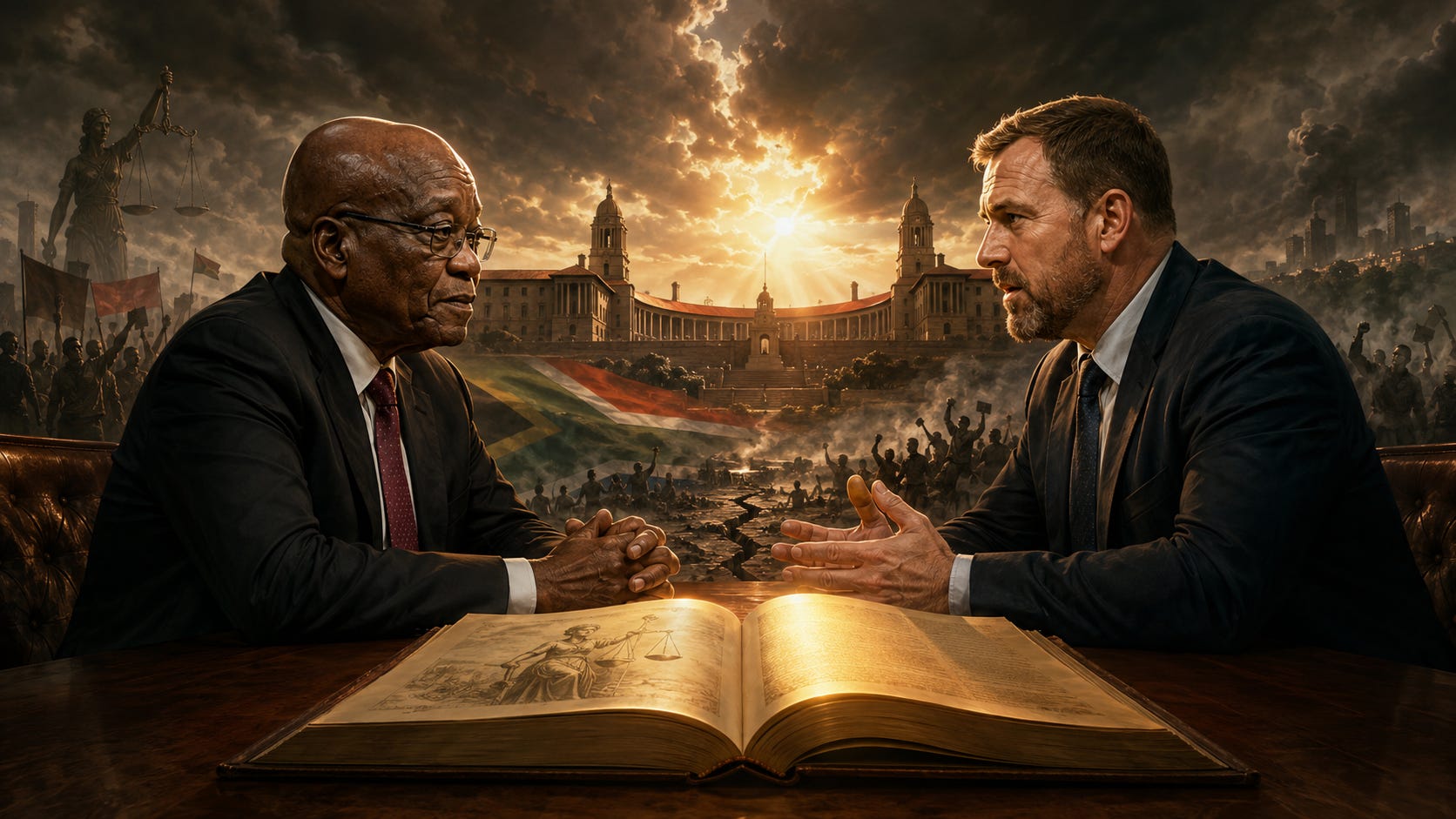
Coincidentally, later that same day, the CEO of AfriForum, Kallie Kriel, posted a photograph with Zuma on his X account, informing the public of a meeting they had held concerning the right to self-determination, its historical background, and its importance in fostering genuine pluralism and creating conditions for mutual recognition and peaceful coexistence.
Unsurprisingly, the photograph generated controversy and sharply divided public opinion. Reactions ranged from claims that Zuma was behaving like a reactionary Zulu nationalist in the mould of the late Prince Mangosuthu Buthelezi and striking a deal with ‘racist Boers’, to arguments that Kriel had made a serious mistake by engaging with a political figure who cannot be trusted.
This piece has little interest in critically engaging with these reactions and is rather more encouraged by the mere fact that the meeting took place. One does not have to like Zuma to acknowledge that his willingness to meet and engage with an organisation such as AfriForum reflects a certain degree of political maturity. The political arsonists in the EFF and other radical political organisations would rather be caught dead than seen participating in any constructive engagement with AfriForum over Section 235.
This is, of course, ultimately speculative, and the precise details of what was said – and whether anything was agreed upon – remain unknown. Nevertheless, given everything outlined above and the broader political context, there is at least some reason to be cautiously hopeful that Zuma listened seriously to Kriel and considered the arguments put before him.
At the same time, it remains entirely possible that Zuma ultimately disagreed with Kriel and that the MK Party will continue pushing for the repeal of Section 235, even if he was willing to hear him out during the meeting.
Either way, this entire episode has brought renewed attention to a very important constitutional clause that not only allows cultural minority communities to exercise a degree of autonomy within a broader unitary system, but to also, to some extent, shield themselves against the dangers of majoritarianism.
The federalists, at least in practical terms, did not ultimately win the battle during the country’s transition from apartheid. They did, however, succeed in securing a constitutional backdoor in Section 235 that has become increasingly important as the National Democratic Revolution (NDR) has entered its advanced stages.
Whatever ultimately happens, those who value Section 235 and the principle of self-determination should continue defending it and should not be discouraged by the current political developments. Equally important is the revival of serious and sustained discourse around what a viable political dispensation for South Africa might look like in the years ahead.
Ayanda Sakhile Zulu holds a BSocSci in Political Studies from the University of Pretoria and is a Policy Officer at the Free Market Foundation.

" ... Section 235 that has become increasingly important as the National Democratic Revolution (NDR) has entered its advanced stages."
You again nailed it, Ayanda. So many intentions of the NDR run against democratic principles and the constitution. Yet, the one escape clause for minorities in the constitution, i.e. Section 235, is now disputed. The mere fact that it is attacked, points to an obsession by some to contol everything and everybody. As part of a minority group, I rejoice in all who defend individual and group rights, and liberal values. Why try to deny people the right to self-determination? The only time you do that, is when they harm others in the process. But if they peacefully coexist with others within a broader constitutional arrangement, it is simply petty and small-minded to deny such people the right to "congregate" around cultulal values dear to themselves, and not necessarily to others. It is pure spitefullness...
Interesting ... Ayanda, you may find this Gandhi approach relevant: https://thetaooffreedom.substack.com/p/nou-x-hcr-swaraj-as-a-consent-architecture