


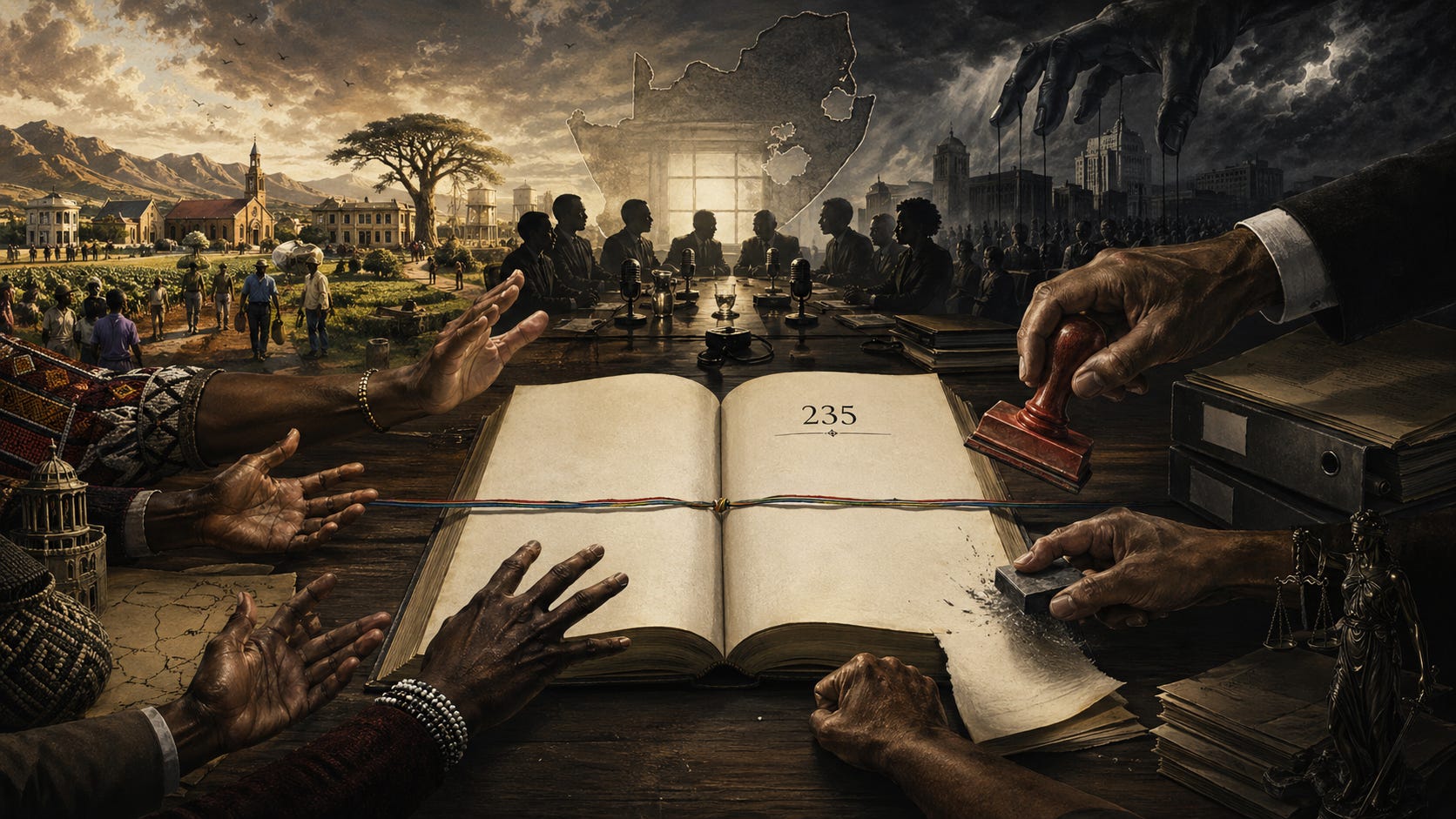
VF Plus leader and MP Dr Corné Mulder has justifiably criticised former President Jacob Zuma, who was part of the negotiations that led to the inclusion of Section 235 in the South African Constitution in 1996, for reigniting unnecessary political conflict against the backdrop of the MK Party’s attempt to repeal Section 235 of the Constitution through the Constitution Twenty-Fourth Amendment Bill.
While Zuma can be accused of many things, being historically naive, misinformed, and unreasonable when it comes to the importance of self-determination as a principle and its conceptual role in accommodating cultural autonomy and diversity in a unitary state like South Africa, is not one of them.
When he visited the town of Orania in September 2010 on an official state visit, he commended it as an exemplary model of self-reliance and cultural preservation, noting that it constituted a legitimate expression of self-determination within a broader national context.
Given this background, it can be reasonably deduced that Zuma is not at the centre of the party’s legislative attempt to repeal Section 235, and that it is rather MP Mzwanele Manyi - who has tabled the Bill - and other naive, misinformed, and authoritarian party members who are driving it, on the basis that Section 235 is vague and has been weaponised as an instrument for separatism.
As an elder with knowledge and experience on this topic and as a dictator of the MK Party, Zuma would do well to educate Manyi and others, who are gravely mistaken, about the political history of South Africa and the relevance of self-determination as a principle in fostering mutual recognition and peaceful coexistence.
Historical background of Section 235
Section 235 deliberately emerged as a vague and cautious political compromise after protracted contestation on the nature of the new political dispensation during the negotiations to end Apartheid. On one end, then ANC leaders like the late Nelson Mandela, Zuma himself, and several others were concerned about secessionism and potential future threats to the territorial integrity of the state, and were intent on pushing for a single, unitary system in which the state would play an active role in forging a national, overarching identity.
On the other end, opinions varied, with hardline and militant voices like the AWB demanding a separate state and other Afrikaner actors reluctantly accepting a unitary system but pushing for a self-determination clause that would make some degree of cultural autonomy and genuine cultural pluralism possible within a broader national context.
The pendulum could have swung in any direction and produced a clear winner, but the negotiations eventually culminated in a settlement that allayed fears about both secessionism (on one end) and cultural marginalisation (on the other end), by recognising the right to self-determination within a broader national context, with the self-determination clause being strategically vague enough about its practical implications and thus creating interpretive room for accommodation and flexibility in its application.
Public opinion remains contested, but arguably no side clearly “won” the negotiations, with both sides claiming partial victories that were necessary to avert serious conflict, and forging a somewhat workable arrangement that has, to this day, mediated some degree of mutual recognition and peaceful coexistence.
That Manyi and others are criticising the vagueness of Section 235 and its application in relation to what they see as separatism in towns like Orania demonstrates that they do not appreciate the complex history that explains its inclusion in the Constitution. In their historical naivety, ignorance, and desire to repeal an important mechanism that can limit the excesses of democratic majoritarianism, they are, as Dr Mulder has correctly noted, reigniting unnecessary political conflict and resurrecting deep tensions that historical negotiations tried to resolve.
Saying this may well be interpreted as a “threat”, but it is a blunt criticism of their policy agenda, and a frank reminder that the kind of authoritarian nationalism that lies at the heart of their legislative push to repeal Section 235 can have serious and damaging consequences for a polity that has, to some degree, created conditions for cultural autonomy and the practical expression of self-determination and cultural pluralism in a culturally diverse society.
There is broadly a need to revive robust political discourse around a viable political dispensation in South Africa and the limits of narrow authoritarian nationalism that does not appreciate the nuances of a layered principle like self-determination, but this falls outside the scope of this piece.
For now, it is worth re-emphasising that uBaba, as he is affectionately known, needs to rein in his misinformed and disrespectful children, who could potentially lead the country down a path of unnecessary political conflict.
Ayanda Sakhile Zulu holds a BSocSci in Political Studies from the University of Pretoria and is a Policy Officer at the Free Market Foundation.

So true, Ayanda. It is totally unneccesary to scratch where you want to believe it is itching. And that is exactly what Manye is doing. Being an Afrikaner myself - that is, part of a minority group/cultural minority - I know that much of the restraint shown by the more radical members of my kin after the 1994 transition, was Article 235. It left a backdoor open for when the Rainbow Nation Ideal did not work out so well. I think that 32 years later, people can't be blamed for feeling that A LOT OF PROMISES were never kept. We are not all treated equally under the law, as we all know by now. We are not all seen as equal, since some people are seen as more equal than others. That is why Lex Libertas, inter alia, is receiving a huge amount of support nationally and internationally for freshly looking at the constitutional dispensation/model of South Africa, in order to explore innovations which will satisfy more people of the country, especially minorities. They are constitutionally completely within their rights to do so, inter alia, on account of Article 235. They doing it peacefully, but perhaps it is the intension of Manye to stir up emotions under minority groups in order to make them feel cornered and start doing what cornered beings are ofter driven to? Let's hope he is not up to such a disgusting motive...
Jimmy "killer pawn" Manyi has never displayed any intelligence.