


Written by: Jodie Chatterton
There is never a reprieve, a moment when you are not forced to confront the continued reality of farm murders.
Grief is like a cloud in the sky. As time moves on, the cloud recedes to the horizon, but it never truly leaves. With murder, that cloud is never allowed to completely recede; it constantly reappears, and on some days, it carries a heavy darkness even after years.
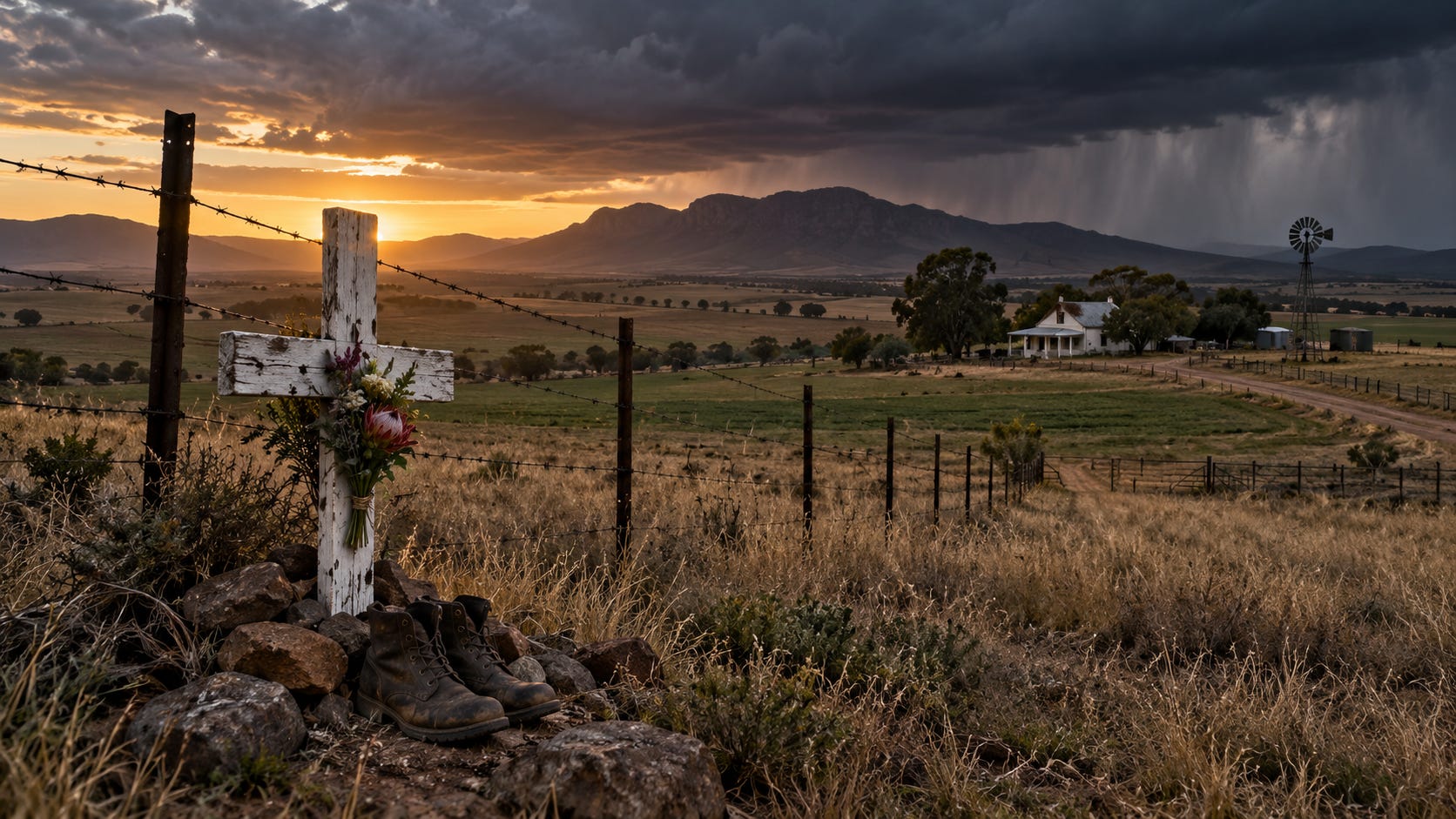
The White Cross Project coming up now in September is another one of those reminders. Knowing my mother’s name will be on one of those crosses makes it deeply personal, reopening a wound that never gets a chance to heal. The fault does not lie with the noble aim of the project. That is reserved for the fact that we are still here making the same points. The march of murders continues, the rhetoric about killing continues, and the fact that we even need such a project is the issue.
The Mechanics of Dehumanisation
Already, the disparaging comments in the lead-up to the event have started, accusing those involved of being far right. I wonder if these individuals who have the time to comment have spared some of it to read the names on the list.
They are just ordinary people who do not match this monolithic stereotype that has been portrayed: a diverse group of people who share an occupation or residence that is more dangerous than any other, that of farmer and farm. Statistically, farm attacks have a higher rate of death than if you are attacked elsewhere. Farm murders often have a perverse level of violence that is not seen in other murders in South Africa.
One can see the dehumanisation on several levels, and there is an inherent danger that eventually you stop seeing farmers as people.
Let us start with the politicians. Every time they stand up and sing “kill the boer, kill the farmer” to a stadium full of people and the crowd dances and cheers, farmers are seen less like people. Whatever argument is made about the historical or political meaning of the song, there is something profoundly disturbing about a society in which words that call for the killing of a group of people who already face a higher risk of death can be treated as entertainment.
And it does not stop there. Farmers are used as the scapegoat for the economic failings of South Africa, the symbol of white privilege, land ownership, colonialism, inequality and oppression. The reality of farming is replaced by this romanticised idea that anyone who owns land must be wealthy, that farming is easy, and that the people who farm are simply beneficiaries of an unjust past.
This is reinforced at every turn, where policies like expropriation without compensation are pushed under the premise that land was simply stolen, casting farmers permanently as the villains of the story.
Then the media plays its part. It amplifies the politicians and mocks and dismisses farmers raising concerns about the violence they face with political slurs like “Afri-MAGA”, or writes tasteless satire asking, “What wine pairs with white genocide?” Joking and mocking are effective ways of normalising the dehumanisation.
Furthermore, you have schools and universities teaching progressive ideology to our youth, which teaches them about white privilege, systemic racism and the idea that equity is more important than equality. The oppressor versus the oppressed is a fundamental part of this ideology. The white male will always be the oppressor, and in a South African context, the person of colour will be seen as the victim, and therefore the oppressed.
This is important and should not be dismissed as something that does not influence society. The reactions to what happened on 7 October 2023 in Israel, when innocent people were slaughtered, bear witness to this. University students around the world praised the atrocities based on the warped narrative that the oppressed were fighting back against their oppressors, and that the violence was therefore justified. This same model contributes to the dehumanisation of the South African farmer.
Words matter because they shape how people see other human beings. When a group is repeatedly described as inherently evil, illegitimate or deserving of violence, it becomes easier for people to regard violence against members of that group as justified.
But those murdered are real people.
My mother.
A life viciously ended far too short. She was 46 years old.
We desperately need to rehumanise the people behind these statistics.
My Mother
She was not a farmer’s wife; she farmed alongside my father. They were partners. She ran the dairy, and he did the rest of the farming.
She had a natural instinct when it came to animals that was impossible to teach. She could tell an animal was sick just by looking at it. Even our experienced vet would say, “Jackie, I don’t think there is anything wrong, but I will take blood.” He would phone back later to say that it was indeed sick. Sick cows and calves that should not have survived pulled through because she cared for them.
That caring nature of hers extended to every aspect of her life. She looked after everybody: her family, her parents, her in-laws, her extended family and her employees. She lived next door to her in-laws for most of her married life, and yet there was never one issue. They always loved and treated each other with respect. For a child growing up, it was a wonderfully wholesome upbringing.
In the early days of the AIDS pandemic, before ARVs were available, my mother researched vitamins or medicine that could boost the immune systems of our staff who were ill. In a time of heavy societal stigma, my parents removed that stigma on our farm so our staff could talk about it openly.
Her one weakness was her predilection for antique furniture. We joked that she was banned from going to establishments that restored furniture.
She had a wicked one-handed backhand and was a graceful tennis player, but she never cared whether she won or lost, only that it was a good game. That was one of the few things we disagreed on, along with me going to bed with wet hair, which was our only real battleground.
She struggled in social settings because she was deaf in one ear, a deafness caused by a childhood illness that led to years of medical challenges and days when she could not get out of bed. She eventually had the nerve removed and had to learn to walk again. During her first tennis match back, she laughed as she fell over a few times. Never once did she feel sorry for herself in all those challenging years.
When she smiled, her grey-blue eyes twinkled, and when she laughed, she often laughed until the tears rolled down her cheeks. She was kind and considerate to all. She valued health over wealth, and as a mother, she loved us fiercely.
When people dance and laugh about the killing of farmers, she is who they are laughing about.
A kind, gentle soul who was hunted down in her own home.
As she ran for her life, she was stabbed in the back with such force that her lungs were penetrated multiple times. Her wounds were not survivable, and yet through sheer force of will and unimaginable strength, she managed to hold herself up and send out the mayday call.
She was courageous until the very end.
The Reach of One Murder
Each murder damages the social fabric of our country.
To those who are closest, the loss is indescribable: my father, my brother, my grandparents, my mother’s sister and the rest of the family. But like a shattered windscreen, the effect spreads outwards to friends, communities and broader society. That is the same for every murder in this country.
Then there is the trauma for those who are present but survive. It breaks even the strongest people. Those who witness their loved ones being murdered live with a different kind of hell that is very hard to ever come to terms with.
My father lives with the horror of that night.
That trauma extends to others: our neighbour who drove our car as they tried to get my mother to the hospital, and then spent the night washing her blood out of it; her close friend, who was in the back seat with her and has struggled with the fact that she could not save her; the friends and family who cleaned the blood from our home so that my brother and I would not have to see it.
Our home carries the scars and reminders of what happened that night.
Two doors do not match the rest of the house because my father and the first responders had to break them to reach my mother. Years later, you could pull a book off the shelf and find a speck on the spine, slowly realising it was your mother’s blood from when she ran for her life down the passage.
Living in the Aftermath
On a farm, your home is your business. Often, when there is a murder, the farming operation cannot continue, or it takes years to recover financially. You also have to reconcile yourself with the fact that you live in a crime scene.
You lose your loved one, your home and your business.
My mother left a vacuum in so many lives that was impossible to fill. Had she not been murdered, she and my father would still be happily farming together, and my brother and I would likely have had different lives. But we stayed, because it was our home, and we felt a responsibility to those whose livelihoods depended on us.
We still live with the risk that it could happen again.
The most recent incident was a few weeks ago. I watched my father on the security camera in the early hours of the morning as he chased away someone stealing diesel. Fortunately, he came home safely, but for a moment, I worried I might have to relive the nightmare again.
This is a risk that all farmers live with. The rural, isolated nature of farms is part of why farms are targeted.
There is something deeply bleak about the juxtaposition.
Our most searing, beautiful, tranquil landscapes, so quiet by day you can hear every bird, so clear at night the sky is lit with stars, are the same places marred by violence so unimaginable that the blood of the dead stains the soil.
A Plea for Moral Sanity
I will be interested to know how the white crosses will be reported on in the media when they appear in America. Will the violence be downplayed? Will there be an acknowledgement that we do have a problem, or will it be political theatre?
We must remember the human beings behind every statistic.
This is not about ranking the dead. My mother’s life is not worth more because she was murdered on a farm. No murder in this country is acceptable, and no political ideology justifies the taking of a human life.
The killing, the apathy, the songs, the constant arguments about whether farm murders are a problem or not. Can it all just stop?
I want to open the news one day and not be constantly reminded of the worst day of our lives. I want other families to be spared what we have endured.
It is not hard to stop singing songs that glorify violence. It is not hard to acknowledge that murdering people is wrong. The fact that our leaders cannot bring themselves to say this is an indictment of the moral decay that surrounds us daily.
I look forward to the day that South Africa is not known around the world for its violence, but rather for something more positive.
Jodie Chatterton is a dairy farmer in the KZN Midlands and Stellenbosch University graduate with degrees in Commerce and Law.