


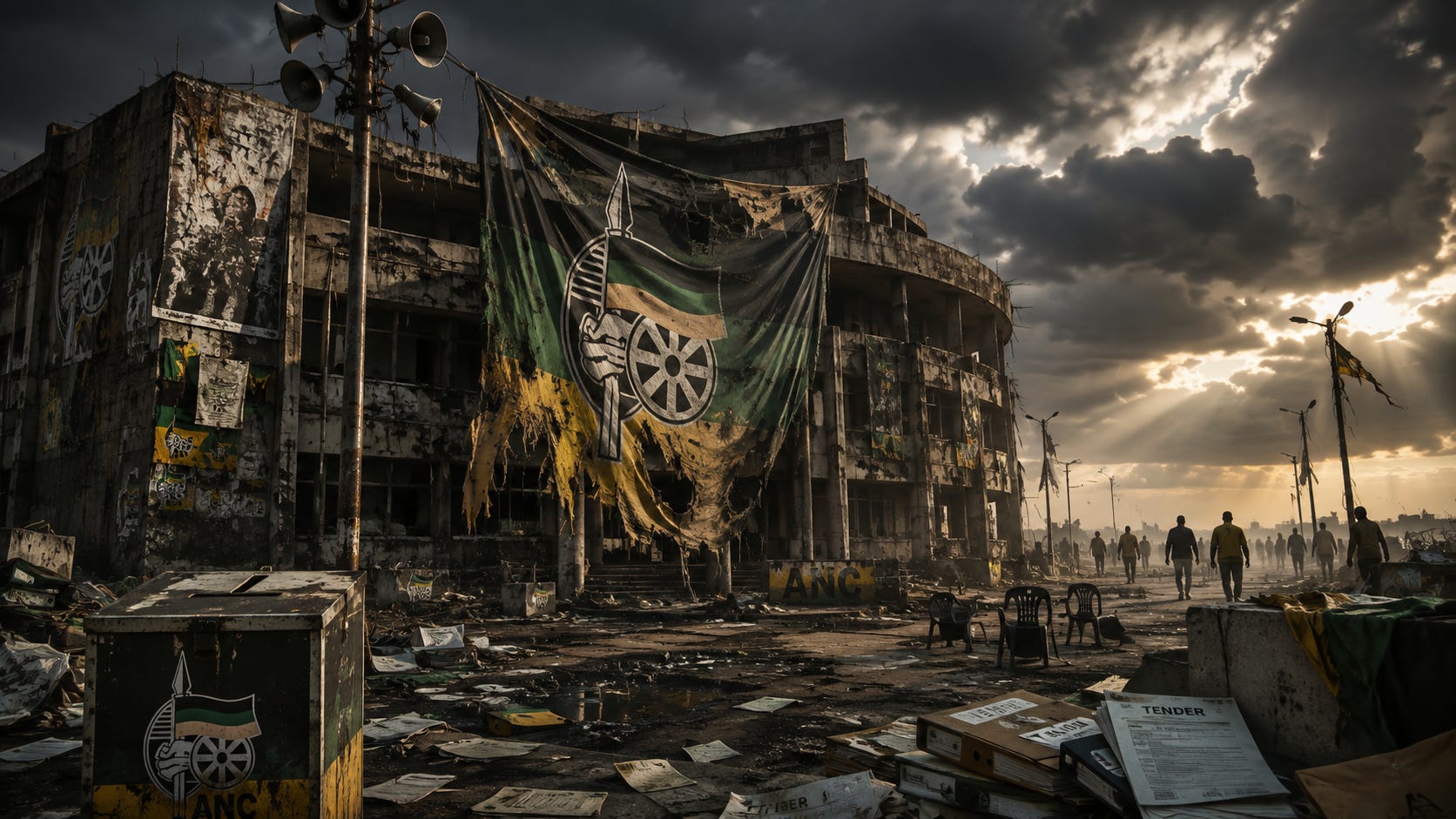
All experienced political analysts warn that the ANC’s ability to mobilise voters must never be underestimated. This applies even to their current efforts in the run-up to the November 2026 local elections, which many analysts regard as extremely weak, and rightly so, as I myself recently pointed out in an article on OntLaer.
Moreover, I recently watched two podcasts from highly credible organisations that were so full of laughter one could have mistaken them for comedy. Yet the topic under discussion was indeed the ANC’s clumsy election campaign. The discussions can be viewed here and here.
Don’t write the ANC off just yet
There are, however, reasons not to write the ANC off completely just yet.
The ANC brand remains a powerful one with a magical attraction for millions upon millions of South Africans. Their historical credibility as the liberators of the oppressed black South African population still carries loyalty value among substantial numbers of South Africans.
The ANC is also by far the dominant “partner” in the GNU, with political power that is shamelessly used by party members in government to “buy” support in various ways. Officials in state departments, local authorities and state-owned enterprises also feel they owe the ANC something for their positions and for keeping them. This is a strong incentive that extends to dependent family members who likewise realise where their livelihood comes from.
Then consider the nearly four out of every ten South Africans who receive some form of social grant from the government every month, for which they thank the ANC.
Nor should one forget the large numbers of businesspeople who owe their contracts to the ANC’s corrupt tender awards. They obtained their contracts through bribery, and their next award or contract extension has a corrupt ANC politician and official at the head of the corruption chain.
These ANC strengths, many of them distasteful in the mouths of excluded cadres and ordinary South Africans without access to the corruption chain, will again convince many voters rather to vote once more for “his master’s voice.”
Nevertheless, all indications are that the ANC’s support will decline considerably compared with previous elections. This obviously works in favour of alternative political parties, but unfortunately it appears that many voters disillusioned by the ANC’s pathetic record as governors will rather not vote at all than vote for another political party.
What happens when the ANC loses power?
With all indications pointing to the ANC being considerably weaker after the November 2026 elections than in any previous period, there is now much speculation and scenario-building about the possible consequences of the ANC’s significant weakening.
Certain outcomes can be predicted with reasonable certainty, such as the increase in coalition governments in local authority areas, and that Zuma’s MKP will reign supreme in KwaZulu-Natal and even emerge elsewhere as a factor that will have to be taken seriously.
Many current ANC councillors will also lose their positions, estimated at between 500 and 1,000, which will be extremely traumatic from a personal perspective, as livelihoods will suddenly disappear. Far too many current councillors lack the knowledge and experience to survive outside the patronage system and without the ANC’s corrupt practices.
Their reactions are unpredictable, but we know that a cornered cat makes desperate leaps. One counter-reaction could be to make life as difficult as possible for the new councillors. The disturbing number of political murders in South Africa also makes it possible that some new councillors’ lives may even be at stake.
This could nullify many of the benefits of change in administrations that may flow from the elections.
Frans Cronjé’s surprising argument
It is perhaps against the above background that the respected and highly capable Dr Frans Cronjé of the online newspaper The Common Sense recently said strange things, in my opinion, in a video interview with Gabriël Makin of the same newspaper.
In fact, I found his views shocking.
Readers can watch the full interview here.
Why am I personally shocked?
My interpretation of what Dr Frans is saying is that we must show the ANC mercy in its hour of weakness. For pragmatic reasons we must not try too hard to hold the ANC to account. We should rather look the other way and try to get them, as the ANC, to correct our destructive economic policies so that our economy can grow properly again.
In a growing economy it will not really be necessary to stress about corruption, because the impact will not be destructive. Corruption is in any case a given everywhere.
I repeat that I am merely reflecting here my own interpretation of what I believe I hear Dr Frans believes would be a good approach.
I am also in favour of pragmatism as he is, when it is appropriate, but I feel much more strongly about ethics and the upholding of law and justice, rather than letting unashamed scoundrels “get away with” their transgressions by letting them off.
That is the equivalent of giving in to the demands of an extortionist. It merely leads the extortionist to believe he can continue with what he is doing.
Don’t compromise with socialists
Perhaps I would have been less sceptical about Dr Frans Cronjé’s points of view, as I have interpreted them, if I had not, at almost the same time as the podcast I referred to, come across a brilliant opinion piece by an equally respected and knowledgeable opinion-former, David Ansara, chief executive of the Free Market Foundation.
The article, titled “Don’t Compromise with Socialists,” was published on 21 August 2026 in The Common Sense of none other than Dr Frans Cronjé himself.
The title says it all, and its content can be summarised in the following words of David’s:
“For those of us who want to halt the advance of socialism through our society, it is therefore necessary to offer firm and responsible forms of resistance. The alternative is to seek compromise, but the best that can achieve is to buy you a little time. The ANC understands and values the balance of forces.”
David specifically warns against what I understand Frans is saying should happen with regard to the socialist-oriented ANC.
David argues that compromise with hostile or socialist-oriented policies is a strategic trap that only delays the damage, and that firm, principled resistance is rather required.
That sounds to me like the polar opposite of Frans’s line of thinking as I have interpreted it.
Ansara describes the ANC’s Marxist-Leninist NDR as a gradual strategy that advances on the basis of the “balance of forces.” Resistance can force temporary retreats, but that is tactics; pressure resumes later.
Firm, responsible resistance is therefore essential to halt the advance of socialism. Compromise buys only limited time.
The ANC understands resistance
That underhanded ANC way of doing things, according to legend, also came from the mouth of former president Zuma, who reportedly once remarked something to the following effect:
If you inflict a stab wound on your enemy with your bayonet and you hit bone, meaning there is resistance, first withdraw the bayonet and then later look for a softer spot for the death blow.
Clearly his metaphor was intended to describe the strategy of attack followed by withdrawal if it is not fully successful, which is of course aimed at making your enemy believe he has survived your assault, only then to deliver the unexpected death blow that was the original intention of the attack.
The same, in my opinion, will apply to handling with kid gloves the ANC criminals who have corruptly stolen taxpayers’ money for their own personal benefit, as it sounds Dr Frans feels must happen for pragmatic reasons.
But what about principles in that case?
Can the failure to act against corruption for pragmatic reasons, which, according to Ansara’s views, will in any case be accepted by the ANC only in order to buy time to implement their inflexible Marxist-Leninist ideology of socialism at full steam again once they have regained power “by hook or by crook,” to use my words, be justified?
No mercy for the ANC
On the basis of two other very recent podcasts, under the banners of the Institute of Race Relations’ Daily Friend and the Free Market Foundation’s Rational Standard, respectively, I found justification for my position of no mercy for the ANC now that its hegemony is crumbling.
Participants in those podcast debates included big names such as Dr Martin van Staden, Nicholas Lorimer, Hermann Pretorius, Nicholas Woode-Smith and Zakhele Mthembu.
They also advocated a no-mercy attitude towards the ANC, and the words “Machiavellian actions” as necessary to break the ANC’s back came up repeatedly in the conversations.
Yes indeed, if there is the slightest chance of destroying or weakening the unreliable and underhanded ANC’s hegemonic grip on the country, we must not hesitate to do so merely for pragmatic reasons.
Corruption and theft can under no circumstances be overlooked.
Piet du Plessis is a retiree with a long history of applied socio-economic development. He describes himself as a liberated Afrikaner who has moved beyond self-flagellation and believes that he has been freed to live out his cultural pride and values, and to proclaim them openly when appropriate.

No mercy from the ANC. The ANC is less inept than it is cruel and uncaring.