


If you could safely and reliably eliminate politicians, parliaments and taxes from your life and community, would you? If you could replace them with a system that worked for 500 years, that uses state of the art computer technology, that gives you a direct say in how your money is spent, would you be interested?
History
The Westminster parliamentary system evolved slowly and hesitantly over the 800 or so years since the Magna Carta was signed in 1215 in England. There have been many civil wars, revolutions and failures since then, resulting in the flawed parliamentary model we use today.
Because communication systems were abysmal, the entire population had to be divided up into manageable chunks of several thousand, and a representative was chosen for each chunk, sometimes democratically, sometimes dishonestly. Because it was hard to do, this dividing up was only done once every 4 or 5 years. These representatives met in a parliament, where they decided what was best for the people they represented, but most commonly, what was best for them and their friends. One of the most important things this parliament of knaves and ne’er-do-wells did was to decide how much tax they could safely extort from their constituents.
The Romans confronted the problem of how to manage a large body of individuals 2,000 years ago. The senate selected two men of high standing to run Rome for just 1 year at a time. These men were called Consuls, and enjoyed considerable power. However, any decision made by one consul had to be agreed to by the other consul before it could become law. This system worked reasonably well for over 500 years.
In 1986, Van Zyl Slabbert resigned as leader of the official opposition and leader of the Progressive Federal Party. He had lost faith that parliamentary politics could ever achieve a non-racial, democratic South Africa. He started the Institute for Democratic Alternatives. In 2026 we still need alternatives to the failed democracy we now inhabit. Secession in the Western Cape is a golden opportunity to explore these alternatives.
As the Western Cape secedes from the rest of South Africa, the residents must choose a system of governing which takes advantage of past lessons, and current technologies, to produce a prosperous state which respects the rights and wishes of every individual.
The five pillars of governance
The integrity of the individual citizen is paramount. Individuals must be protected from harm. Their wishes must be heard and respected via continual referendums.
The geography of the new state would reflect the existing borders of the Western Cape as a whole, the 6 existing districts, and the 30 existing municipalities and 1 metro, similar to a canton system.
Leadership of the state at all 3 levels will be based on the Roman Consul system, not a Westminster political system.
Bonds and property rates will be used to finance the state, not taxation.
State functions will be privatised wherever possible.
CapeChoice - The software solution for continual referendums
We live in an age where software like Facebook and X can uniquely identify more than 1 billion different people, gather their data, get their opinions on thousands of questions, and make this all available on several platforms. Existing systems like SARS, Home affairs, municipal rates, Checkers Xtra card, all maintain current information about virtually all South Africans, including Cape residents. Asking each and every South African their opinion on a daily basis is a relatively simple technical problem. Your bank does something similar everyday. Websites like DearSouthAfrica.co.za or Change.org do it for free for millions. And yet the myth persists that democracy only works if you make a mark on a piece of paper once every 5 years.
The very first task of any new administration in the seceded Western Cape must be to establish a website with every citizen registered on it. Lets call this website CapeChoice. Every referendum question, every new proposal, every prospective consul’s biography would appear, with any citizen able to safely and securely view and vote. This CapeChoice website would be at the core of the seceded Western Cape governance system.
Choosing leaders
We can assume that the leadership structure in the Western Cape just after secession will reflect the structure before secession, warts and all. While we must strive for continuity and minimum disruption during this interim period, we did not come this far just to return to where we started - a parliamentary democracy run by politicians with minimal input from citizens.
Although it would be subject to confirmation by CapeChoice polling, let’s assume that the consul system is adopted by a majority of citizens.
Members of the community would put their names forward to act as consuls at the state, district and municipal level. They would not represent political parties, although they might be members of a party. The candidates would not just be professional politicians. Captains of industry, distinguished academics, community leaders could put their names forward, planning to share their expertise with the citizens. The one year term would allow them to take a sabbatical, without jeopardising their careers.
The biographies, budgets and manifestos of potential candidates would be added to the CapeChoice website. Citizens would browse through the available candidates and select a state consul, a district consul and a municipal consul. The consul choice facility would remain open for a set number of weeks before year end, and the number of votes for each consul could be inspected dynamically. If a consul candidate falls behind in the polling they may have to extend their canvassing efforts. The first and second choice in each contest would be declared the 2 new consuls from 1st January in each state, district and municipality.
Consuls start to govern
A consul’s manifesto and budget published during their election campaign would be the basis of their plans going forward.
Each consul would select the members of their cabinet from the general public. These cabinet members would be paid from the consul’s own budget, and would serve at the pleasure of the consul. They would assist with administrative tasks, and may recruit staff of their own. They would constitute the bureaucracy of that consul, and may be re-employed or replaced each year by the next consul.
The consul and cabinet would immediately begin to fund their plans by drawing up and publishing bond contracts for desired projects. These bond documents would be published on CapeChoice, and in financial circles where bonds are offered to subscribers. Expenditure can only begin once the bond funding is available.
Municipal consuls have access to rates funding which will be used to maintain local services such as water and electricity.
The value of bonds taken up would be published on CapeChoice, and would define the scope of the Consul’s ability to act. As always, both Consuls must agree on every step. A running barometer on the website would display each consul’s popularity, or lack thereof.
The district consuls would convene the Council of Governors, and schedule regular meetings with the 2 state consuls.
Consuls would outsource almost all current state responsibilities, confining themselves mainly to an oversight role, with occasional interventions where necessary
Social welfare
Ordinary bonds for social welfare expenses are unlikely to be successful, as social welfare does not generate useful returns over time. However the state does generate income from non-citizens which is not constrained by the HarmConsentRule. These various sources, such as foreign aid, tariffs, visa issuance, customs duties, sale of assets, interest, and fines do not require coercion of individual citizens. However, excise duties and licensing fees conflict with the HCR.
Charitable bonds could also be issued which offer no interest or repayment date, allowing citizens to effectively donate to their preferred charity.
Reducing the number of people drawing on social welfare will be a major target of any new government. Many social welfare services are provided privately by charities, sometimes for profit and sometimes at no cost.
Border defence and immigration control
As activities affecting the entire state, border defence and immigration control would be functions of the state consuls.They will be advised by international practice, existing treaties, safety and security considerations.
Policy proposals will be published on CapeChoice, and bonds offered for proposals. Private contractors will be hired to man border posts and supervise immigration applications. If there is popular support and funding, illegal immigrants may be pursued and transported back to their home states.
Judiciary
The judiciary would mostly be replaced by user funded arbitration agencies. CapeChoice would provide the legislation desired and funded by the community. One could expect a massive drop in the cost of litigation, much quicker access to justice, and a decline in nuisance lawsuits.
Security and policing
This function will be the responsibility of district and municipal consuls. The existing policing structure would probably be replaced by private security, mostly paid by users, which already is widespread in the Western Cape.
Many victimless crimes such as prostitution would no longer be classed as crimes. As with social welfare, policing for poor people would be funded by existing income streams and charity. Traffic control would be a function of the municipality and funded from rates.
Insurance
Disasters occur at both the personal and state level. Floods, fires, earthquakes are outside the control and often beyond the resources of ordinary citizens. The best approach would be to encourage widespread insurance against all manner of risks. Using insurance you can effectively privatise the cost of catastrophe, and distribute the cost of risk. The 3 branches of government, state, district and municipality would be expected to make prudent investments in insurance to deal with unexpected events.
Popular resistance and uprisings
What if the current recipients of Sassa grants, corrupt tenders and preferred employment in the Western Cape reject any plan to reduce their influence and income, and take to the streets to protest? They might refuse to accept the results of referendums, and appeal to external parties such as the South African government to intervene. This is a very real possibility, and the protestors probably represent a significant bloc of citizens. This would be an early and serious test of the fledgling Cape governance.
If the protestors do no harm to anyone or their property, they are welcome to protest and make their point. If they do harm people or property, then the existing private law enforcement structures would come into play. It is quite possible that a dedicated riot control security company would arise, with specialised training and equipment.
Consequences
What would be some of the consequences of these quite radical proposals?
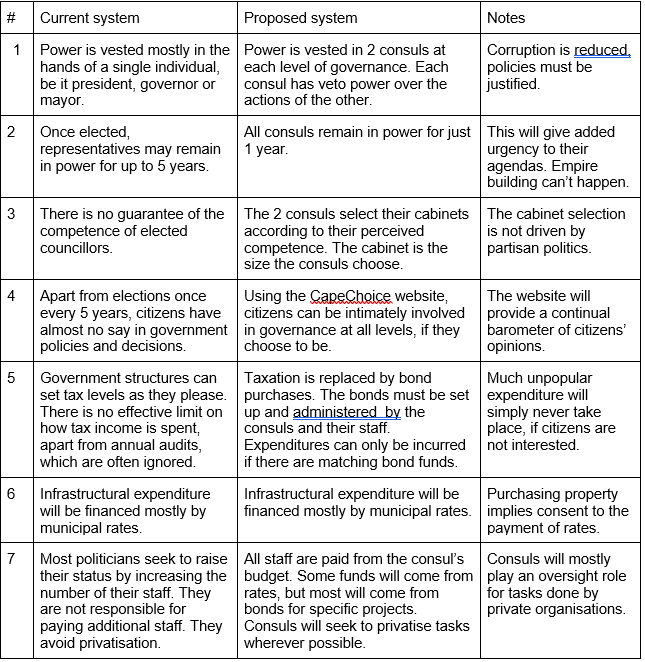
Conclusion
This article lays out the practical steps to achieve a radically new seceded Western Cape governance system. It demonstrates how existing problems like corruption and nepotism could be avoided. This system is untried anywhere in the world. That is its great advantage. It could not be worse than what we currently tolerate.
Trevor Watkins is the founder of the Individualist Movement, the author of two books, and a contributing author for the Free Market Foundation. He publishes on a blog at libertarian.org.za.

I want to understand how property rates (paying rent on property you own), customs duties and tariffs don't violate the HCR? If, as you say, buying property implies consent to paying the property tax, does getting a job imply consenting to payroll taxes? Starting a business imply consenting to corporate income tax?
Practical and pragmatic as per your signature style 😉 ... Rome meets Henry George meets Cinque Stelle of Italy - if I may: https://thetaooffreedom.substack.com/p/nou-x-hcr-a-free-market-of-voluntary