


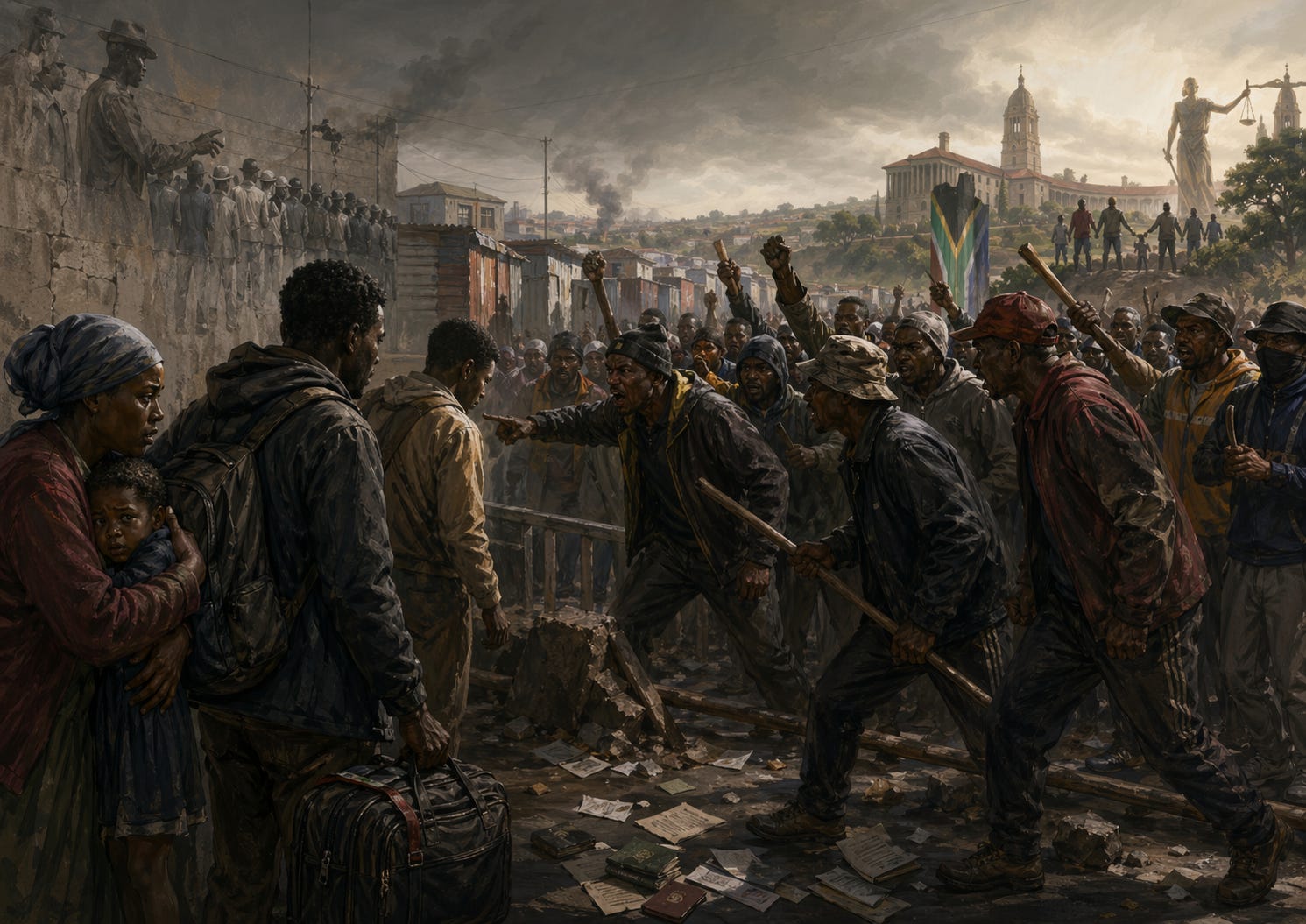
I have previously discussed how anti-immigrant (African) sentiments, words, and actions harm our interests as South Africans. The moral side of this is just as important. It is essential that it be made clear that those who attack immigrants, express ill-informed opinions about them, and otherwise mobilise against them on the basis of ignorance, have no excuse. There is no amount of poverty or social deprivation that makes hate against an entire group of people acceptable.
What we are seeing on our streets, with mobs stopping people and asking them for their papers, is despicable. We are also now subject to regular violent pogroms against innocent people, often South Africans who are dark-skinned or speak Tsonga or Venda. There is also no nuanced understanding that naturalisation, permanent residency, employment and student visas, and asylum are all legal and valid reasons to be in this country.
We have a constitution that ensures free expression and various forms of political participation (voting, petitions, peaceful protests, commenting on government policy, court action), so there is no excuse to attack innocent people on the streets who may or may not be in the country illegally. Even for those who are here illegally, a violent attack is wrong. It is not a proportionate response to the violation committed. In fact, simply crossing a border is not a crime under natural law, since it does not violate the Non-Aggression Principle or the Harm-Consent Rule.
What these people are doing is as bad as what poor Afrikaners did in subjecting black South Africans to apartheid, and the justifications in both cases are very similar. In both cases, you have people who feel that they have a right to certain jobs by virtue of their identity (citizenship or race), and that strangers cannot contract freely with each other because of this identity-based entitlement. Whether the strangers are a South African business and an immigrant or black employee, “legal” or not, is beside the point. Apartheid legislation also reserved skilled labour for white people. Legally, it was still immoral.
What we must avoid doing is buying into the victimhood narrative that poverty justifies immoral behaviour. If this premise is accepted, we can no longer trust our poor fellow citizens to exercise moral agency. Taking that argument to its logical extreme means almost any immoral behaviour, e.g. eating your own children or selling them into prostitution, can be justified. As a society, we must never lose empathy for the poor, but at the same time, we must never treat poor people as anything less than human. They are not pets we must feel sorry for but who ultimately cannot be trusted to be moral. They are people with moral agency who must be held to a moral standard.
The fact that we live in a democracy also means we should expect a certain level of engagement around issues of public policy. We trust all adults with a vote, so all adults are expected to be amenable to logical arguments about public policy, otherwise it is reckless to entrust everyone with the vote. Adult citizens must be able to understand that immigrants do not lead to fewer jobs for South Africans, and that South Africans commit most of the crime in this country.
Are immigrants facilitating corruption in the public service? Do they have the political power to do that? Or is it South African politicians facilitating corruption? Do immigrants sell documents to themselves at Home Affairs? Do immigrants bribe themselves at the border to enter the country illegally?
The fact is, immigrant crime is largely a symptom of, and facilitated by, South African crime. Some stats suggest that in 70% of South African homicides, the victim knows the perpetrator, i.e. these are family members, friends, acquaintances, etc. These are not random (immigrant) strangers killing South Africans. It is mostly South Africans killing South Africans. Of the murders by random strangers, the vast majority are committed by South Africans.
South Africans have the power to pressure their government. A million-man march by unemployed youth, for example, would do it. They could go and camp peacefully at the Union Buildings until a policy like the FMF’s Job-Seekers Exemption Certificate (JSEC) was implemented. That would immediately remove a major barrier to hiring them and create possibly millions of jobs.
Choosing instead to organise into mobs and attack foreigners means that these violent degenerates know that they cannot persuade others of their ideas. I doubt they have persuaded even themselves that immigrants are the problem. It is just a convenient group to take out their anger on. Violence is never acceptable if it is not being used in self-defence, and crossing a border is not aggression.
I hope law enforcement does its job and arrests all of the ringleaders and anyone else who can be identified as participating in these violent acts. It is exactly the same as racism and the thinking that produced apartheid here and Jim Crow in the USA. Unfortunately, the victims are members of the groups who were most helpful to South Africans when they suffered under those past wrongs. It is evil behaviour, and it disgusts me. There is nothing to empathise with in this mindless bigotry.
Mpiyakhe Dhlamini is a libertarian, writer, programmer and an Associate of the Free Market Foundation.

I'm glad that I'm not an anarchist, and that anarchy will probably only ever be an ideal in the minds of a few individuals.
If we loosened immigration control like you and others have argued elsewhere, we would trigger a crisis of massive proportions not because you're wrong, but because your analysis is overly normative and detached from reality.
What we're dealing with in the broader picture to some degree (I don't condone violence) is not mere bigotry or hatred, but an old tension between nationalism and Pan-Africanism on the African continent. Nyerere termed it the Pan Africanist dilemma when he spoke about it in 1966.
The nationalisms that we have worked to forge (for several plausible reasons) across the continent in the sovereign, nation-states that we inherited from colonialists naturally exist in tension with this push for greater Pan-African unity and consciousness. South Africa, while an important case study, is not unique in this regard.
Our reality is that Africa as a whole is not ready to unite. The continent may not unite for the foreseeable future as nationalism continues to be an enduring force. When I speak of a "crisis", people are going to resist this kind of Pan-Africanist politics as they are right now. They will resist continental integration as they are right now. I doubt there is much anyone can do about it.
The tradeoff with stricter immigration control is that you obviously create more bureaucracy and expand the decision making power of the state, but this is a tradeoff I'm willing to make on this topic. Our borders need to become more fortified. We must concede to nationalism on this one. We are not ready.
To be clear, I am fully with you on condemning violence and taking action against it. I'm perhaps using this piece as a launchpad to engage you on your broader views on immigration.
People are the problem, but it’s those in government who are to blame for this nightmare of an economy.