


Written By: Professor Christopher Paul Szabo
Another day in South Africa, another farm attack.
This time, a farmer in the North West, Donovan Marx, was “shot, stabbed and ears cut off”, as the headline reads. He survived, as did a farm worker, and two of the suspects were arrested, with a third being sought. Justice will hopefully follow.
This incident follows a murder in the same vicinity earlier in October, when Hannetjie van Zyl was killed on her farm. Another instance of “Agricide”.
The furore over the use of the term “genocide” in relation to farm murders, specifically white genocide, is a distraction from what is taking place.
I’ve visited the Kigali Genocide Memorial, dedicated to the Rwandan Genocide, and the Tsitsernakaberd Memorial Complex, dedicated to the Armenian Genocide, in Yerevan, Armenia.
My grandmother was Armenian, an Ottoman Armenian who escaped the Armenian Genocide, fleeing by boat from what was then Smyrna, now Izmir, better known today as a coastal holiday destination.
How time erodes history, eliminating the past as if it never happened. A genocide. But it did happen.
What is happening here is not a genocide. My visits to both of the aforementioned sites were instructive in this regard, an impression supported by the United Nations definition of genocide.
Farm murders are a phenomenon that could simply be subsumed into the murder statistics of South Africa, with 58 murders per day in the fourth quarter of the 2025/2026 financial year. Murder statistics that somehow become reduced to just that: statistics. Faceless.
But in this instance, News24 published a picture of the victim of the attack, a smiling Donovan Marx with his wife. A face.
I recently watched the Lex Libertas documentary, Crossed Out: Confronting Persecution in South Africa, and was surprised to read, at the end, the number of black victims. Farm attacks and murders are not exclusively a “white” issue.
The opening pages of Ernst Roets’ 2018 book, Kill the Boer: Government Complicity in South Africa’s Brutal Farm Murders, are deeply unsettling. He describes the brutality, senseless violence and torture inflicted on not just men, but women too. Gender-based violence of an extreme nature.
I don’t recall activist protests being held in solidarity. On the contrary, a previous commentary in relation to a protest against farm murders characterised the protest as race-based victimhood linked to white supremacy.
When a group calls attention to its plight by mobilising in protest, surely its race is irrelevant? When citizens feel abandoned by a government, they are entitled to protest. A democracy demands an active and engaged citizenry.
In this instance, one might have viewed this protest as a “service delivery protest” against a lack of security, and nothing more.
Don’t demonise the messenger who highlights an uncomfortable truth. Deal with it. That the protest involved a specific demographic should not have become noise that obscured the signal.
Food security is every citizen’s problem. Murder is ultimately a threat to all.
South Africa is nothing if not known for “service delivery protests”. In 2025, there were 229. Some have argued that the term is a misnomer and that such protests often relate to deeper governance issues beyond the immediate, identified grievance.
Returning to the attack in question, why cut off the man’s ears?
It sounds like torture, which is defined as having three central components: the infliction of pain (physical or mental), the intentional or deliberate infliction of such pain, and a specific purpose, such as obtaining information, punishment or intimidation.
One can only speculate.
But think about cutting off a man’s ears after having shot and stabbed him and, according to other news reports, taunting him and chopping up his ears to ensure they could not be sewn back on, while further threatening to cut off his genitals.
Reading the accounts in Ernst Roets’ book, there is much torture, which makes each murder more harrowing. The suffering endured before death. The apparent playing out of a power dynamic.
There is a recurring theme, albeit with different perpetrators. It feels like a conspiracy, with a familiar pattern in diverse settings. Yet there is no evidence to suggest that. Maybe no one has delved deeply enough or connected the dots.
What such an investigation might reveal could be even more unsettling than the murders themselves.
Best not to go there. Better to simply bury each murder in the overall statistics and tell us that the incidence of farm murders is just an extension of murder in South Africa generally, and rural crime specifically.
Nothing to see here.
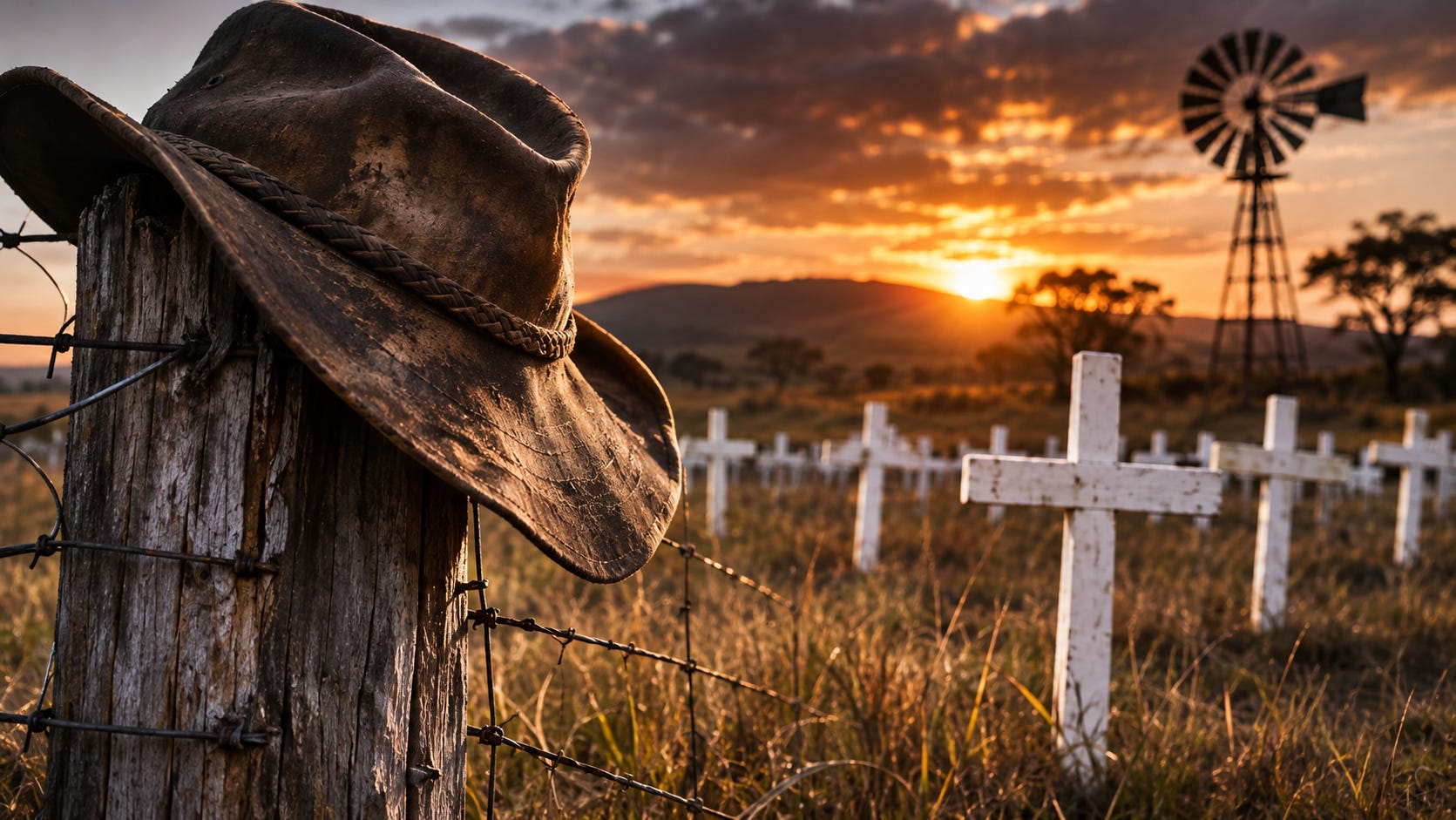
Tell that to the victims commemorated by 3,000 white crosses, taken to Washington, DC, in acknowledgement of their deaths, which evoked such controversy. Something similar is planned locally, in front of the Union Buildings in Pretoria, if permission is granted.
Maybe we need an equivalent of Arlington National Cemetery in Washington, DC, USA, to commemorate every victim of murder in South Africa since 1994, the dawn of our democracy.
I have visited Arlington National Cemetery, which commemorates fallen US servicemen and women. The sheer scale is a spectacle that evokes humility, sadness and respect for those lost to war (over 400,000), those who sacrificed their lives in the name of freedom.
And I wonder if all murdered South Africans since 1994 might be seen in the same light?
Maybe not. Simply victims who collectively tell a sad story that transcends race in our non-racial democracy.
All murder victims are the same: dead.
So, should we be outraged at Afrikaner farmers for standing up and drawing attention to what their community, and the extended farming community, experiences and has experienced?
Or should we look at them as the canaries in the coal mine, forcing us to confront an uncomfortable truth?
The truth of a state that has failed not just them, but every murdered citizen: men, women and children of all colours.
Death unites us all. It does not discriminate.
However, I’m not sure that this is what the Preamble to our Constitution (1996) had in mind when it spoke of being “united in our diversity”.
Professor Christopher Paul Szabo is a retired psychiatrist.