


Whenever South Africa’s farm murders attract international attention, our left-wing media and political commentators rush to dismiss the concerns with a familiar retort: there is no white genocide.
They are right that there is no credible evidence of an ongoing genocide against white South Africans. But this is a convenient distraction from a very real crisis. By obsessively disproving an exaggerated accusation, commentators have given themselves an excuse to ignore the brutal reality of farm attacks, the government’s culpability, and the political incitement that continues to threaten our farming communities.
We do not need a white genocide for farm murders to be a national disgrace. And we certainly don’t need to be white to be a victim.
Perhaps it is time to introduce a more appropriate term: agricide. The deliberate persecution, intimidation and killing of farmers because of their occupation. Unlike genocide, this proposed term would recognise occupational persecution rather than racial extermination.
Not every farm murder constitutes agricide. Robbery remains a predominant motive behind farm attacks. But this does not mean politically motivated hostility towards farmers does not exist, or that the state should be absolved of responsibility for allowing this hostility to fester.
The white crosses are not just for white victims
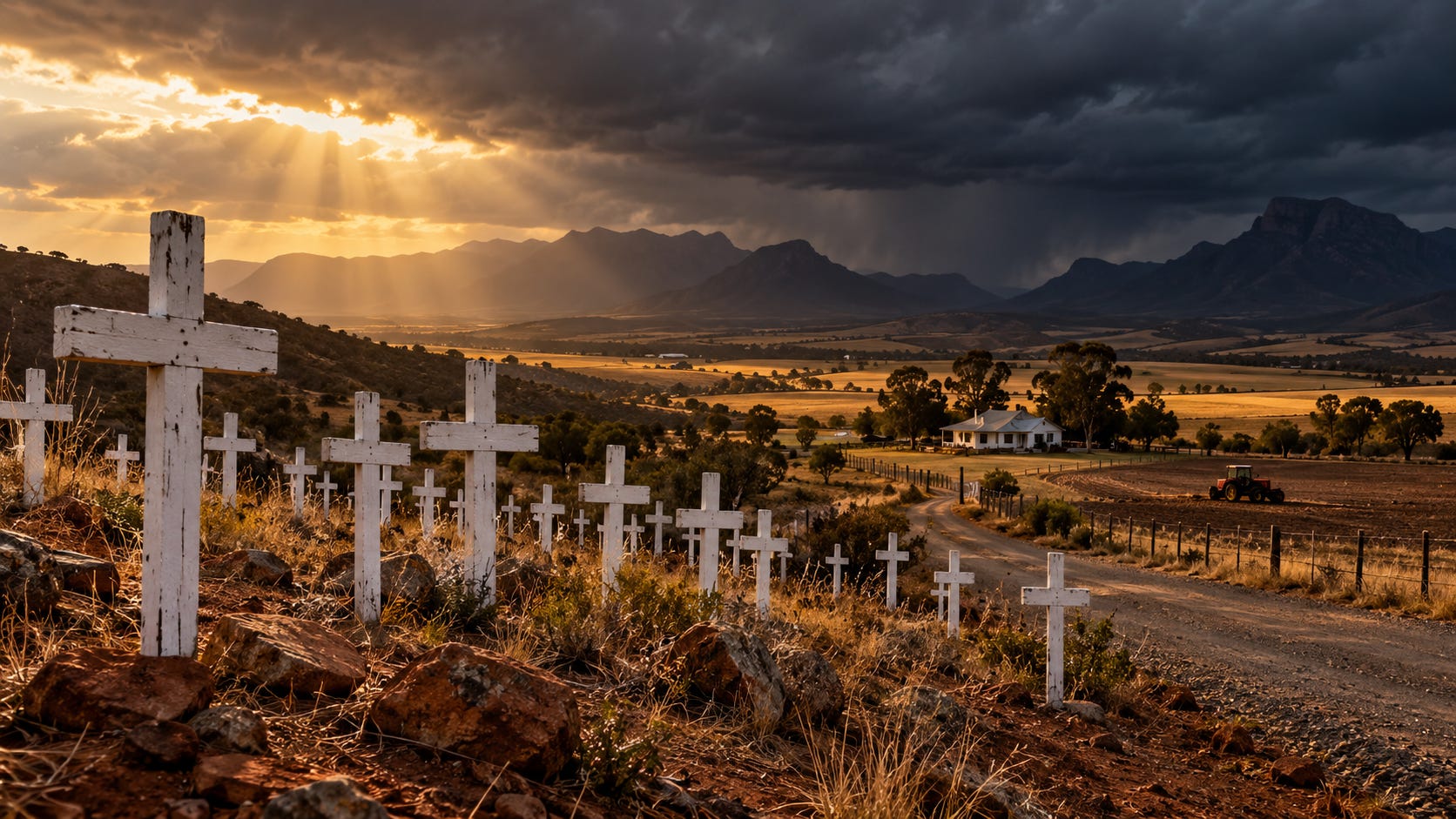
In September 2026, Lex Libertas’s White Cross Project erected 3,000 white crosses in Washington, DC, commemorating the victims of South Africa’s farm murders. Predictably, the memorial became embroiled in accusations of white genocide propaganda.
Yet the organisers made it clear that the crosses represented victims of all races. Black farmers, farmworkers and rural residents are also victims of the scourge of rural violence. The crosses commemorate lives lost, not merely white lives.
The organisers have legitimate political objectives, and those can be debated. But the cynical attempts to discredit the memorial by reducing it to racial propaganda reveal a disturbing attitude towards the suffering of ordinary South Africans.
These people were murdered. Their families were devastated. Their communities were terrorised. Yet recognising their suffering has somehow become controversial because it embarrasses the ANC and its apologists.
The ANC’s history of targeting farmers
The political targeting of South African farmers is not some conspiracy theory invented by American conservatives. It has a documented history, and the ANC played a central role in it.
Research presented by Dr James Myburgh at the White Cross Project conference detailed how the ANC conducted a campaign against white farmers during the 1980s, seeking to destabilise the country through incitement, guerrilla operations and landmine warfare.
Farmers were not incidental casualties. They were deliberately identified as targets in a revolutionary campaign intended to undermine the apartheid state.
Myburgh also traced the resurgence of farm attacks during the early 1990s, when ANC-aligned paramilitary networks continued operating amid the political transition.
This historical evidence does not prove that today’s farm murders are orchestrated by the ANC. But it does expose the dishonest narrative that hostility towards farmers is merely an invention of contemporary right-wing politics.
The ANC helped popularise the idea that farmers were legitimate enemies of a political revolution. This legacy deserves acknowledgement, not denial.
Kill the Boer and political irresponsibility
This history makes the continued singing of Kill the Boer, Kill the Farmer particularly reprehensible.
EFF leader Julius Malema has repeatedly sung and defended the chant. In March 2025, the Constitutional Court dismissed AfriForum’s attempt to appeal earlier judgments that had found the song did not constitute unlawful hate speech.
The courts accepted its historical and political context. But that context is precisely why the song should concern us.
During the liberation struggle, farmers were deliberately targeted. Now politicians continue singing about killing them, while the authorities insist that we should understand the revolutionary symbolism rather than the actual words.
In August 2025, the Equality Court separately found Malema guilty of hate speech for remarks encouraging his supporters to kill. Evidently, even our courts recognise that revolutionary rhetoric can cross into incitement.
More concerning is the government’s unwillingness to confront the issue. US Ambassador Brent Bozell recently accused President Cyril Ramaphosa of refusing to condemn Kill the Boer, citing the court judgments as justification.
A court ruling does not prevent a president from condemning irresponsible rhetoric. Legal permissibility is not moral acceptability.
Nobody needs to prove that Malema personally ordered a farm murder to demand that our political leaders stop glorifying violence.
The destruction of rural security
The ANC’s responsibility does not end with its revolutionary history or tolerance of inflammatory rhetoric. It also systematically weakened the institutions responsible for protecting rural communities.
In 2003, President Thabo Mbeki announced the dismantling of South Africa’s rural commando system. These units provided an essential security presence across vast agricultural areas that conventional policing struggled to cover.
The commandos had their problems and apartheid-era baggage, but they could have been reformed. Instead, the government chose abolition, promising that the SAPS would assume their responsibilities.
Research by the Institute for Security Studies warned that closing the commandos would weaken rural policing. The consequences of inadequate replacement capacity have been borne by isolated farming communities.
The ANC also dismantled specialised police units and centralised law enforcement, undermining the investigative capacity needed to combat violent crime.
Farm attacks can involve appalling brutality, including torture, sexual violence and the murder of entire families. Victims can live enormous distances from the nearest police station, with little prospect of immediate assistance.
South Africa suffers from a national violent crime epidemic. Township residents, rural villagers and urban communities also face horrific criminality. But acknowledging that crime is widespread does not excuse ignoring the distinctive vulnerabilities of farming communities.
Farmers are a national priority
Agriculture is not merely another industry. It is essential to South Africa’s food security, employment, exports and economic survival.
While individual farms are not automatically National Key Points under law, agriculture is undoubtedly a strategic national sector. Allowing farmers and their workers to live under constant threat undermines the prosperity and security of the entire country.
We need dedicated rural policing, restored specialised investigative capacity, cooperation with private security and farming organisations, and political leaders willing to condemn violence without ideological excuses.
Above all, we need to stop treating the suffering of farmers as an inconvenience to be explained away.
The white genocide debate has distracted South Africans from a legitimate crisis for far too long. Whether motivated by robbery, hatred or political extremism, farm murders demand justice. Where farmers are deliberately persecuted because of their occupation, we should recognise that threat for what it is: agricide.
South African farmers deserve protection regardless of their race. They produce our food, create jobs and sustain entire rural economies.
The state’s most fundamental responsibility is to protect innocent lives. The ANC’s repeated failure to fulfil this responsibility is indefensible.
Nicholas Woode-Smith is Managing Editor of the Rational Standard and a Senior Associate of the Free Market Foundation. He writes in his personal capacity.