


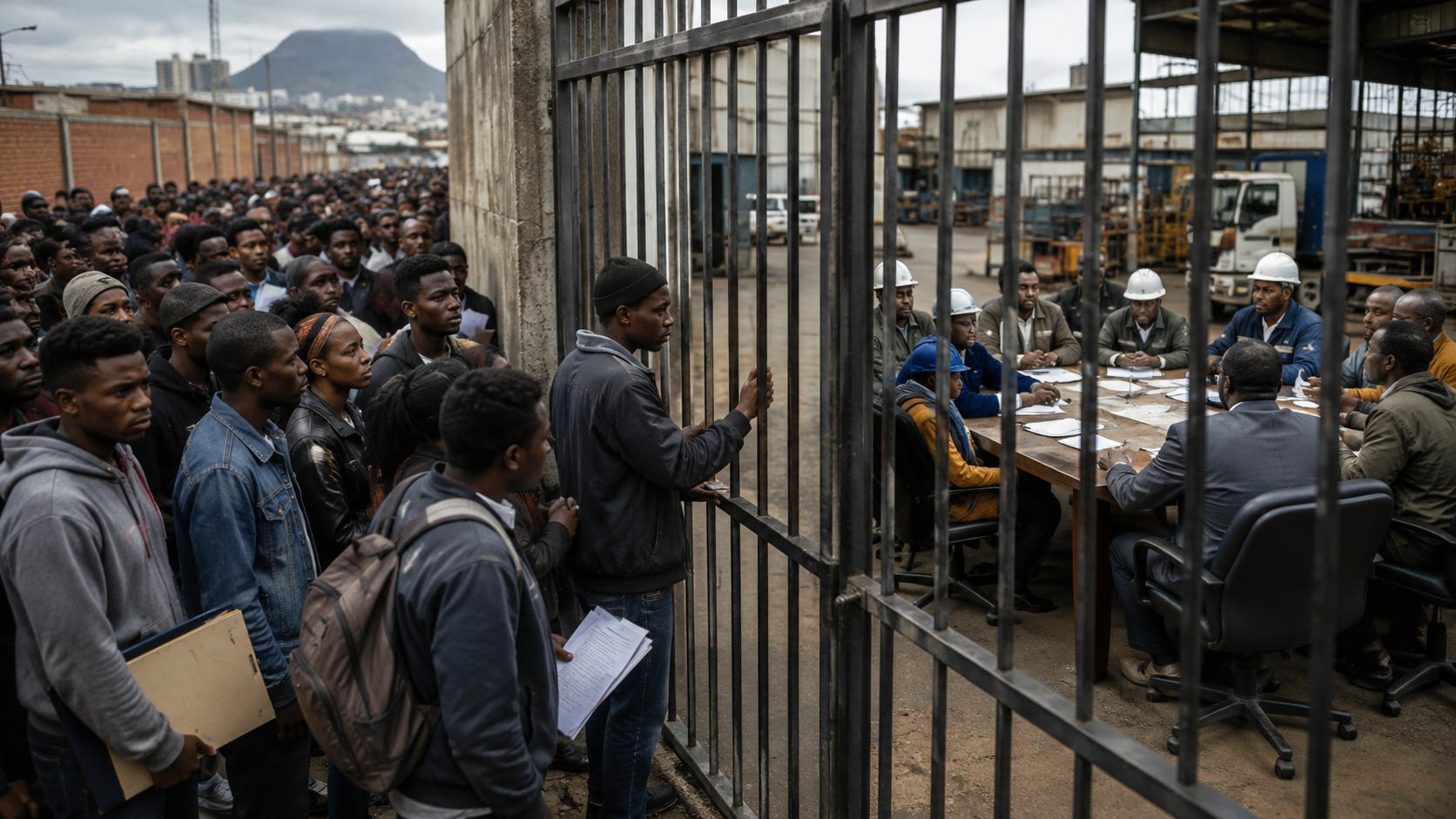
Trade unions have been allowed to dominate South Africa’s labour market for far too long. They are treated as if they speak for workers as a whole, when they represent only their members. Worse than that, they have every incentive to make it harder for outsiders to compete for the jobs their members already have.
Their dominance in politics and the economy has created a cocktail that guarantees that unemployment and poverty will continue to rise.
This matters enormously in a country with 8.5 million officially unemployed people and an unemployment rate of 33.6%.
Yet, when South Africa decides how its labour market should work, who grabs the privileged ear?
The answer is trade unions representing people who already have jobs. No one truly speaks for the unemployed, or the over 60% of youth that haven’t been given even the chance to earn a wage.
The greatest trick of organised labour was convincing society that the interests of people with jobs and people who need jobs are always the same - they aren’t.
A union exists to improve the conditions of its members. That is perfectly rational. Its members want higher wages, better benefits, stronger job security and greater protection from dismissal.
But every additional cost and restriction placed on employment can make an employer less willing to hire the next person. The union member gets the raise while the unemployed person never gets the job.
An unemployed South African may happily accept a lower starting salary, unusual hours, a probationary arrangement or some other compromise to get their foot in the door. Who is a politician or trade union official to tell them they are not allowed to make that choice?
If two consenting adults agree to an employment contract, it should take an extraordinarily good reason for some third party to prohibit it.
There is nothing inherently wrong with trade unions. Workers should be free to join together, bargain together, strike together and even resign together. An employer should be equally free to negotiate with them. That is freedom of association. But freedom of association means nothing if there is no freedom not to associate.
Collective bargaining becomes something very different when workers who did not join a union, or employers who did not negotiate an agreement, can nevertheless be bound by collective arrangements.
South Africa’s Labour Relations Act allows bargaining council agreements to be extended to non-parties under specified conditions. At that point, a union is no longer merely representing its members. It is helping determine what other adults are permitted to agree to. In a way, it has become an unelected regulator.
An individual worker should be allowed to negotiate their own wages and conditions. A worker who wants to work during a strike should be allowed to work. A business that never consented to an agreement should not have that agreement imposed upon it. Rights belong to individuals. They do not disappear because a sufficiently large collective has decided it knows better.
Big business and big labour
The usual story presents unions and corporations as natural enemies. Reality is more complicated. Huge corporations can afford labour lawyers, HR departments, compliance staff and expensive employment regulations. Small businesses cannot.
Rules negotiated between government, organised labour, and major incumbent businesses can therefore create a comfortable arrangement for everyone already inside the room while crushing those outside it.
Jeremy Magruder’s research into centralised bargaining in South Africa found bargaining agreements reduced employment in affected industries by an estimated 8% to 13%, with the losses concentrated among smaller firms. Big Labour and Big Business can both survive rules that kill small businesses and shut unemployed workers out of the market.
Industry-wide bargaining also weakens competition for workers. McDonald’s, KFC, and Wimpy should be competing to attract decent employees. One might offer higher wages, another flexible hours, another better bonuses, training or faster promotion.
Employers should have to compete for workers just as workers compete for jobs. The more employment conditions are homogenised across an industry, the less room businesses have to experiment with different arrangements, and the less choice workers ultimately have.
Union’s ugly history
South Africa’s history provides an especially ugly demonstration of what happens when incumbent workers gain political power over who may compete with them.
During the 1922 Rand Revolt, white mineworkers fought attempts by mine owners to cut costs partly by expanding the use of lower-paid black labour in positions previously reserved for whites.
The racial politics of that era were uniquely abhorrent, and modern unions should not be equated with the white labour movement of a century ago. But the underlying incentive is instructive.
Incumbent workers possessed something valuable and used organisation and political influence to prevent outsiders from competing for it. The Industrial Conciliation Act of 1924 subsequently excluded African workers from statutory collective bargaining while industrial council decisions could still affect their conditions of employment. When politically powerful incumbent workers are allowed to control entry into a labour market, they have an incentive to close the gates behind themselves.
That lesson should matter today. COSATU remains an ANC alliance partner, while organised labour enjoys an institutional seat at NEDLAC alongside government, business and community constituencies.
Why should a private organisation representing its own members receive privileged political influence over legislation affecting millions of unemployed people, non-union workers and entrepreneurs who never appointed it? We would rightly be suspicious if a handful of giant corporations enjoyed the same degree of political privilege. Calling an organisation “labour” does not somehow eliminate its self-interest.
Trade unions must fall
Trade unions must fall. That does not mean workers should be prevented from organising. They must fall from the privileged position they occupy above individual workers, unemployed South Africans and businesses that never consented to their authority.
The problem is not union size; the problem is union privilege. Workers should be allowed to build unions as large as they want, but membership and collective bargaining must be voluntary. Industry agreements should not be imposed on outsiders, individual workers must remain free to negotiate their own terms, willing employees must retain their right to work, and organised labour should not enjoy a privileged political voice merely because it is organised.
South Africa does not need to crush trade unions. It needs to strip them of their power to dictate terms to everyone else and return them to their legitimate role of representing those who voluntarily choose to be represented. A trade union should have exactly as much power as its members can voluntarily give it, and not an inch more.
Nicholas Woode-Smith is the Managing Editor of the Rational Standard and a Senior Associate of the Free Market Foundation. He writes in his personal capacity.