

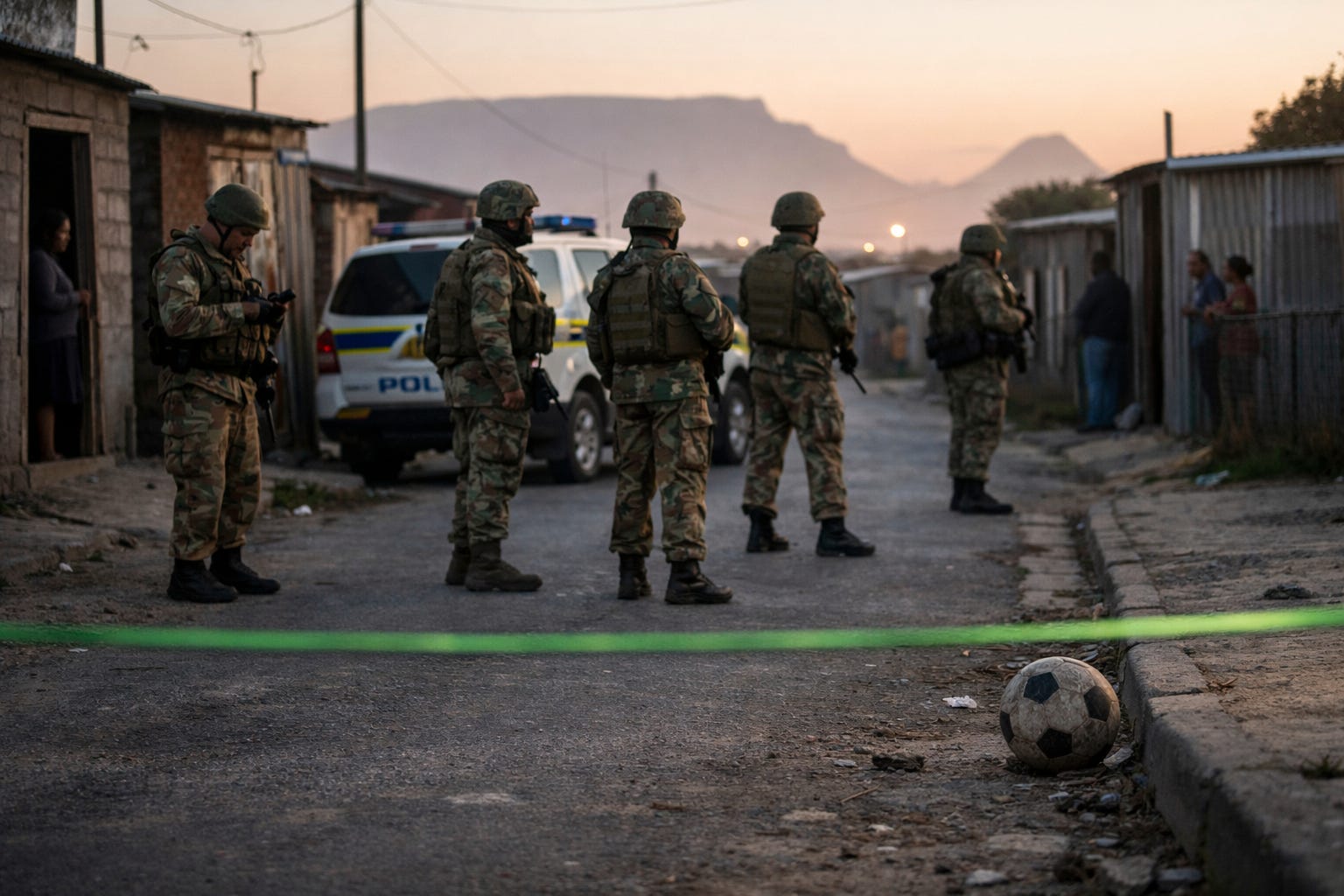
The recent State of the Nation Address (SONA) by President Cyril Ramaphosa brought a chilling, announcement to the residents of Cape Town: the South African National Defence Force (SANDF) is to be deployed to curb the scourge of gang violence. While the desperation of communities living under the thumb of organised crime is palpable, the welcoming of this move by Democratic Alliance (DA) leadership – including Premier Alan Winde – marks a troubling departure from the liberal principles the party once championed.
Premier Winde has framed this as a necessary measure, stating, “The safety of our citizens is paramount, and we welcome any additional resources to break the back of the gangs that terrorise our streets.” However, this pragmatism masks a dangerous erosion of the boundary between civil policing and military engagement.
The tool and the task
The fundamental problem lies in the nature of the tool being used. To put it bluntly, using the military to manage civilian criminality is like using a sledgehammer for dental surgery. It is the wrong instrument for a delicate, complex task.
The training of a police officer is centred on de-escalation, community engagement, and the use of proportional force. Policing, at its best, is about maintaining the social fabric and protecting individual rights through the rule of law. In contrast, the military is trained for maximum force and the neutralisation of an enemy in combat environments.
When soldiers are turned inward against their own citizens, the distinction between a “foreign enemy” and a “domestic resident” blurs. This creates a “securitisation” of social issues, where complex societal ills like systemic poverty and gang recruitment are treated as military objectives rather than human crises requiring nuanced intervention.
A threat to constitutional order
The deployment of troops in a democracy touches the core of constitutional law and human rights. There are four primary reasons why this practice should be approached with extreme caution, if not outright opposition:
Erosion of civil boundaries: Turning the army inward mimics the behaviour of authoritarian regimes. In a healthy democracy, civil society deals with its problems through civil institutions. When the green uniforms of the SANDF become a permanent fixture on street corners, it signals a failure of the state and a shift toward a “garrison state” mentality.
The risk of lethal escalation: Soldiers lack the psychological conditioning for nuanced civil policing. Their primary objective in an engagement is tactical victory, not “arrest and trial.” Using brute physical force to manage the behaviour of a population is a regressive step that increases the risk of unintended consequences and possible fatalities.
Politicisation of the armed forces: If the military is used to enforce the specific will of the ruling coalition, it ceases to be a neutral defender of the Constitution. It becomes a tool of political expedience. Furthermore, once the military becomes comfortable in domestic governance, the psychological barrier against seizing political power is lowered, inadvertently creating a blueprint for future instability and military coups.
The fracturing of public trust: A military depends on the support and taxes of its citizens. When that army is used against those same people, the social contract is severely damaged. This lead to long-term social fragmentation and the radicalisation of the very populations the state is trying to protect.
The DA’s liberal identity crisis
The DA has long presented itself as the vanguard of liberal values in South Africa. However, since its inclusion in the Government of National Unity (GNU), it appears to have veered off its grounded tracks. By supporting military intervention, the DA is effectively endorsing a bypass of the judicial system. In a military engagement, there is no due process; there is only the achievement of a tactical goal.
As the official opposition and a key partner in governance, the DA should be the first to point out that the people are not the enemy. The crisis in Cape Town is a failure of police intelligence, a lack of resources for the SAPS, and a breakdown in the socio-economic support systems. None of these are problems that can be shot out of existence by a rifle.
Conclusion
We must be wary of “quick fix” solutions that compromise our long-term democratic health. The deployment of the SANDF might offer a temporary, superficial calm, but the cost to our constitutional integrity is too high. Instead of welcoming the army, our leaders should be demanding a professional, well-resourced, and accountable police force that understands the difference between a battlefield and a neighbourhood.
Charl Heydenrych is a retired human resources practitioner and a libertarian.