


This article has possible spoilers for the series From (2022-). They have been made as vague as possible and names of characters have been omitted.
You wouldn’t really expect a supernatural horror TV show to carry some unintentionally poignant lessons about politics and economics. But fiction has a great way of teaching lessons about human psyche and the results of human action without even meaning to.
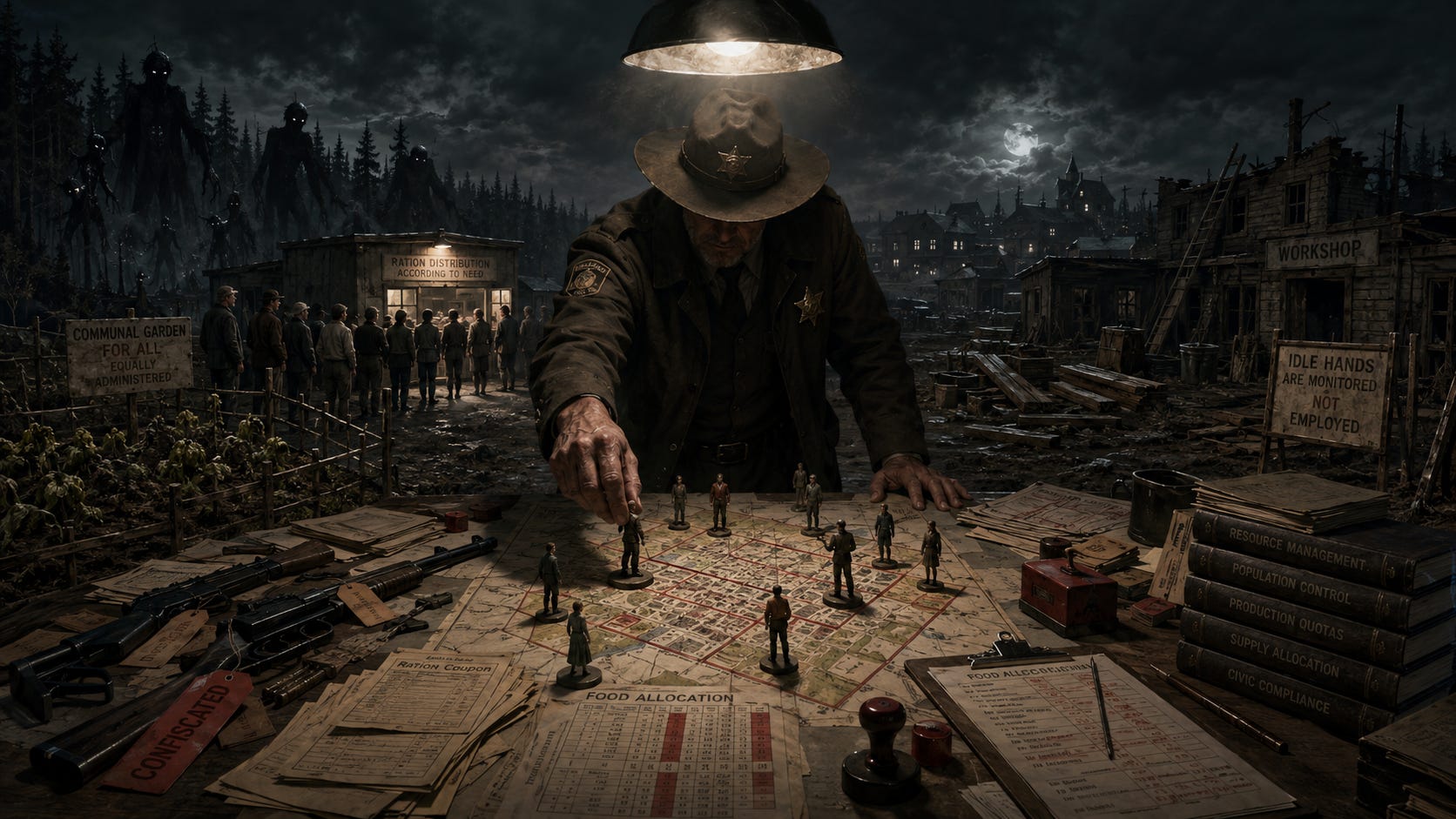
I doubt that the writers of hit MGM+ horror series From (2022-) truly intended for the series to showcase the failures of central planning. The series follows a town whose residents are trapped by supernatural forces who routinely terrorise and murder the community.
It is a well-written show with many twists, an engaging mystery, and some good scares for the horror fans among us. But something that can be quite frustrating for the economics minded viewer is the community’s distinctly ignorant approach to running a small-town economy.
This shouldn’t come as a surprise. One of the main cast members, the sheriff, hero and leader of the town is a retired US Army logistician. He applies his knack for organising to helping the townspeople survive.
The problem is that a town isn’t a military base. Even with only a few dozen people, the town has all the hallmarks of a complete society. It needs to produce its own food, it has healthcare needs, security issues, mental health problems, desires for entertainment and meaning. While a military base may have some of these needs, if not all, the Army has the benefit of being able to import its supplies from a productive metropole, and has the united purpose of a professional corps.
The town in From has none of this. It is a town of hapless survivors thrown into a nightmare. A common occurrence throughout the series is the mental breakdown of characters as the horror gets too much for them.
The sheriff runs the town with a kind but firm iron fist, alongside a possibly more warmly authoritarian matriarch that runs a community within the town. Together, they enforce the rules of the town, confiscate all guns (with some select exceptions), centralise food production into a single garden, and centralise item storage and rationing.
Now, it would be unfair to blame the dire straits of the town on this centralised, communal economy. Many viewers probably excused this approach as resources are scarce in the town and should be looked after properly. But it is this scarcity that makes a free market approach even more important.
Centralised farming is collectivised famine
Later in the series, the town is hit by a famine when its single garden supernaturally rots. My main question was: why did they have only one farm? There are dozens of idle people in the town and a lot of unused land. They should have been encouraging free hold farming, with every family farming their own plot. Even if all the farms were corrupted, this extra production would have allowed a much better stockpile to be built up before the farms were infested.
Decentralisation allows for risk-mitigation. It prevents the overflow of crises and improves overall productive output. Many farms could have produced far more food than one big farm and may even have escaped the supernatural disaster the struck the single farm.
Even the solution of foraging near a lake is tightly controlled through arbitrary lottery, rather than an incentive structure of profit. It is made clear in dialogue that there is plenty of forgeable food in the forest, but without central authority, no one does anything.
If a profit-motive was introduced that incentivised food production and foraging, a roster of an arbitrary handful of people to feed an entire town wouldn’t be necessary.
No enterprise
Likely due to the communalisation of property, there isn’t any incentive for anyone in the town to really do anything. The only characters who do anything at all are obsessed with escaping the town itself or just surviving day to day. The exception to this rule is an enterprising bartender who creates the most popular product in the town: moonshine.
There is an abundance of alcohol; so much so that even when production stops, there is a huge stockpile. There is not much of an abundance of anything else because there is no enterprising spirit. The townspeople expect all solutions to come from the central authority of the sheriff and his inner circle.
What is particularly disturbing is how no construction takes place on a large scale. The townspeople show evidence of having the ability to repair and construct, but very seldom do so. Rather, they cram themselves into preexisting structures – one of which is a stereotypical, hippie commune in an old manor house.
The way the in-universe rules work around holding back the supernatural evil could have been exploited more if the townspeople had the drive to build fortifications, additional shelters or any sort of infrastructure at all. But because the sheriff vetoed even having a unified project because he was in a bad mood when the proposal was given to him, nothing is done.
Gun rights
While the supernatural horror in the series is impervious to firearms, the gun control in the town is still counterintuitive. There are still human threats to innocents in the town and allowing more than three or four people access to firearms in the town could have stopped multiple murders, and perhaps even driven innovation towards defeating the supernatural evil.
The irony of the gun control in the town is that murderous elements always promptly obtain a firearm despite the gun control and can wreak devastation until one of the handful of armed townsfolk finally arrive.
Playing God
The root of much of the town’s problems is that the well-meaning sheriff does see himself as a saviour. He is built up by many of the supporting cast and the show is quite aware of his martyr complex and obsession with being the only person who can save the day.
He doesn’t want to risk anything. Even a proposal to build a radio tower to contact the outside world is almost vetoed by him because he’s afraid of getting people’s hopes up.
The sheriff’s monopoly on power is made even worse when he covers up murders and crimes to protect his loved ones. An abuse of power by a ruler.
The sheriff is like many real governments, ideologues and politicians. He is well meaning. Possibly even virtuous as an individual. He is no doubt heroic and a good character. But his duty goes to his head, and he ends up inhibiting much of the town’s ability to survive.
Finding solutions
The closest the town comes to finding a solution to its problems doesn’t come from the sheriff. At least, not when he is sheriff. One big discovery that improves the livelihoods of the town is made by him before he becomes sheriff, and this discovery is one of the root causes of his belief that he is the town’s saviour.
After that, much of the uncovering of the mystery that may lead to the survival and liberation of the townspeople come from the town’s arguable misfits.
A tormented man who has been trapped in the town for forty-years and still has the mind of a child has a privileged knowledge of this horrifying world. When he tries to warn the sheriff of an impending doom, he is imprisoned.
A tech-mogul who is driven insane by the town’s mystery uncovers much of the conspiracy and comes up with a plausible solution. He is shot down constantly by the authority figures, and it takes four seasons for him to finally be taken seriously.
The sheriff puts brakes on possible solutions constantly cautioning against every imagined risk, while ignoring guaranteed doom. Something reminiscent in many real-world governments.
Central planning doesn’t even work in fiction
The monsters and supernatural horror may be the real source of concern for the people in From, but central planning exacerbated the issue.
This is the same in real life. All countries inherit issues outside of their control. Lack of resources, bad geography, historical baggage. But socialism and central planning only make these problems worse.
When we embrace the human spirit of spontaneous innovation, free markets and incentives, we flourish. Perhaps, a free-market economist could have solved the horrors of From far sooner than a soldier or cop.
The best lesson to come out of all this is, even when surrounded by monsters, the answer is always freedom.
Nicholas Woode-Smith is a political analyst and author. He is the managing editor of the Rational Standard and a senior associate of the Free Market Foundation. He writes in his personal capacity.
Great stuff, Nicholas.