


Aldous Huxley took a measure of mescalin and waited for his worldview to change; trouser folds morphed into another world, a chair into the throne of God. The experience allowed him to escape the filter of his mind, to see the world as it truly is.
I am not that committed to radical experimentation. But I also have Huxley’s deep curiosity about our existence. For me, it is good literature that aids the mind in its search for meaning, for identity.
It was the printing press in the 15th century that transformed the Western world. It enabled the quantum acceleration in consciousness that birthed the revelatory transformation from crude political coercion towards the rising light of the Reformation, large-scale democracy, the Enlightenment and the ending of global poverty and early death through capitalism and the free market.
All the while, in Africa, a parallel indigenous knowledge system and humanist philosophy called Ubuntu was the cooperative background to an equally hostile and violence-prone continent. It was the denouement of the remarkable King Shaka story and legend that was first properly understood and communicated by Mazisi Kunene in his epic, Emperor Shaka the Great.
Kunene rightfully occupies a place amongst the few luminous literary minds that built the collective cooperative library on which Western and African humanism arose. It was Kunene who exposed the complex nature of Shaka’s mind, not dissimilar to the contributions of imperialists like Alexander the Great and Napoleon Bonaparte, leaving strong civilizing threads in their war-like enterprises.
Against these existential musings, I wondered, yet again, why Mathabo Kunene, widow of our 2006 Poet Laureate, was left almost entirely alone to protect the greatest South African literary body of work in the modern era.
I will suggest that there is a direct link between the ANC (and its political clones) eschewal of cooperative governance that led to their rejection of South African literature’s greatest son.
Why did the State fail to financially support Mathabo Kunene’s heroic efforts to preserve this priceless literary legacy, to insert his literary genius into our national education system? Some background to the life of Mazisi is relevant.
Often described as the black Shakespeare, Kunene set up the first ANC office in London in the 1970s as an exile. His global posthumous reputation as a writer and poet gave him Google recognition. Epics such as the historically immense Emperor Shaka the Great and Anthem of the Decades, along with his ten thousand handwritten poems of activism against apartheid and colonialism, all celebrate the extraordinary African spirit. The poetry is searing in its criticism of Western colonialism, but always retains the open hand of inclusive altruism, an altruism that forms the cornerstone of the Ubuntu philosophy.
He lectured for many years at UCLA, bringing his family up amongst the virtues of American freedom. Today, this immensely important oeuvre is at least recognized by the American Library of Congress (the modern equivalent of the ancient libraries of Alexandria; thank you, America…).
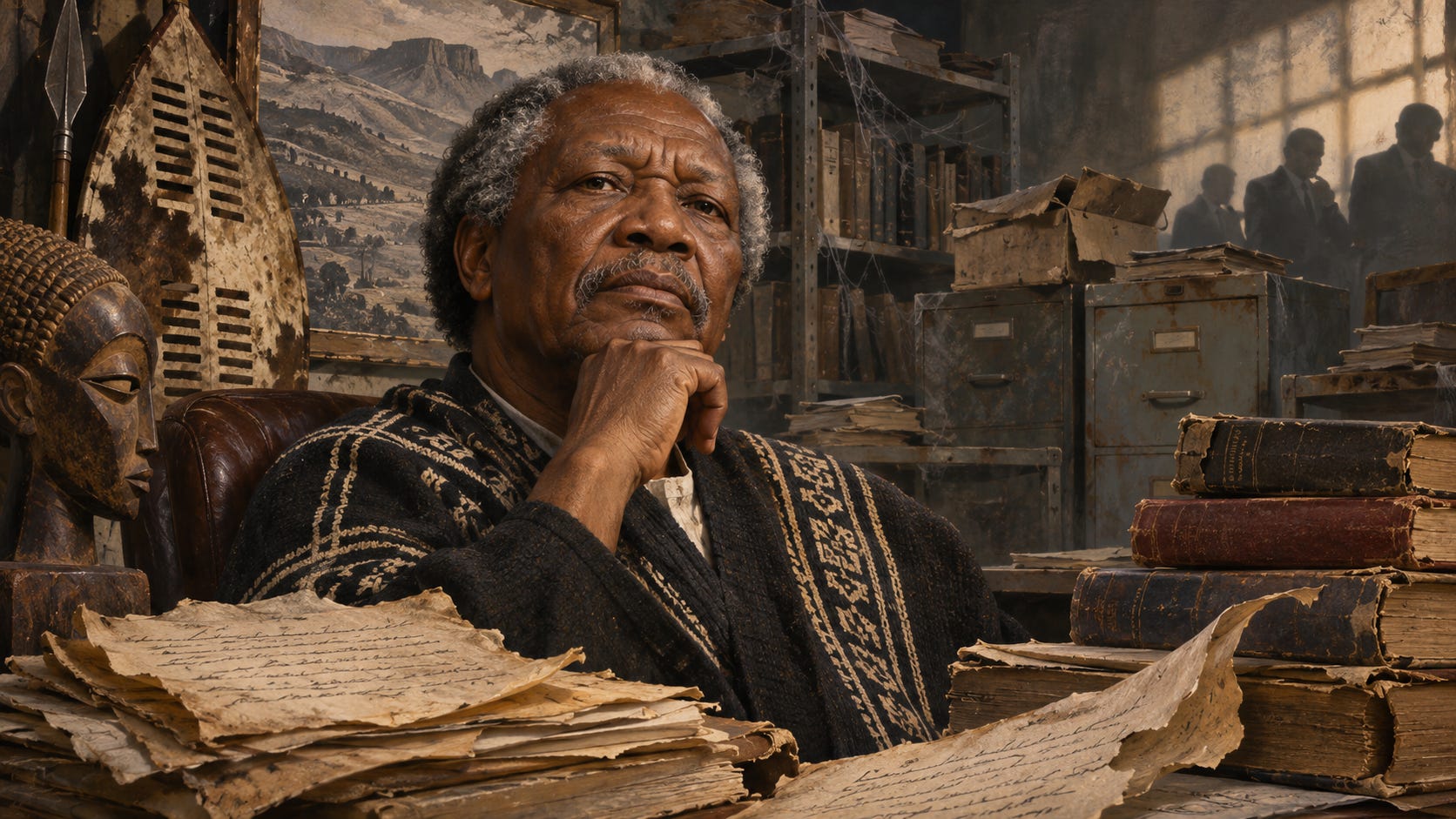
Yet here in South Africa, the home of Kunene, his work is at extreme risk of being damaged beyond repair. Underfunding from the state and tyrannical conduct by the eThekwini Municipality Billing Department led to the bulk of these handwritten historical documents being moved to the Bessie Head Museum in Pietermaritzburg to stop damage from Durban’s humidity. Kunene’s wife, Mrs. Mathabo Kunene, was hounded over water and electricity debt by corrupt debt collectors, gun-brandishing mafia subcontracted by the Municipality. The ANC couldn’t care less if this elemental part of black South African identity was lost.
The works are without doubt a core cultural asset to South African identity, an identity being hollowed out by ANC contempt, ignorance and abuse of power. Kunene’s widow Mathabo and her fellow Kunene Trust board members do what they can on very limited funds, while the ANC continues to pile insult on injury in their disregard for the literary hero and his wife.
In sabotaging Kunene’s gift to South Africa, the ANC has actively retarded the rebuilding of a viable, successful identity for all South Africans. A dose of moral mescalin is called for to answer the question: Why?
Simply put, Marxism suppressed the necessary evolution of Ubuntu.
I realize I am going against the politically acquired socialist grain in presenting this idea. However, I simply must. Having watched the economic evisceration of functional free market economics in the Umbilo, it is time to call out the need to turn away from moribund Marxism in the African milieu.
Kunene’s work celebrated the sophisticated philosophies of Zulu governance. These Ubuntu-based philosophies celebrated human dignity, being based on individual personhood within a communitarian commitment to the well-being of society itself. Socialism and particularly coercive communism were and are entirely antithetical to Ubuntu society. To Kunene, legitimate leadership was measured by care for people, not its power over them.
Kunene defended his altruism fiercely. In 2006, near the end of his life, he was honoured at a gala event celebrating his award as Poet Laureate. Sitting in his wheelchair, for he was very ill at the time, he was approached by then-Minister of Arts and Culture Pallo Jordan, hand outstretched to greet Kunene. With his arms crossed, he turned to his close friend behind the wheelchair, sculptor Andries Botha, and said:
“Who is this man?”
Botha whispered Jordan’s name and rank, no doubt including the borrowed honorific of ‘Doctor’ in Kunene’s ear.
“I don’t know him. Let’s go.”
Jordan was left with his hand waving in the air, and the incident no doubt typified the relationship between Kunene and the many disreputable members of the liberation movement that had morphed into a crime elite.
Marx’s anti-religious worldview also mitigated against African ancestral cosmology. In no way has any single utterance of Marx supported the spiritual continuity that the ancestors represent for African society.
In a very real way, the importation of Marxism into Africa, and the Fanoning of communist flames as a consequence, have, in my opinion, had a destructive effect on the extraordinary inclusive humanism of the African Ubuntu psyche.
It is the very spirit of Marx and the admixture of weak African leadership into the Ubuntu-depleted void that set the African zeitgeist adrift from its identity, from its natural moral moorings. This effectively ruined the 1994 opportunity South Africa had to build a successful identity and economy for all who live here.
The parlous state of the Kunene Museum and the consequently depleted educational awareness across the country is a direct consequence of Africa’s erroneous pursuit of Marxism.
Will the new Government of National Unity step forward to right these wrongs?
Or will the politicking that clearly places personal power and ego ahead of self-evident voters’ wishes for service delivery excellence once again set South Africa down the cursed road of socialist failure? If Herman Mashaba’s ego is anything to judge by, all the usual state capture rogues will be delighted.
Hopefully our non-political and legendary South African generosity of spirit will prevail, and the genius of Mazisi Kunene can help restore our stolen identity.
Ian Campbell-Gillies is the author of two books, Hopetown and Black Light. He works in Durban’s Umbilo and is the policy director of the Umbilo Business Association.
