


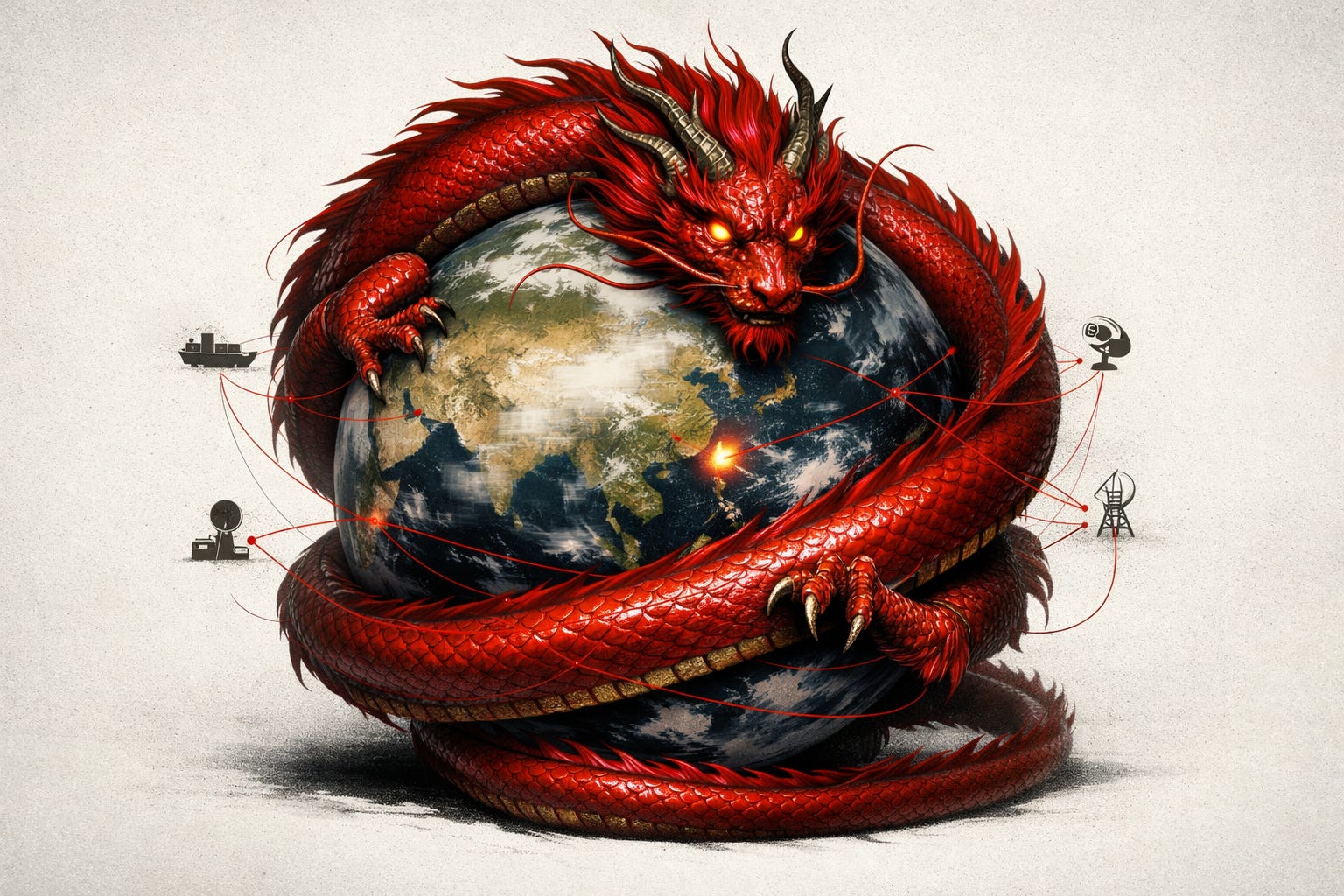
As the United States pulls away from its role as global hegemon, and the world shifts towards a multilateral order, new powers have risen to vie for extra power. These new powers have exhibited a capriciousness that we are unused to in the democratic West, but as this series has explored in previous articles on Russia and Iran, most are not truly capable of truly replacing the USA as the preeminent world power.
The People’s Republic of China is the exception. It has the population, the economic power, and the sheer unified will to become a true threat to not just its region, but to global stability and freedom.
While Russia languishes in the trenches against Ukraine, it is China supplying ammunition. While Iran brutally crushes its freedom protests, it is China giving it a lifeline by continuing to purchase sanctioned oil.
If the Axis is an octopus, then China is the head. But the Middle Kingdom doesn’t think of itself that way. It has always seen itself as a dragon, and it will stop at nothing to ensure that its fiery ambitions are achieved – no matter how many of its temporary allies are burnt in the process.
China: The Red Dragon
In 1949, after a brutal civil war and surviving the malevolent occupation of Imperial Japan, mainland China became communist under the leadership of Chairman Mao Zedong and the Chinese Communist Party (CCP). Those who opposed him fled to the island of Taiwan, declaring their own Republic of China.
What followed was a brutal crackdown on not just landlords and the old imperial state of China, as was the promise of the CCP, but on the people of China’s freedoms and livelihoods.
Land collectivisation, and communist policies that perverted incentive structures and led to institutional deceit and corruption on every level led to the starvation and death of upwards of 45 million people between 1959 and 1961 in the Great Chinese Famine.
The Cultural Revolution, an effort to purge the remnants of capitalism and traditional Chinese culture, killed a further 1 to 2 million people.
Communism impoverished China destroyed its spirit and turned it into one of the poorest, most dangerous countries in the world. By Mao’s death in 1976, China was an isolated, agrarian backwater – one of the world’s poorest countries – a fall from the golden dynasties of Ming, Qing and Song that was felt in secret by many Chinese leaders.
In 1978, Deng Xiaoping secured power over China, after seizing de facto control of the CCP in the power vacuum that followed Mao’s death. He drastically reformed the country, opening China to foreign trade and embracing free market capitalism that led to explosive growth.
But China’s capitalism wasn’t what we were used to in the West. It wasn’t accompanied by political liberties or democracy. It unlocked economic growth through shredding up red tape and enabling free market competition between firms, but this economic power wasn’t meant to serve individual entrepreneurs – but was ultimately a resource that would be used by the CCP under a new form of Authoritarian State-Capitalism. Or what Bethany Allen, author of Beijing Rules, calls economic state-craft.
China’s empire
The reason to fear China today is its economic statecraft and its ability to leverage its population and economic power towards geopolitical ends. But before we proceed with how it uses its power, it is important to determine its goals.
China is an imperial power. Like how the Soviet Union decried imperialism while growing and presiding over an empire, China is the same. It seized control over the peaceful state of Tibet in 1950, forcing its spiritual leader the Dalai Lama into exile.
It still maintains control over vast swathes of its imperial territories, including, notably, Xinjiang, where it maintains forced labour camps, re-education camps and has undertaken a persecution of the Uyghur people that has been likened to genocide.
It has forced itself on the free republic of Hong Kong, where it used the cover of COVID-19 to crush pro-democracy protests in 2019 and 2020 – turning one of the world’s freest states into a colony.
It actively invades the waters of other countries, claiming control over the South China Sea, and poaching fish in territorial waters as far as South Africa’s.
Skirmishes are common between China and India over their shared border, where China has constantly tried to encroach on India’s sovereignty. And the Chinese government has actively violated Bhutan’s territory by building settlements and outposts within its borders.
The list of China’s violations of sovereignty and territorial integrity goes on – including soft-power coercion and shadow puppeteering of satellite states.
Vast human rights abuses
China has no respect for the freedoms of other countries. But despite trying to gain global hegemony, it also has no respect for the rights of its own people.
The CCP maintains absolute control over the country, engaging in heavy censorship and control of the media – including the internet. Information is tightly controlled. This is especially utilised to quash any remembrance of the Tiananmen Square massacre of 1989, where potentially thousands of pro-democracy protesters were slaughtered by the military.
Today, any mention of the massacre is censored and punished by the CCP. This censorship extends overseas and to non-Chinese citizens. In June 2020, China used its power over the video conferencing tool Zoom to shut down pro-democracy meetings using the platform. The CCP constantly leverages the greed of multinational corporations wanting access to its market to enforce its illiberal behaviour – forcing Cambridge University Press to restrict access to Tiananmen-related scholarship, and Bing to block searches about Tiananmen Square.
The CCP engages in arbitrary detentions, capturing and making any perceived dissident disappear. Pro-Democracy supporters and individuals who do even petty things to spite the party are jailed and often are not heard from again. Famously, Jack Ma, the billionaire co-founder of Alibaba, was forced to step down from control of his company and largely disappeared from public life after criticising China’s banking regulations.
This pettiness and control go as far as harassing and destroying the career of MMA fighter Xu Xiaodong – who was perceived to be bringing shame on traditional Chinese martial arts and was subsequently censored, humiliated, and blacklisted.
China enforces a dystopian “Social Credit Score” system, where citizens are rewarded for compliance with the authoritarian state, and punished for even petty offences. A low credit score results in blacklisting, that can lead to bans from public transport and flying, public shaming, prohibition on serving in positions of economic or political power, and limitations on access to credit.
Economic statecraft
China has a population of approximately 1.4 billion people, and an economic system that mixes a lack of red tape with support by the government to meet economic needs. Companies deemed strategic, like electric cars, solar panels and others, are given vast subsidies by the government, and are equipped to undercut foreign markets and dump imports on smaller countries to crush their local industries.
This economic power was made scarily apparent during the COVID-19 pandemic, which originated in China. China used its censorship abilities to deny that COVID-19 was transmissible to humans, all the while using organised institutions spread throughout the Chinese diaspora to buy up local supplies of medical masks and then send them back to China.
When the world realised that there was a pandemic, they found a major shortage of medical masks. And the only country with a sufficient supply and manufacturing base to fulfil the new global demand for medical masks was China.
China utilised its veritable monopoly over medical masks to enforce geopolitical demands on other countries. Germany was restricted from buying masks after refusing demands from Chinese diplomats to lie about China’s handling of the pandemic. Mask exports were tied heavily to geopolitical ties.
China uses access to its market and its control over manufacturing to punish countries and force itself into positions where it can dictate the policies of other nations. Australia’s wine industry was decimated after its government called for investigations into the source of COVID-19, and Beijing retaliated effectively with sanctions on Australian wine.
The list goes on and on and is almost impossible to exhaust. Couple these actions with the fact that China is the fastest growing nuclear power, and its never-ending imperial ambitions.
China has also proven far more adept than even Russia at information warfare – utilising its control over TikTok to control algorithms and push users into believing pro-Beijing narratives, while censoring or quashing the reach of anything critical of China.
China has never given up on taking Taiwan – a vibrant democracy and one of the freest countries on the planet. But even if you do not care for the rights of the Taiwanese people, there is a strategic reason to fear the CCP’s ambitions over the island republic.
Taiwan is the leading source of semiconductors and chips needed to power the modern world’s computers and technology. Military and civilian technology relies on Taiwanese manufacturing. If China takes Taiwan, it will strangle the world’s supply of essential technology and leverage its new control to effectively dominate every country on the planet until it complies with its strict authoritarian regime.
How does this affect South Africa?
The African National Congress (ANC) is an active ally of Beijing and has seen the CCP as not just an ideological ally against so-called “Western imperialism” and “neoliberalism”, but as an example to copy.
The ANC has provided diplomatic cover for China’s “One China” policy, actively signalling support for China’s desire to violently annex Taiwan. This includes actively pushing Taiwan diplomats out of Pretoria.
The Dalai Lama, invited by the late Archbishop Desmond Tutu, was denied a visa in 2011 and 2014, actively supporting China’s illegal occupation of Tibet.
South Africa continues to engage in naval exercises with China, Russia and Iran, much to the dismay of our Western partners, which has threatened our trade and strategic relationships.
All this diplomatic posturing to suck up to Beijing has had negative consequences for South African citizens. Chinese surveillance has infiltrated South African infrastructure, making all South African citizens potential targets of Chinese censorship and control.
The government turns a blind eye to Chinese over-fishing in our waters, and abalone and rhino poaching that feeds Chinese demand.
Chinese firms receive subsidies, and unsustainable support from their own government, backed by slave labour. This has led to its imports being almost impossibly low. While free trade is meant to result in competition that may threaten local industries – China’s unfair, immoral and illegal practices have led to South Africa’s textile industry being decimated and our manufacturing industry collapsing.
An estimated 102,000 manufacturing jobs were lost between 1992 and 2010 due to Chinese imports. Families have been impoverished, and entire communities have collapsed into ruin due to China utilising its economic state-craft to destroy our local industries.
What should we do?
Protectionism is not a sound economic policy, most of the time. It coddles local industries and leads to inefficiencies and bad economics. But China isn’t playing by the rules and actively engages in human rights abuses and coercion. Allowing China to decimate our industries on purpose with unsustainably cheap goods is very different from allowing an American multinational the opportunity to compete with our companies.
We should be doing whatever we can to divorce ourselves from reliance on Chinese goods, especially strategic goods like medical masks. Textiles are not a hyper-advanced industry where we must rely solely on foreign supply chains. We had a thriving textile industry and we can again – if our local industry no longer needs to compete with a Chinese industry designed to predatorily destroy foreign industries at the cost of their own taxpayers and human rights.
The world must also take a stand against Chinese coercion and influence. Platforms like TikTok, which are actively used as an information warfare tool, must be banned or restricted.
Countries and corporations must realise that access to the Chinese market is a poisoned fruit and not worth the price of admission. Not only have profits from the Chinese market been vastly below projections, movies and technology that have entered said market have been quickly copied and bootlegged so that China does not need the foreign company. Just see how solar panel and electric vehicle technology was stolen from US firms after they opened manufacturing facilities in China.
Ultimately, what South Africa and the world needs to realise is that China isn’t just some benign global actor. They have a very real imperial ambition that goes far beyond anything ever expressed by the United States or British Empire. They want global dominance and they have used their influence to push for it, decimating economies, causing genocides, purging dissidents and stomping on human rights to achieve what they believe to be their manifest destiny.
They are the true threat of the New Axis; the cog that keeps Russia, Iran, North Korea and many other crack-pot rogue states functioning. And even without their allies, they will still be a threat. One that the world must take seriously or find themselves as vassals of a capricious Beijing overlord.
Nicholas Woode-Smith is the editor of the Rational Standard and a senior associate at the Free Market Foundation. He writes in his personal capacity.
The concept of "free trade" was/is camouflage for the use of modern day slavery as labour trapped in oppressive regimes has no choice but to work for a bowl of rice a day.
Western capitalists sought to increase their profit margins via the bypassing of the cost of labour in their far free-er nations.
Western consumers bought effectively stolen goods in the sense that these goods are contaminated by the theft of labour, the difference in wages that a modern day slave secured versus that of their Western equivalent.
That difference is the stolen component, and that difference is the amount that should be confiscated in every sale and held in trust for reparations directly to the slaves.
Not tariffs, but reparations.
For a slave who faces being crushed by a tank, even when we apply the Harm Consent Rule of Trevor Watkins coupled to the "Nature of Us", the NoU, we do have harm without consent because the slave willing to work for that bowl of rice does not have the freedom of choice that a worker in a freer-er society would have.
Be it a tank about to crush you or the threat of having your organs harvested for dissent is not free choice wherein HCR x NoU is not violated.
For the NoU see: https://thetaooffreedom.substack.com/p/the-nature-of-us-nou?utm_source=publication-search