


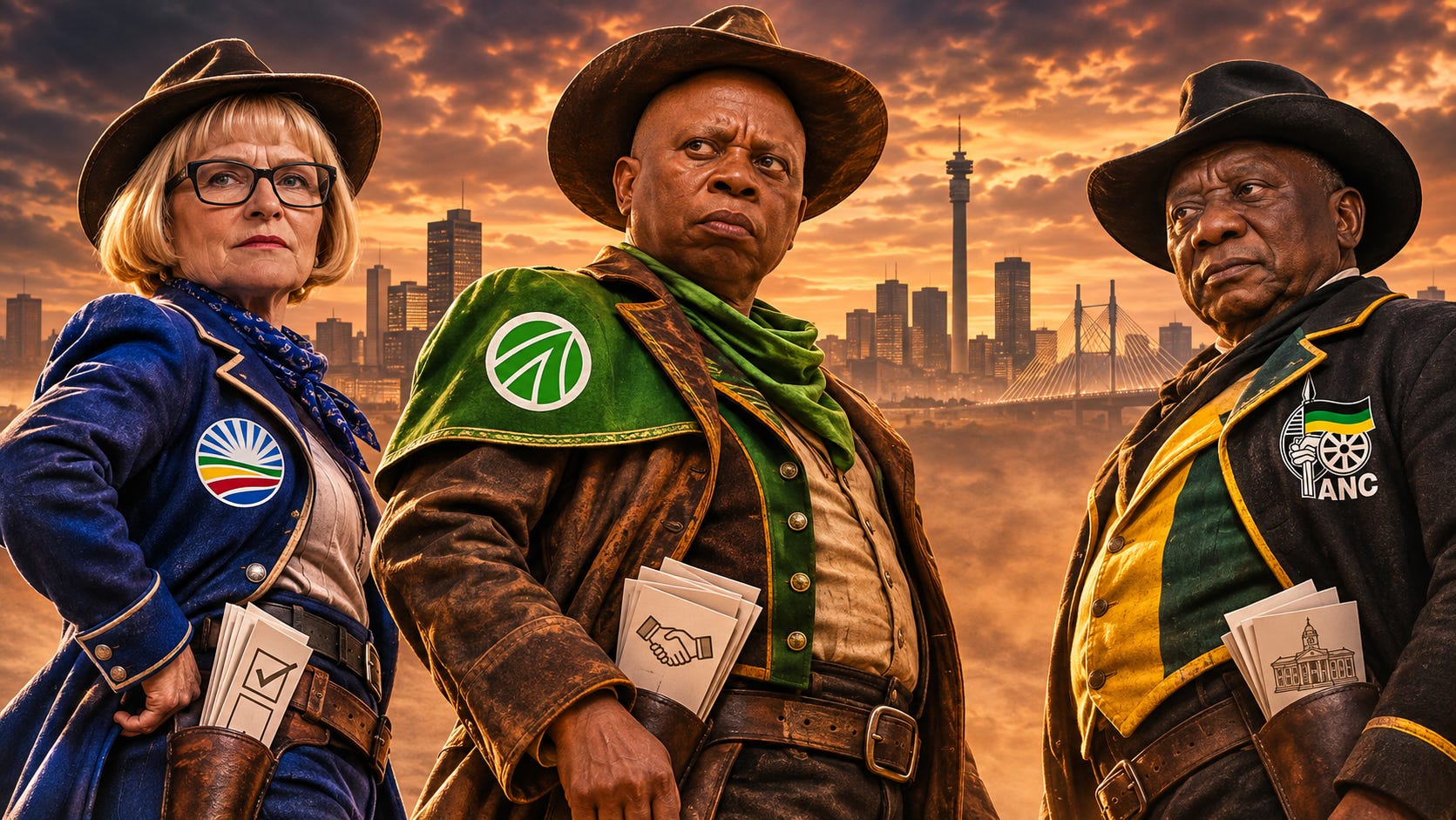
We say this every election cycle, but 2026 has truly been a watershed for South African democracy and for democracy on the continent. Already, media personalities are celebrating the end of one-party dominance and the rise of truly chaotic, multi-party politics.
This is all true, if becoming a bit trite. We need to celebrate that, as of the morning of 8 November 2026, the African National Congress’ (ANC) total national vote-share has dipped from 45.59% in the last local government election (LGE) to a record low of 30.78%. But we’re not out of the woods yet, and there’s going to be a lot of work before we start seeing South Africa escape this nightmare.
The Good
Let’s lead with what we should celebrate. The ANC has less than a third of the total votes cast in the country. It may still be leading in 6 of 9 provinces, but it has lost the lead in most of the metros. Gauteng has gone blue, with the ANC only retaining 20.27% of the vote in Johannesburg. It isn’t even second place in Tshwane, with only 20.22% of the vote, and ActionSA (ASA) pulling up second with 22.07%, versus the Democratic Alliance’s (DA) 34.37%.
The ruling party may have clung onto power nationally as a senior partner in the Government of National Unity (GNU), but increasingly, in the urban centers, it will be required to bow its head as a junior partner or not be included in coalitions at all.
Another welcome development is the electoral collapse of the Economic Freedom Fighters (EFF). Overall vote share for the EFF declined from 10.31% in 2021 to 6.22%, signaling that voters do not trust Malema’s party to govern local affairs and may be truly tired of the party’s antics. This is a welcome development for the country, as the EFF has come to represent some of the worst impulses of our radical politics.
The GOOD Party seems to be all but gone for good. This has-been party has been clinging onto politics since former DA mayor Patricia De Lille founded it in 2018. Brett Herron has been representing the party disgracefully, having the worst takes on South African politics that you can expect outside of the ruling party and the EFF. This includes attacking Ian Cameron for successfully defending himself against armed criminals in 2025.
GOOD declined to 0.24% of the national vote share. Unfortunately, its 2.29% in Cape Town is still large enough to stay alive another term.
The DA has made modest but important gains nationally with 24.63% of the total vote, dominating metros in Gauteng and the Western Cape, and picking up wards and municipalities across the country. While it lacks a clear majority in many of them, the DA should recognize the progress it has made from a minority opposition party years prior.
The VF+ has also made modest gains, securing 2.99% of the vote. It should prove to be a stable coalition partner to the DA, despite occasional upsets on X.
In Makana, a coalition of residents under the MUCM party banner was able to beat the odds and secure 19.51% of the votes. This is without any major financial backing and proves what residents can do if they work together to save their communities.
Another big win is that media pundits prophesying the DA’s downfall were dead wrong. Tara Roos predicted that the DA would lose its Cape Town majority. At 56.42%, that has not happened. Roos’ argument was backed by many commentators who believed that coloured voters were dissatisfied with the DA and would turn to the Patriotic Alliance (PA) and ASA.
The PA and ASA did make some inroads, with the PA growing to 3.77% and ASA getting to 2.75%. Al Jama-ah, an Islamic party with a coloured base, also gained 1.13 pp, pushing it to 2.38%. Yet, very little of this seems to be thanks to DA decline. The DA only declined by 1.84 pp, with the VF+ growing by 1.84 pp. It makes much more sense that the PA and ASA benefited from the decline of the ANC, EFF and other smaller parties.
The biggest long-term victory of all is that the National Democratic Revolution (NDR) bloc of radical left-leaning parties has declined and fragmented. Total vote share in the 2011 LGE sat at 62.9% amongst the major NDR parties, dipping to 56.6% in 2021, and now 49.2% in 2026. Even if we include every smaller party sympathetic to NDR principles, that number has still declined from 67.4% in 2011 to 55.7% in 2026.
This is all while the NDR bloc is fragmenting. The ANC has split off into, notably, the MK and EFF. The SACP, usually running under the ANC banner, also chose to run under its own branding this election. Not to mention the smatterings of sympathetic left-leaning parties like GOOD and the UDM.
South Africans are sick and tired of false promises, failed mandates and destructive radicalism.
The Bad
It’s not all sunshine and rainbows. One of the biggest victors of this LGE has been ASA. While it maintains a modest 5.68% nationally, ASA has proven to have a strong base in Gauteng, securing major vote shares in Johannesburg, Tshwane and Ekurhuleni.
Why is this a bad thing? Well, we need some background on ASA.
ASA was founded in 2020 by disgraced former DA mayor Herman Mashaba. After a torrid tenure as mayor of Johannesburg, where Mashaba put the interests of the EFF and other parties over his own party, he resigned as mayor after suspected political pressure. He never forgave the DA or Helen Zille and founded ASA to contest the elections against them.
Despite hopes in the run-up to the 2021 elections that ASA would secure votes that the DA would struggle to gain, and that the pair could work in tandem to secure municipalities against the ANC, this did not happen. ASA repeatedly sabotaged DA-led coalitions, including ousting the DA’s Cilliers Brink in Tshwane and handing the city to the ANC in 2024, withdrawing from the DA’s coalition led by Tania Campbell in Ekurhuleni in 2022, despite previously supporting her reinstatement, and fighting the DA over what should be shared policy.
Mashaba clearly founded ASA to be a spite party against the DA, repeatedly refusing to work with them, and reportedly not even wanting to be in the same room as Zille. The vendetta becomes even clearer when one recalls the widely reported 2010 allegations of an affair between former DA leader John Steenhuisen and ASA National Chairperson Michael Beaumont’s then-wife.
Many of ASA’s most vitriolic and loudest leaders are former DA members who have some personal vendetta against the party. The hate runs irrationally deep and personal. Which means that the party now in the king-maker seat for many South African metros isn’t a serious political party. It exists to take revenge.
In KwaZulu-Natal (KZN), former South African president Jacob Zuma’s MK Party has taken a huge chunk of almost every municipality, and the largest overall share of the province. The MK splintered from the ANC after Zuma’s fall from grace and has proven to be even more radical on economic transformation and nationalization. Importantly, the Kremlin connection to the MK is cause for concern, and the MK’s gains, even if they eroded ANC support, should not be celebrated.
And despite the decline of the NDR bloc, NDR-aligned parties still make up over half of the vote share. Fragmentation has made them less coherent, as cadres fight over a diminishing pool of loot, but this does signal that at least half of South African voters still have an appetite for disastrous policies.
The Ugly
Despite the collapse of the ANC across major metros, it still dominates across the country. Rural areas still overwhelmingly support the ANC and that doesn’t seem to be changing anytime soon.
The ascendancy of ASA and its petty personal politics also means that what could have been clean breaks away from ANC rule in South Africa’s largest metros are unlikely to occur.
While ASA has not ruled out going into coalition with the DA, Mashaba has stated a refusal to work with Zille, who is running for Johannesburg mayor. ASA also has a long track record of flip-flopping in coalitions, sabotaging their stability.
This means that ASA will likely choose to be a junior partner or weak senior partner in de facto ANC-led coalitions. So, more of the same. This is a depressing conclusion to what should be celebrated as a huge win against ANC-dominance.
Either the DA will attempt to woo the ANC as a junior party (which they will not be happy about), or ASA and a collection of smaller NDR parties will hand the keys back to the ANC. Regardless, what could have been a huge victory for Gauteng residents in particular has been squandered by the petulance of ASA.
That is, unless ASA quickly grows up and realizes what’s at stake. Johannesburg is our richest and largest city. Yet under coalition chaos and ANC rule, it has become a slum where electricity and water are a passing privilege. ASA has 16.29% of the vote. It could combine that with the DA’s 34.81% for a clear 51.1% of the vote. Add the VF+’s council seats and a clear majority will likely be established. There would be no arguments or bickering. Just a clear coalition that doesn’t include the destructive corruption and meddling of the ANC.
But as things stand, that seems like a vain hope, and we are likely to see the ANC continue to hang on precariously to power like the perpetual zombie that it is. Weakened, but not defeated. At least for another five years.
Nicholas Woode-Smith is a political analyst and author. He is the Managing Editor of the Rational Standard and a senior associate of the Free Market Foundation. He writes in his personal capacity.