


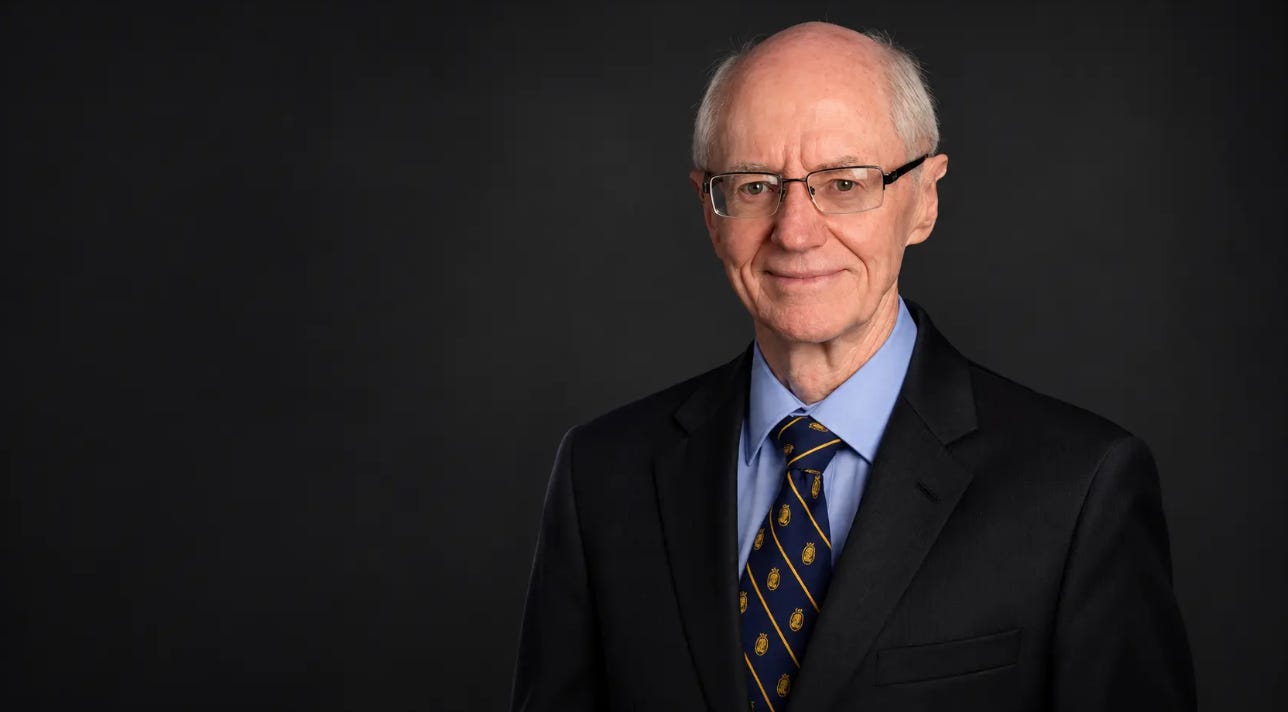
The President of the Free Market Foundation (FMF), Eustace Davie, passed away on Tuesday, 17 November.
For nearly five decades, Mr Davie dedicated his life to advancing individual liberty, economic freedom and the principles of a free society in South Africa. Central to his intellectual work was the belief that South Africans could thrive and prosper when given the opportunity to do so.
While I did not know him personally, his seminal book on the voucherisation of education, Unchain the Child: Abolish Compulsory Schooling Laws (2005), has greatly influenced my thinking on education as a young classical liberal.
I am penning this tribute to reflect briefly on the book’s central ideas and why it has left such a lasting impression on me.
Unchain the Child
In the book, Mr Davie presents a fresh and groundbreaking perspective on education by challenging some of its most fundamental assumptions: compulsory schooling laws and a standardised state schooling system premised on the belief that the state knows best.
While he acknowledges that compulsory schooling was historically introduced with the intention of expanding educational opportunities for young people, he argues that it has largely achieved the opposite and contributed to educational failure.
His conclusion is that compulsory schooling and standardised state education stifle the development of alternative educational institutions and, in effect, force children into a one-size-fits-all system that fails to accommodate their individual natures, talents and abilities. In doing so, the system “chains” not only children but also their parents, who are deprived of the fundamental freedom to make decisions about their education.
Consequently, education entrepreneurs, whether for-profit or non-profit, commercial or philanthropic, are also prevented from providing an array of educational offerings through alternative educational institutions that can accommodate the different natures, talents and abilities of children.
According to Mr Davie, the solution is not complicated. “Unchain” the child. Abolish compulsory schooling laws and restore agency and freedom to parents. Allow parents, who naturally have a vested interest in their children’s education, to make their own choices. In doing so, education entrepreneurs can finally have the space to innovate and tailor their educational offerings to the needs of different children.
In his own words:
“Abolish compulsory schooling laws and education will lose its stultifying conformity and become characterised by unprecedented innovation and creativity.”
Unchaining my mind
I first encountered a copy of Unchain the Child a few months into my internship at the FMF, which began in March 2025. Although my intellectual development was already underway, it was the outgoing Head of Policy at the FMF, Dr Martin van Staden - who is now the Head of AfriForum’s new Institute for Federalism - who suggested that I read it. This was during a meeting in which I expressed my research interest in education and my view that fixing it should be a top priority for South Africa (I must add, somewhat jokingly, that Dr van Staden may not even remember this encounter).
When I began reading the book, I still held the view that our country’s public education system simply needed reform to improve. By the time I had finished reading it, however, I could no longer limit my concerns to poorly trained teachers, deteriorating infrastructure or overcrowded classrooms.
Mr Davie made me realise that there is something fundamentally wrong with the very foundations of our public education system. And while I had intuitively felt this even before reading the book, Mr Davie gave me the language to understand and communicate it.
Since then, I have become a huge proponent of voucherisation and a fierce critic of the one-size-fits-all public education system in our country, which fails to unlock the potential of young people and ultimately condemns many of them to lives of misery and hopelessness.
I have also become a huge critic of the underlying assumption that we all have the same natures, talents and abilities as individuals. Looking back on my younger years, I now recognise that my peers who struggled academically in primary and high school were not stupid or incapable. They were simply not well suited to an education system that rests on the wrong foundations.
I believe in voucherising education, unchaining millions of chained children, restoring agency to parents and laying the foundations for an education revolution in our country.
Continuing the fight
While reality still demands that I engage with practical questions in my research on education, and sometimes tone down its more philosophical aspects, Mr Davie’s book has ensured that I grasp the deeper foundations of the problem. It has taught me to think more systematically and critically about education and strengthened my resolve to persist in pushing for much more meaningful and radical change.
In this regard, I am not alone. We classical liberals and libertarians may not be a huge community, but I take pride in knowing that there are young classical liberals like me who have encountered the ideas contained in Unchain the Child and begun critically engaging with them.
We are the next generation of freedom fighters in our country, and the flame of liberty that burned so powerfully in Mr Davie throughout much of his life continues to burn in us all.
We remain committed to fighting for millions of children in our country to be unchained, and for a genuine education revolution that can unlock the potential of young people and be of enormous benefit to our country.
Rest in power, Mr Davie. You have given me, and many others, the intellectual foundation and conviction to continue the fight for a free and prosperous society.
Ayanda Sakhile Zulu holds a BSocSci in Political Studies from the University of Pretoria and is a Policy Officer at the Free Market Foundation.
