


In a November 2025 article I made the following remarkabout resurging anti-immigrant sentiment in the country:
“Before delving into the analysis, I want to note that I agree with existing scholarship that rightly characterises the ‘legal’/ ‘illegal’ frame as nothing more than a smokescreen for underlying nationalist concerns about the very notion of immigration itself, its rate, and its perceived threat to the imagined community. This is a deeper philosophical question that falls outside the scope of this piece, and it will be explored in a future article.”
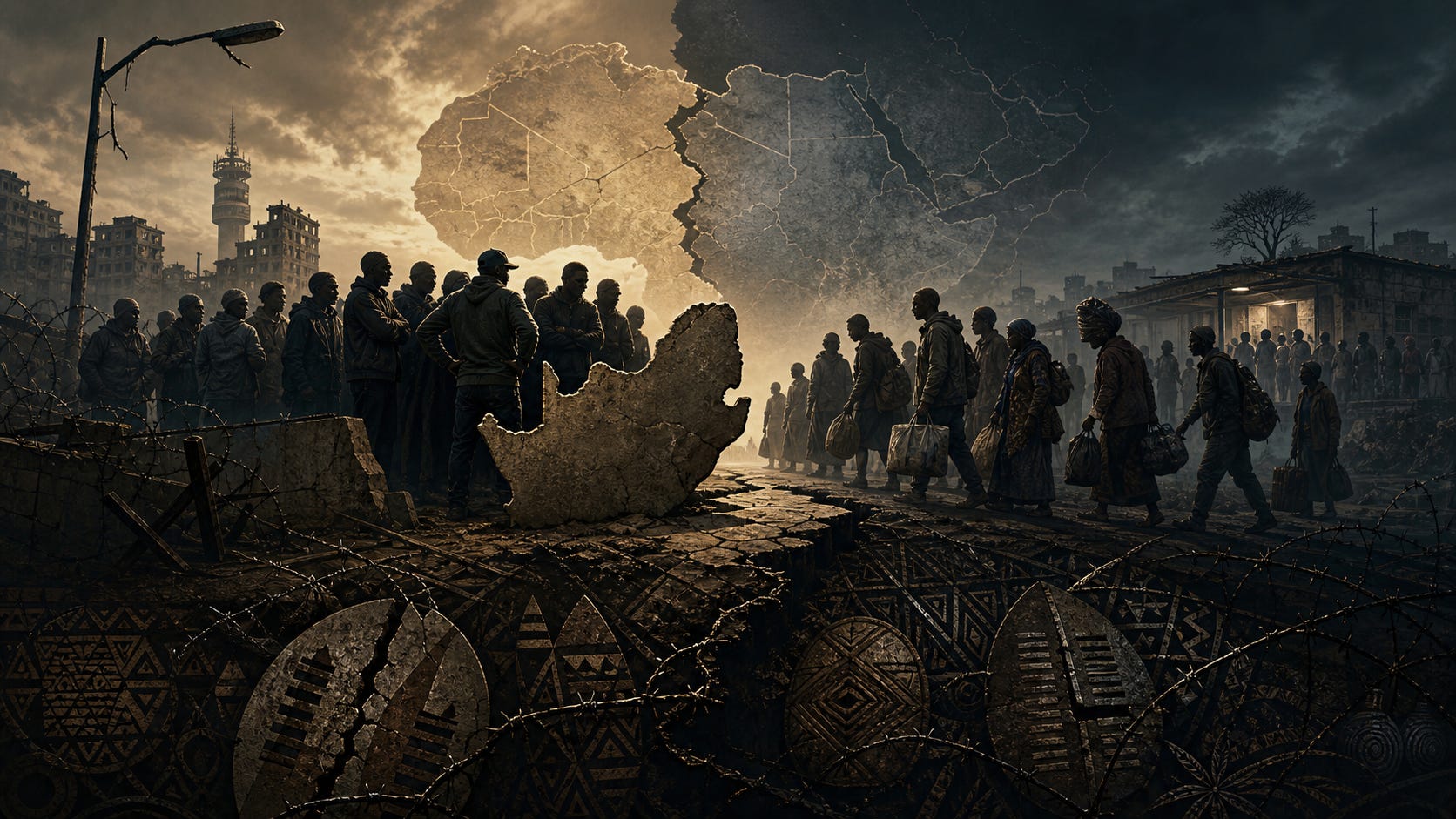
This article is a sequel to the November 2025 piece, and it attempts to make a further contribution to the vast body of literature that explains how nationalism, broadly, is a driver of resurging anti-immigrant sentiment in the country.
Context
Not too long ago, a self-confessed black nationalist – who will not be named here – argued that anti-immigration politics in South Africa has almost always been overwhelmingly led and dominated by South Africans from the Zulu community. While he did not expand on the point, what he likely meant is that Zulu ethnonationalism forms a part of the broader nationalist undercurrent that is driving hostility among black South Africans towards other black Africans.
Ethnonationalism and Afrophobia
If the ethnic composition of March and March, some of its popular activists, and a song that was sung by its supporters during a recent protest are anything to go by, then this argument has some merit. There appears to be a highly regressive and reactionary form of Zulu ethnonationalism at play. This nationalism, which rests on precarious historical grounds, is characterised by chauvinism and a belief that Zulus are a distinct people who are destined to lead other weaker and inferior black ethnic groups.
It has historically, and continues to, manifest as prejudice, hostility, and, at times, outright hatred towards black Africans who are viewed as fundamentally different and inferior. Domestically, it takes the form of a kind of ‘tribalism’ that has contributed to the common perception of Zulus as violent and arrogant people who generally harbour a condescending attitude towards other black South Africans.
To be clear, this is the same form of nationalism that, in part, drove Zulus under the banner of the IFP in the late 20th century to unleash deadly violence on other black South Africans in Gauteng townships.
Having said that, ethnonationalism is not unique to one ethnic group, and there are other local forms of it that share similar premises and manifestations, both within the country and in the context of immigration.
Unpacking this part of the broader nationalist undercurrent that encompasses a cluster of ethnonationalisms is important because it demonstrates the relationship that existing scholarship has established between tribalism and what can be termed Afrophobia here for analytical purposes.
A South African nationalism and its pitfalls
The other, more central part of the broader nationalist undercurrent - which intersects with the cluster of ethnonationalisms - can be described as a specific form of South African nationalism that is rooted in exceptionalism and a belief that black South Africans are superior to other black Africans.
This nationalism is centred around a shared history amongst black South Africans, who suffered under Apartheid and fought to usher in the vibrant constitutional democracy that now exists, notwithstanding its challenges. It is further grounded in the idea that they have collectively contributed to building the most industrialised state on the African continent with relatively functional infrastructure, despite ongoing structural constraints.
Several other African states, particularly those in sub-Saharan Africa, have struggled to reach South Africa’s level of economic development and institutional capacity, and this has driven many of their citizens to migrate to it, where they have increasingly come to be seen as a source of moral and social degeneration, infrastructural decay, and institutional decline.
In this regard, the leader of March and March, Jacinta Ngobese-Zuma, has made no secret of the perceived damage that immigrants have inflicted on South Africa’s public infrastructure, as well as the perceived threat they pose to the country’s growth and development. In one of her many provocative posts on Facebook on 3 April, she said: “It’s that time again where we have to watch the refugees and asylum seekers who are here destroying our country and basically replacing the natives in the employment sector because they are the modern-day slaves for cheap labour, go back to their ‘dangerous’ countries and come back to continue where they left off, then swear at us.”
Her candid words embody the spirit of this South African nationalism and its passionate drive to save the South African polity from perceived destruction.
To be sure, nationalism, and the pride that accompanies it, is not intrinsically problematic. Black South Africans have good reason to be proud of their country and to naturally want to defend it. However, a regressive form of nationalism that is premised on false exceptionalism and the dehumanisation of other people is dangerous and misleading.
It is true that several other African states have consistently lagged South Africa in terms of development, but this is because their own leaders have taken them back to the dark ages with socialist policies that have no record of delivering prosperity in any developed part of the world. It may be unfashionable to acknowledge this, but South Africa has increasingly become “another African country’ because some of its political elites refuse to learn from history and their contemporaries whose poor governance has systematically undermined the bigger project of building a more united Africa.
The Pan-Africanist dilemma
While the South African nationalism that has been discussed above is problematic, it is unlikely to dissipate soon. More broadly, nationalism is unlikely to dissipate on the African continent, and it will continue to exist in tension with the goal of fostering a Pan-African consciousness and building African unity.
The late founding president of Tanzania, Julius Nyerere, who notably impoverished the country through his failed socialist policy of Ujamaa, realised this in 1966 when he spoke of the Pan-Africanist dilemma. This concept refers to the tension between building individual sovereign African nation-states and achieving continental unity.
The modern states that exist in Africa are inherited colonial structures, whose leaders must prioritise their immediate needs, stability, and development over continental integration. Because the carving up of arbitrary borders brought many different ethnic groups across the continent into single nation-states, leaders also must prioritise the cultivation of a national consciousness that can transcend ethnicity, foster national unity, and prevent ethnic fragmentation.
All this naturally comes into conflict with Pan-Africanism, whose central focus on continental development and integration can sound distant and detached to citizens who have immediate demands and concerns, and a natural desire to be prioritised within their own states. The project of building a united Africa creates tension with a host of competing African nationalisms, and nation-building can create a political climate that makes the emergence of Pan-African consciousness incredibly difficult.
South Africa finds itself in this dilemma where its own efforts to step up and play an important leadership role on the continent are increasingly being met with resistance by citizens who feel that they are being neglected by leaders who are prioritising other countries over them. As a country with many ethnic groups and a deeply divided past, it has had to work to foster national unity and a national consciousness that is now coming into tension with a broader Pan-African identity.
What is worth noting is that it is not alone in this regard, and that virtually every other country in Africa is dealing with the same dilemma, which will continue to shape political developments on the continent.
While all of this does not mean that the vision of a more united Africa is doomed, it does mean that its proponents – especially those whose vision specifically rests on free trade and market integration – must grapple with the reality they are operating in beyond their lofty ideals.
Conclusion
The immigration issue in South Africa is a complex one that cannot be reduced to economics, legality, or even nationalism in this case. However, the contention of this sequel is that nationalism, broadly, is one of the drivers of anti-immigrant alongside concerns relating to crime, other socio-economic issues, and the burden on public infrastructure.
This sequel will naturally divide opinion, and this is to be expected, because its aim is not to claim expertise or provide easy answers and conclusions, but, at the very least, to spark dialogue on a highly relevant issue that is firmly on the national agenda.
Ayanda Sakhile Zulu holds a BSocSci in Political Studies from the University of Pretoria and is a Policy Officer at the Free Market Foundation.

We can look at Europe, how did they go from two devastating wars to free movement, free trade and a single currency? The continent was devastated after WWII yet this devastation solidified their resolve to push forward with 'ever closer union', their version of pan-Europeanism.
In some ways, Africa resembles a continent that has been devastated by war. And we have made some progress towards unity, notably driven by Thabo Mbeki's presidency, NDZ's chairing of the AU commission and Kagame's chairmanship of the AU in 2018.
So leadership is key, notably from South Africa for the same reasons you mentioned as a magnet for immigrants here. Kagame tried and failed to push continental free movement and failed, even though it was as much a part of agenda2063 as the AfCFTA. If SA had made the push, we would certainly have gotten it.
The one thing you failed to address is in our national interest. European integration was partly a response to the existence of the two superpowers of the USSR and the USA, even though the latter was an ally to Western Europe. They understood the reality that division would make them vessels of either America or the East (now including China).
If there was no national interest question, pan-Africanism would not matter as much as it does. The reality of geopolitics is that SA will never reach great power status on its own, and only the great powers are truly sovereign.