


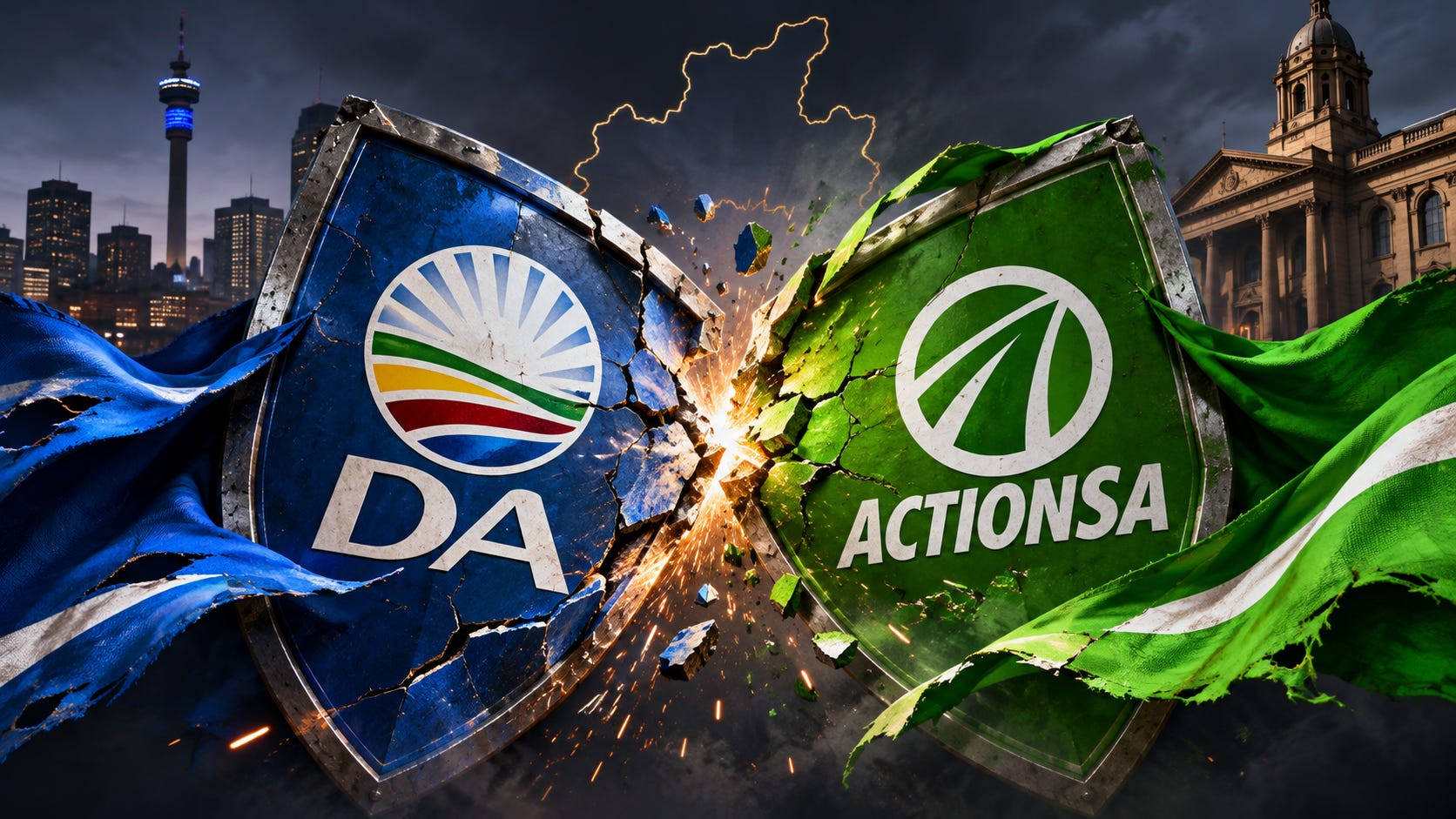
South African voters achieved something remarkable in the 2026 local government elections. In Johannesburg, Tshwane and Ekurhuleni, the Democratic Alliance (DA) emerged as the largest party, overtaking the African National Congress (ANC) and presenting a historic opportunity to finally dislodge the governing party from power in Gauteng’s three metros.
Yet, before the new councils have even been constituted, this opportunity looks increasingly likely to be squandered. Not because the ANC has won back the confidence of voters, or because the opposition lacks sufficient numbers to govern, but because ActionSA seems more interested in settling personal scores with the DA than establishing a stable alternative to ANC rule.
There is something profoundly depressing about this situation. ActionSA could have been one of the most important opposition parties in South Africa, complementing the DA and appealing to voters that the official opposition has historically struggled to reach. Instead, it has allowed a political feud to define much of its relationship with its most natural coalition partner.
And the ANC, as always, is more than happy to reap the rewards of opposition infighting.
ActionSA’s wasted potential
ActionSA was founded in 2020 by Herman Mashaba following his dramatic departure from the DA in 2019. Mashaba had served as the DA’s mayor of Johannesburg, but resigned following a breakdown in relations with the party, particularly after Helen Zille’s election as federal council chairperson.
While Mashaba cited ideological differences and concerns about the direction of the DA, the subsequent behaviour of ActionSA suggests that personal resentment has become a defining feature of the party’s political identity.
This is perhaps unsurprising given how many of its prominent figures came from the DA. Mashaba, Michael Beaumont, John Moodey and Athol Trollip all have histories within the official opposition. Some left under acrimonious circumstances, and many clearly have grievances with their former political home.
But a political party should be more than a support group for disgruntled former DA members.
This is especially tragic because ActionSA has genuine potential. Its populist appeal, emphasis on crime and corruption, and ability to attract disillusioned ANC voters have allowed it to make inroads into constituencies where the DA has traditionally struggled. Rather than competing for the same voters, the two parties could complement one another in building an alternative governing coalition.
I argued as much in 2022, suggesting that ActionSA should focus its energies on taking votes from the ANC rather than cannibalising support from other opposition parties. The DA and ActionSA did not need to like each other. They merely needed to recognise that their common interests were more important than their differences.
Unfortunately, ActionSA has repeatedly demonstrated an inability to do this.
By 2023, I had already described ActionSA as a spite party, criticising its apparent obsession with sabotaging DA-led coalitions and attacking its supposed allies. I had hoped that time, political maturity and the prospect of genuine governing power would eventually encourage a more constructive approach.
Apparently not.
Personal politics before good governance
The latest coalition negotiations in Gauteng have demonstrated just how far ActionSA is willing to take its hostility towards the DA.
Despite the DA emerging as the largest party in all three metros, Mashaba has insisted that Helen Zille and Cilliers Brink should not be candidates for the mayoralties of Johannesburg and Tshwane respectively. He has even suggested that negotiations would be a waste of time if they remained in the picture.
It is perfectly reasonable for coalition partners to negotiate over positions. ActionSA has its own electoral mandate, and Nasiphi Moya’s incumbency in Tshwane is a legitimate consideration. No party should be expected to surrender its interests simply because the DA received more votes.
But there is a difference between negotiating a fair coalition settlement and attempting to dictate who another party may put forward as its candidates. Rejecting experienced political figures seemingly because of personal animosity is not the behaviour of a serious party interested in establishing stable government.
The Freedom Front Plus (FF+) has attempted to broker a settlement between the DA and ActionSA, but these efforts have so far failed to resolve the deadlock.
The tragedy becomes even clearer when considering the numbers.
A coalition between the DA, ActionSA and FF+ would command 139 seats in Johannesburg, 139 in Tshwane and 117 in Ekurhuleni. These are sufficient for majorities in all three metros, although the margins would be narrow in Johannesburg and Ekurhuleni.
It is therefore mathematically possible to govern Gauteng’s major cities without the ANC, EFF or MK Party. This would be an extraordinary achievement for opposition politics, offering the opportunity to build competent administrations that could demonstrate what South Africa might look like without ANC rule.
Instead, ActionSA is negotiating an alternative arrangement with the ANC, EFF and MK Party. The emerging proposal would reportedly give Mashaba the Johannesburg mayoralty, allow Moya to remain mayor of Tshwane, and give the ANC control of Ekurhuleni.
This is an astonishing reversal for a party that has spent years presenting itself as an alternative to ANC misrule.
It becomes even more absurd when considering reports that the ANC wants control of the finance portfolios and Speakers’ offices in Johannesburg and Tshwane in exchange for supporting ActionSA mayors.
Mashaba may get the mayoral chain, but the ANC wants its hands on the purse strings. One wonders how much meaningful change ActionSA expects to accomplish when the very party it claims to oppose retains such important levers of municipal power.
ActionSA may insist that it is acting pragmatically and securing the greatest possible influence for its voters. But influence towards what end? If the result is merely the perpetuation of ANC power, with a different face occupying the mayor’s office, then what exactly has been achieved?
The DA must know when to walk away
None of this means the DA should be given a free pass. The party has its own history of arrogance, internal dysfunction and poor political judgment. It has also demonstrated, particularly through its participation in the Government of National Unity (GNU), a worrying willingness to compromise without always securing meaningful policy concessions in return.
I have repeatedly criticised the DA for this tendency. Its purpose cannot simply be to occupy positions in government while the ANC continues pursuing much the same policies that have damaged the country for decades.
The same principle applies to local government.
The DA should make every reasonable effort to establish a stable, responsible coalition with ActionSA, the FF+ and other compatible parties. That means negotiating in good faith, compromising where necessary, and recognising that coalition partners have their own legitimate interests and electoral mandates.
But compromise must have limits.
The DA cannot be expected to exhaust its political energy and capital continually appeasing coalition partners who seem more interested in undermining it than governing. It cannot sacrifice its policy programme, abandon competent candidates merely to satisfy personal grudges, or accept a coalition arrangement that leaves it responsible for failures it has little power to prevent.
A coalition that is permanently on the verge of collapse is not a victory. Nor is a government in which the largest party must constantly surrender its principles to keep smaller partners happy.
If a reasonable settlement cannot be reached, the DA should accept opposition as the preferable outcome.
This is equally true of the temptation to form coalitions with the ANC. There may be circumstances where cooperation is necessary or beneficial, but the DA should be exceptionally cautious about entering arrangements that merely prolong ANC influence while compromising its own political identity.
Local government is also deeply personal. Municipal politics is not always dictated by national ideological differences, and there may well be smaller municipalities where competent councillors from different parties can work together effectively despite their party affiliations.
A DA councillor and an ANC councillor who have spent years working together in a small town may be able to negotiate a practical arrangement that benefits their community. Such circumstances should be judged on their own merits rather than rejected through a blanket national prohibition.
But the Gauteng metros are clearly not examples of this sort of cooperation. Their recent history is characterised by factionalism, unstable coalitions, political opportunism and governance failures. Adding another arrangement built around incompatible political agendas and personal antagonisms is hardly a promising solution.
Opposition is better than a doomed coalition
Ultimately, the DA needs to recognise that entering government is not always synonymous with political success.
A stable coalition that can deliver improved services, restore financial discipline and implement meaningful reforms is worth pursuing. A dysfunctional coalition that consumes the party’s resources, damages its credibility and prevents it from governing according to its principles is not.
There is also a political benefit to allowing irresponsible parties to bear responsibility for their own decisions. If ActionSA believes that it can provide better government alongside the ANC, EFF and MK Party, it should be prepared to demonstrate this to voters and accept accountability for the results.
The DA should not rescue ActionSA from the consequences of its own political choices. Nor should it undermine its credibility by entering a coalition that it knows cannot function.
For the people of Johannesburg, Tshwane and Ekurhuleni, however, this remains a profound tragedy.
Millions of residents have endured deteriorating infrastructure, unreliable services, corruption and the consequences of incompetent municipal administration. The 2026 election offered a genuine opportunity to break this cycle and establish governments that could begin repairing the damage.
Yet that opportunity is being sacrificed on the altar of political ambition and personal vendettas.
ActionSA could have been a vital partner in ending ANC dominance. Instead, it risks becoming the very instrument through which that dominance is maintained.
The DA should continue seeking a fair, stable coalition while that remains possible. But if ActionSA cannot put aside its grudges and negotiate in good faith, the DA should walk away.
South Africa needs a credible alternative to the ANC, not another unstable coalition that keeps it in power.
Nicholas Woode-Smith is a political analyst and author. He is the managing editor of the Rational Standard and a senior associate of the Free Market Foundation. He writes in his personal capacity.
Good overview, Nicholas.
A revote in these 3 metros will result in a completely different outcome. Voters will say what they think about this mess.