


The Johannesburg Society of Advocates has accused me of spreading misinformation. The chair Don Mahon SC says that my description, on Case In Point, of the pupillage admissions process as “highly racially charged” is false. The JSA says that it does not operate a quota system or impose a cap on the number of white male pupils admitted to the Bar. But the same statement then confirms the central point: applicants are scored through a structured assessment model in which “points are allocated in recognition of historical disadvantage and the constitutional imperative of transformation.” It also says the JSA “does not apologise for placing significant value on transformation.”
Whether the mechanism is called a quota, a cap, a transformation score, a holistic assessment, or a point allocation, the substantive question remains the same: is race being used to influence who is admitted to pupillage? The JSA’s own answer is yes.
In 2019, the General Council of the Bar said that its selection of pupils has enabled the GCB bars to “transform more aggressively.” It says that 75% to 80% of new pupils countrywide are black and 50% are female. Most revealingly, it says that “without selection” the Bar would not be able to “fast-track transformation” because there are proportionately more white male applicants than others. If selection is used to prevent too many white men from joining the profession, then the policy is racially discriminatory.
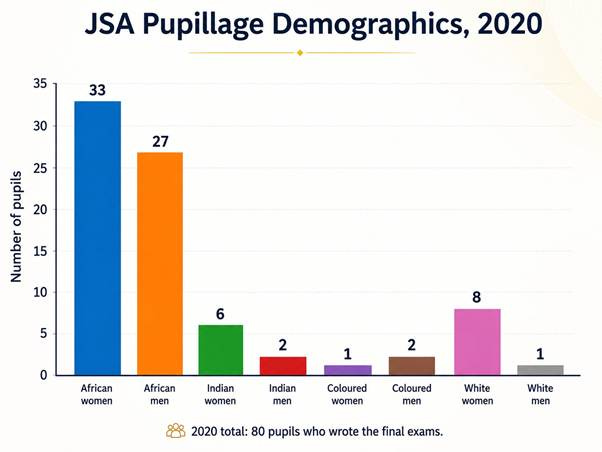
The JSA’s own published statistics make this clear. In an April 2021 article in Advocate, the JSA described pupillage as “integral to the transformation of the Bar” and said that the racial and gender composition of each year’s pupillage group has a “profound and lasting effect” on the legal landscape. In 2020, 80 pupils wrote the final exams. Of those, only one was a white man. Eight were white women. The remaining 71 pupils were classified as African, Indian or Coloured.
The pattern was not isolated. Between 2016 and 2021, the average pupillage intake was 79 and the cohort was classified as 27 African women, 24 African men, 5 Indian women, 3 Indian men, 1 coloured woman, 2 coloured men, 11 white women, and 6 white men.
The JSA says this should not be attributed to an exclusionary quota or cap. It says that white male applications have declined and that misinformation may play a role in that decline. But if the profession’s own representative body says selection is used to fast-track transformation because there are proportionately more white male applicants, white male applicants do not need misinformation to draw the obvious conclusion that they are less welcome than others.
The JSA relies on the fact that white men remain dominant among senior counsel. It says that 148 of its 238 silks are white men, approximately 62.2%. But that is a different question. Senior counsel status reflects the composition of the profession as it existed over decades. It tells us little about whether entry-level admission policies today are fair, lawful or consistent with non-racialism.
A lagging indicator cannot justify present discrimination at the point of entry. If the concern is that black junior advocates are not receiving briefs, are not being mentored, or are being excluded from commercial work, then those issues should be addressed. It does not follow that the Bar may ration entry opportunities by race.
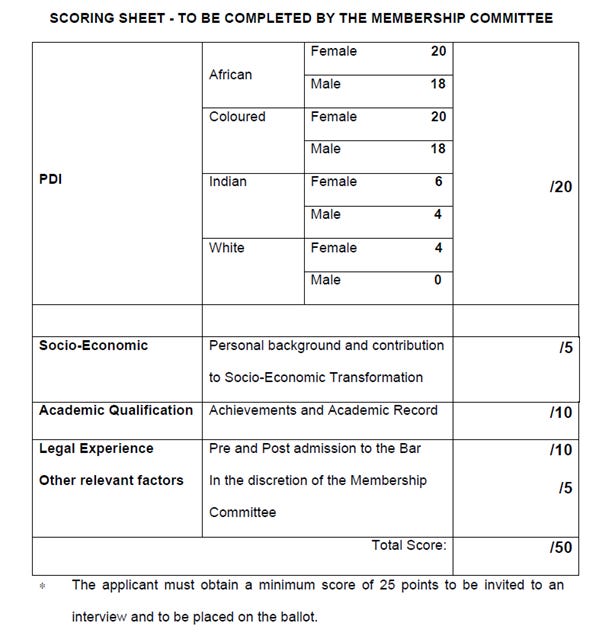
Race classification and membership selection is also entertained by Groups at the Bar. In 2017 the Bridge Group of Advocates considered adopting an overtly racial preference system for admitting new members. Those deemed White or Indian would be heavily discriminated against under this system.
South Africa’s Constitution was drafted against the background of a repugnant racial classification system and established non-racialism as a founding value. South Africa has no legitimate machinery for deciding who “really” belongs to which racial category. Under apartheid, the state used grotesque tests to classify people. A constitutional democracy should not recreate that mindset by making access to professional opportunity turn on racial boxes.
If the Bar wants to rectify past discrimination it should focus on individuals. Was an applicant denied opportunity by the wrongs of the past? Did they attend a failing school? Was the family poor? Those questions can be asked without pretending that every person with the same skin colour has the same life story.
The danger of race-based professional policy is that it often assists the already advantaged. A person applying for pupillage is not among the most marginalised people in South Africa. They have a law degree and are seeking entry into an elite profession. The people most in need of transformation are poor South Africans who cannot afford lawyers at all.
During Apartheid, those classified by the State as Black were marginalised from the legal practice. However, a profession committed to the rule of law cannot defend racial selection by invoking past racial exclusion. The lesson of apartheid is not that racial classification must be used by better people for better ends. The lesson is that we must not attach burdens and benefits to racial identity.
There is an easy way for the JSA to resolve the dispute about its conduct. It should publish the admission policies, scoring matrices, and demographic data for applicants and admitted pupils. It should disclose how race is determined, how points are allocated, and how those points affect outcomes. If race is not decisive, the documents will show that. If race is decisive, the public should know.
The Bar should select pupils on merit, aptitude, and integrity. It should support junior advocates who lack resources. It should mentor and train its members. But it should not use race as a blunt instrument to decide who gets through the gate.
The JSA says it values diversity and does not intend to leave any race or gender behind. That is a worthy sentiment. But it is not enough. In a constitutional democracy founded on non-racialism, the legal profession should be able to say something simpler and stronger: no applicant will be discriminated against because of their race.
Mark Oppenheimer has been a practicing advocate at the Johannesburg Bar for 16 years.

Great article. If I may, I can add further context (at least from my own perspective) to the wording “professional policy is that it often assists the already advantaged.”, namely ”...and as such, replicates its own DNA – by design- of a highly racial-bias-weight factor deeply within functions, which were appropriately economically engineered with weights accumulated during a long history of a successful vocational spectrum of a tertiary/college qualification and experience.
The consequences of '‘racial weight’' in LAW requirements – even if only marginal, or at least, perceived as marginal – can be dangerous when owners or shareholders of such functions are equally IGNORANT to the highly deceived trajectories of imbalanced weights. It is a known reality amongst Large Language Modellers, how important ‘'assigned weights’' (and how critical ''judgemental WEIGHT RE-ADJUSTMENTS'') are in the digital-binary-linguistic world. These ‘weights’ have a tremendous compound magnetic force ‘’for-the-next-token’ on a type of Zion-voyage within ‘’The Matrix-World-of-Captured-Reason’’. The ‘’oppressive gatekeeper programs known as Agents and machine-controlled drones called Sentinels, ultimately battling the ego-driven machine architecture’’, is a highly effective force to consider in the vast neuron-network of paths who extracts from ‘'captured minds'’ data and energy to formulate highly impressive arguments to justify reasons for hi-jacked minds locked within its sphere of powerful influence and control. But we all know by now, that NEO was born for a reason. That is, the ‘human’ NEO character, and not the ‘machine NEO’ acting as having super human like capabilities in the provinces and states of of Data Centres.
For many years I had wondered, whether one’s sown extreme naivety of BEE and B-BBEE and tremendous lack of experience in the Tax world and even greater impairment in the realm of logic arguments in the world of TAX LAW, were the only drivers that I was neither able to grasp, nor really ‘skilled’ to see; the latter one never denies as a former accountant at a Multinational firm in South Africa, but nonetheless.
But the real problem Mark in South Africa, is not the LAW as such or even BEE – though they are highly problematic in quite a few instances - but those who are abusing it for personal gain, and in myriad ways. As ArcelorMittal did overseas. And its local counter part. The '‘racial weight factor'’ killed the Steel Business in this country, and you will be shocked the '‘names'’ associated with it and the vast array of weaponry, it (i.e. skewed LAW interpretation and skewed LAWS) used over many years to accomplish ''The Matrix mind capture mission". You even may ask PM Benjamin Netanyahu, who knows (all of what I am writing here) the actual drivers behind minds highly inconsistent with narratives of the past to destroy innocent lives, and do it with much delight, ignoring to delve into the narrative of the ancient past, and I say this with no political agenda towards Israel or Palestine or USA or SA or Europe or Russia or Africa. Or with having an obscure or an evil intent, whether to a Jewish or non-Jewish audience. I speak from the intent of LAW only... and its outcome.
The greater question is, what Judge or Advocate or Lawyer is really willing to take-on the big Goliath amongst us? Is there such one in South Africa? Not even Rob Hersov (great respect for him) will be able to take them on, I can guarantee you that. The biggest problem amongst many existing problems, is not the Political Leaders or the Racial laws, but the problem of those ‘'appearing‘' like opponents of Social-Marxist notions, but the bulging purses overseas, speaks a different narrative. And that is a tragedy.
No-one should buy the Mittal shareholding in ArcelorMittal South Africa, or else, they will buy a 50cent coin and pay R100 for it, unless a transfer of wealth flows back into South Africa from those very extractor. And the Europe-wealth-distribution? Even past JSE Chairs boast about own ''transparencies'', but that is far from the truth...
There are many wealth-extractors in this country and overseas, and ironically, many of their ‘'beneficiaries'’ occupy powerful political and business seats locally and abroad, and often in CEO and CFO capacities and within JSE-regulated Board Rooms.
I have learned this terrible thing, Mark, that RACE should never be a factor in any vocation, and agree with you 100%. The JOHANNESBURG BAR, should set the example for all others BARS, and be a proper example to this country, that SKILLS are the real and only underlying factor to abide within the function of a Public Officer (PO), and not RACE. That is, the PO of a firm w.r.t. SARS. Or any other Public Officer in any domain for that matter.
ELON MUSK did not become successful from spheres validated by race-laws, but from him having raw high-ended skills.
READ the letter-of-concerns to Mittal Steel, Mark, but with a very wide aperture lens , and I will answer all questions to you personally, and no one else.
If a TAX-STRATEGY or any TAX/ACCOUNTING concern cannot be logically explained to an African Chief in the middle of Africa, then – if I can use Afrikaans – ‘’moet jy lont ruik.” In other words, it may lead to a dynamite-effect destroying empowerment and growth, and be far from the ambit of a true farmer, who have only the following in mind: good soil. seeds. animals. rain. growth. produce. harvest. etc.
If an African Chief, or an analogy I often use for myself in my own cognitive world, a little Bedouin Boy lost in the desert of highly cognitive distorted world, cannot understand and agree with the principles of a TAX OPINION or TAX STRATEGY, then something deeply hides itself within the vast hidden layers of intent in the argument ....and that is....GREED. Utter, Raw Greed. That is why South Africa is where it is now, and Phala-Phala and Nkandla are but two cherries only of a much larger corrupted Marie-Antoinette-cake, if I can use this example from France’s history.
I really respect the LAW. But not the ones ‘raping’ the LAW. David – and ancient biblical king – also had a great respect, and a reverence for the LAW.
That is a problem. Our leaders have no reverence for the LAW, but has become a Law-fugitive themselves: state capture, corruption, lies, steal, jealousy, unforgiveness, impartiality, will full lack-of-understanding, tremendous ignorance, etc.
Start and end with January 2010 to March 2010. Involve the JSE. And all their lawyers. We have a far greater ENRON on hand as what you may perceive.
And inform the NYSE.
And I am not lying. We need legal minds to change the trajectory of South Africa, and I think you can help.
👏🏻👏🏻👏🏻