


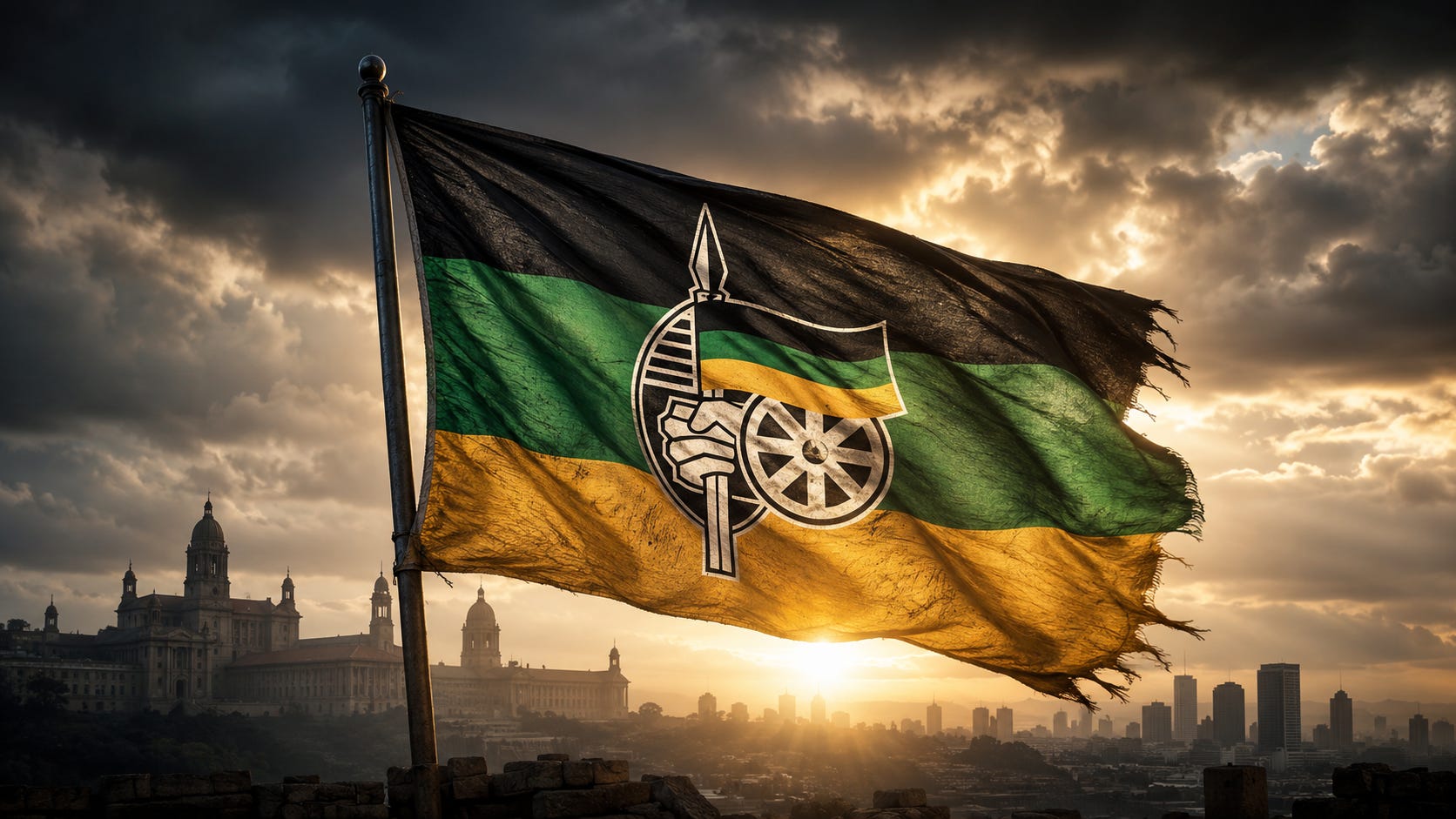
In general, I have lost interest in politics. I tend to see politicians as followers rather than leaders. Lasting change will come from a bottom-up effort. Politicians in a democracy go where people are. But some developments in the ANC and GNU deserve comment.
The first is the historic break-up of the tripartite alliance. The SACP has now taken serious steps to leave the alliance after years of hinting it would. They will be contesting the coming elections independently, and they are now openly campaigning for President Ramaphosa’s impeachment. Following the latest Phala Phala Constitutional Court judgment, we will come back to this.
At the same time, labour unions are in a weak position, but the labour lobby is stronger than it has ever been. While there are some attempts to reform labour law, such as introducing a three-month trial period where unfair dismissal claims would not be possible, there are also new restrictions being introduced, like doubling statutory severance pay. The labour unions in the alliance are strongly resisting the attempts at reform.
So the SACP leaving the alliance doesn’t mean socialist thinking will magically leave the ANC. But it is still an opportunity for the ANC to go back to its more liberal, African nationalist roots. Those who care about the ANC should take some time to reflect on the evolution of the organisation over the past 114 years, what the original mission was, how and why it changed, and how it needs to adapt to modern South African reality.
The alliance with the communists, socialists and labour movement was necessary in order to provide internal resistance to apartheid, as labour unions were key to the fall of apartheid, as well as secure funding and arms for the ANC and its armed wing. The USSR and CCP would not have funded the ANC without the SACP’s support. Following the fall of the Berlin Wall and the transition to the current constitutional order, the rationale for putting the alliance with leftist forces ahead of the ANC’s historic mission of restoring the property rights of the Bantu peoples of South Africa was no longer present.
African nationalism is not well suited to party politics either. What experience has proven is that such movements work best at the private level. The closest parallel to African nationalism is Afrikaner nationalism. It worked best when it was a grassroots community movement and became oppressive when it seized state power. We do not need African supremacist thinking. Mandela understood this well when he pointed to black domination as being an evil to be fought as much as white domination was.
The ANC would do well to find its way to being a “parliament of the Bantu people”, as it sometimes claims to be, and separate itself from party politics. This would give a platform for all Bantu people, from liberals to socialists, nationalists, libertarians, conservatives, etc., to debate a way forward and, more importantly, to form institutions that address problems we face in our communities.
Of course, these people would have to fund the ANC themselves, so they would have to see value in this. And a political party, or even numerous political parties, could be just one of the possible outcomes of this platform. Today, Solidarity and AfriForum represent between 300,000 and 500,000 members, according to online sources. Yet the party which is the closest thing to a political representation of Afrikaner nationalism, the FF+, gets less than half of this maximum number of votes.
Yet I would argue Solidarity and AfriForum are far more effective representatives of Afrikaner interests than the FF+ is. And yes, I know they work together. That is the point. It is through the lobbying efforts of AfriForum and Solidarity that the plight of South African farmers came to the attention of the highest levels of government in Washington. I may not like the obviously false framing of white genocide that Trump uses, but it’s hard to deny the effectiveness of these organisations.
Relying on state power as the primary means of organising themselves and pursuing their interests objectively led to a decline in the ability to pursue these interests. This is why South Africa became isolated under apartheid and the government was eventually forced into negotiating with its enemies. This objective loss was a blessing in disguise for the ability of Afrikaners to organise through institutions, whether these are community institutions or businesses.
The loss of the ANC’s majority in the 2024 election must bring about a similar reflection and pivot among the Bantu peoples who still desire cooperation among Bantu and the pursuit of our mutual interests. What exactly are these interests, one may ask? Let’s start with poverty. After more than 30 years of state dominance, the Bantu peoples of South Africa are still the poorest and least productive, as a collective, among all groups.
We urgently need to uplift ourselves through wealth-building institutions. This cannot be led from above. Those who believe BEE, affirmative action and grants can ever do anything for us will wait forever. We need to do it ourselves. History has proven that any people can uplift themselves if they really want it.
We can complain about business funding, or realise the enormous potential stokvels have if used in the right way. We can complain about the lack of jobs, or realise that we don’t have to enforce labour laws on the government’s behalf. And we can complain about education, or realise that nothing is stopping us reforming our own schools, like my former school, Phendukani Full Service High School, did. It is now regularly beating former Model C and private schools in KZN on every metric. The models exist; it is up to us if we want to apply them.
The second most important issue is crime. We need to form community watch organisations. Indeed, this is already happening. This could be a much-needed outlet for youths who see no hope because they can’t get jobs. Training can be provided, and we must also lobby for gun rights. It is not just Afrikaners who have an interest in being able to own firearms legally, as any taxi owner, or any property owner really, will tell you.
I would say the third most important issue is language. Bantu languages are going extinct, and it worries me how little this worries everyone else. Parents see no problem educating their children solely in Afrikaans and English. They even express pride that their child does not know IsiZulu, IsiXhosa, etc. They do not fight for their languages in the media and, more importantly, as members of school governing bodies when language policies are set.
This has real consequences. I initially sent my daughter to an English-only crèche, the best one in Newcastle, part of a school that goes up to Grade 12, now owned by the Curro group. She is a brilliant young girl, but she could not communicate this at school and was always miserable. Not to mention that she had to wake up very early to take the scholar transport to the school.
After a few weeks of this, schools were closed for COVID, and I saw the laughable attempts at online teaching as an opportunity to take her out of the school. I paid the fees for the rest of the year, which was painful, and sent her to a much cheaper crèche, technically an ECD centre, located in the township with a good reputation. When the time came for her to move to Grade 1, public schools wanted to force her to repeat Grade R, so I started looking for a private school where the teachers would be able to communicate in IsiZulu with her.
By God’s blessing, I found one. Essentially the only black-owned private school in Newcastle, it was owned by African immigrants. She has thrived there and is currently in Grade 4. This is despite the fact that some naysayers told me not to send her to that school because it was run by “amakwerekwere”. They didn’t seem to mind the schools run by white people and only offering English and Afrikaans.
When you lose your language, you lose access to your history and your people’s accumulated genius. This is particularly important because the Bantu did not develop writing, so our history is in oral form. Imagine losing the ability to understand izithakazelo, imperfectly translated as clan praise songs, or the songs your grandmother used to sing. That would be equivalent to losing your identity.
As we speak, we do not have nearly enough books in the Bantu languages. I was lucky that my grandmother was a voracious reader of Zulu novels, so that was my first exposure to reading. I was shocked to discover, after reading them all and getting a library card, that the books I had read at home were most of the Zulu books available at the library too, and that a public library in a township in KwaZulu-Natal had more Afrikaans books than Zulu books.
And lastly, when it comes to ANC politics, the political culture of the ANC needs to change if it is to represent the interests of most Bantu people again. Reflexively defending their leaders will not do. Whipping their members to oppose the Section 89 panel report on Phala Phala was unacceptable, just as whipping their members to oppose the impeachment of Jacob Zuma was unacceptable. The only votes that should be whipped are things that are in the manifesto. At the same time, we as voters need to care more about the manifestos of the different parties than the personalities of those parties.
Our institutions are largely modelled on British ones, so if we want these institutions to work optimally, we should take it upon ourselves to learn from the political culture of the British. When following a British election campaign, you will be struck by how seriously they take the manifesto, even going so far as to cost the manifesto and campaign on this. It’s not just a list of promises. Voters want to know if it’s actually possible within the constraints of the budget. In the Commons, within a party caucus, especially in the governing party and the official opposition, there is a clear distinction between the backbench, ordinary MPs, and the frontbench, those who are in government or, for the official opposition, those who are in the shadow cabinet. There is no expectation that backbenchers will vote for everything the government wants, only what is in the manifesto.
As Bantu people, we have to abandon the desire for special treatment from the state. That is a recipe for decline for any people. The Constitution, taken at face value, provides a good starting point for all peoples of South Africa, including the various Bantu peoples. But we have to be honest with ourselves and abandon regressive policies like BEE and the attempts to weaken property rights.
The political organisation of all Bantu people as a group started through the opposition to attempts to take away our property rights, including our right to buy land, so land reform does not only depend on government power. We need to rediscover the energy towards institution-building that existed before 1994 and that died when we fell for the lie that the state was now on our side.
Mpiyakhe Dhlamini is a libertarian, writer, programmer and an Associate of the Free Market Foundation.
