


Written By: Thabo Khumalo
South Africa’s 2026 local government elections have delivered another significant blow to the African National Congress (ANC). After decades of political dominance, the former liberation movement is facing an electorate increasingly willing to abandon it, even in areas once considered its political heartlands.
Yet, while the ANC’s decline may be the biggest headline of this election, the more important question is whether this political realignment will produce functional municipalities or merely another five years of political squabbling, unstable coalitions and deteriorating public services.
For classical liberals, the results present both an opportunity and a warning. Political competition is essential to democratic accountability, but replacing one set of politicians with another does not automatically create good government.
The ANC’s decline is unmistakable
With 81.5% of voting districts reporting as of the afternoon of 6 November, the provisional election results place the ANC at approximately 31.8% of the national municipal vote, down from 45.6% in 2021. That represents an extraordinary decline of nearly 14 percentage points in just five years.
The Democratic Alliance (DA), meanwhile, is sitting at approximately 24.1%, compared with 21.7% in 2021. The Economic Freedom Fighters (EFF) have declined from 10.3% to approximately 6.2%, while ActionSA has grown from 2.3% to 4.9%. However, ActionSA’s growth must be understood in the context of its expanded electoral presence, having contested only six municipalities in 2021. The uMkhonto weSizwe Party (MK Party), contesting its first local government elections, has attracted approximately 9.3% of the national vote.
These are provisional figures, but the scale of the ANC’s losses is already apparent, particularly following its loss of an outright parliamentary majority in the 2024 national elections.
South Africa is becoming a more politically competitive democracy, with no single party enjoying the dominance that characterised much of the post-1994 period. However, this does not necessarily mean that the country is becoming more liberal.
While the DA has increased its share of the vote, the ANC’s decline has coincided with growing support for parties with vastly different ideological positions.
The emergence of the MK Party is especially significant. Its strength in KwaZulu-Natal demonstrates that opposition to the ANC does not necessarily translate into support for constitutional liberalism, free markets or limited government. The MK Party has explicitly advocated replacing constitutional supremacy with parliamentary supremacy, expropriating land without compensation and nationalising strategic industries.
Indeed, some former ANC supporters may be finding alternatives within movements that share elements of its ideological tradition or offer their own forms of populist politics.
The South African Communist Party (SACP), contesting independently, has also attracted approximately 2.5% of the provisional national vote, while the EFF’s declining support indicates that the broader left-wing political landscape is undergoing its own realignment.
South Africa is experiencing a fragmentation of political loyalties rather than a unified ideological shift. Voters may agree that their municipalities are failing while disagreeing fundamentally about why they are failing and how to fix them.
The battle for the metros
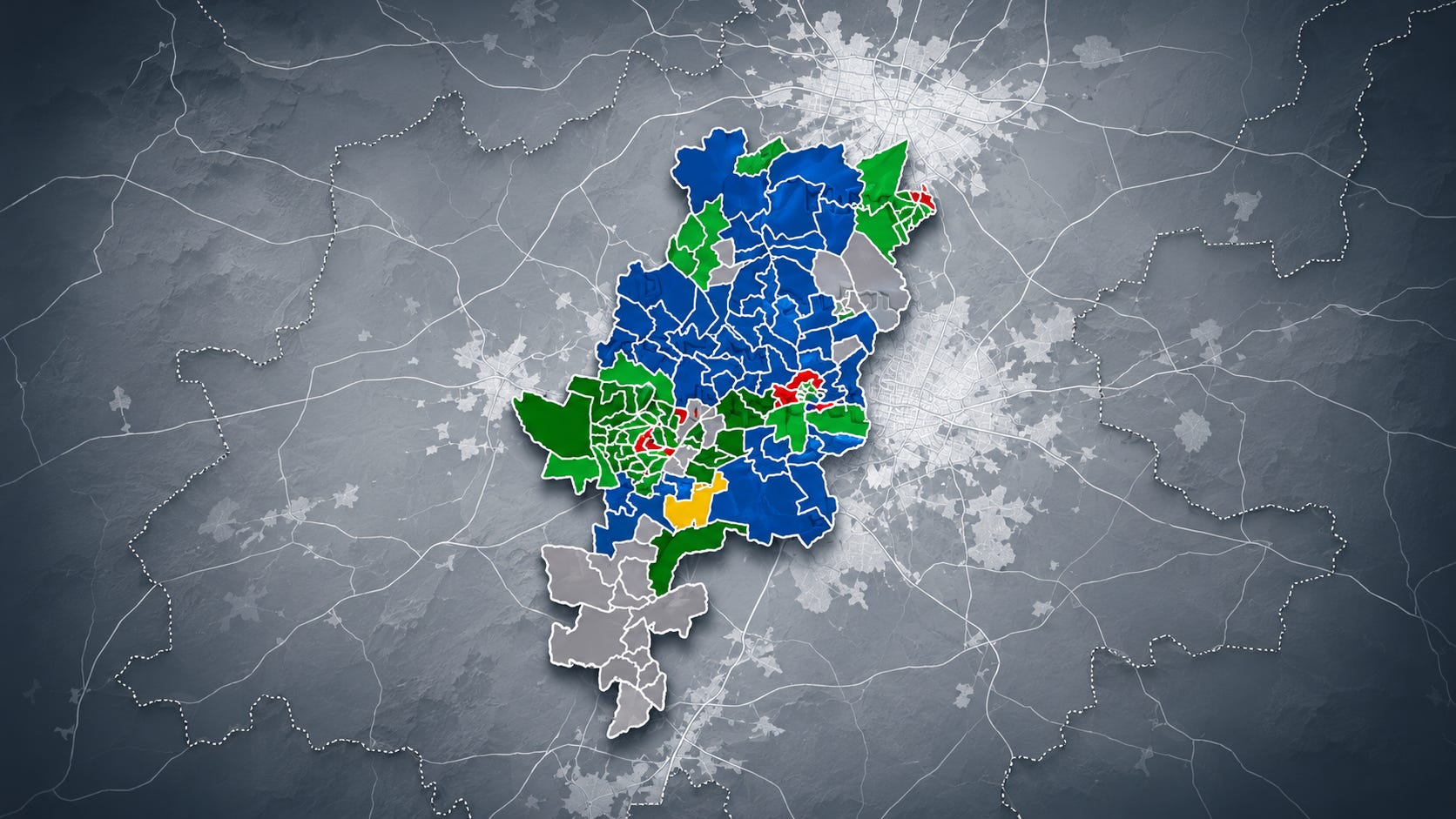
Some of the most consequential electoral developments are occurring in South Africa’s metropolitan municipalities, where local government decisions have enormous implications for employment, investment and economic activity.
In Johannesburg, the DA has established a substantial provisional lead, approaching 40% of the vote compared with its 26.1% in 2021. Yet even such an increase would not necessarily deliver an outright majority, leaving the city’s future administration dependent on coalition negotiations.
Tshwane presents another interesting case, with ActionSA attracting approximately 23% of the provisional vote compared with 8.6% in 2021. The party’s increased support raises questions about the importance of local leadership, municipal performance and the political visibility of its mayor, Nasiphi Moya.
In eThekwini, the MK Party’s emergence has fundamentally altered the political landscape, challenging the ANC’s traditional dominance in the municipality.
Cape Town presents a different picture. The DA, which won 58.2% in 2021, has attracted more than 60% of the provisional vote, suggesting that it will retain its outright majority in the city.
These contrasting results demonstrate why it would be misleading to treat the election as a uniform national political movement. Different municipalities have experienced different political histories, governing arrangements and electoral pressures.
They also highlight the importance of political stability and clear accountability.
Where a party governs alone, responsibility for municipal decisions is relatively straightforward to identify. In coalition municipalities, responsibility is divided among several political organisations, each potentially able to blame its partners when things go wrong.
That does not mean coalition government is inherently undesirable. However, it does mean that the quality of coalition agreements and the willingness of political parties to cooperate become essential considerations.
The coalition problem
The 2021 local government elections produced 70 hung councils out of 213 metropolitan and local municipalities. The years that followed demonstrated how difficult it can be to establish durable administrations when parties cannot agree on their basic governing priorities.
In several municipalities, political disputes have contributed to changes in executive leadership, uncertainty over governing arrangements and difficulties maintaining consistent policies.
The 2026 results suggest that coalition government will remain an unavoidable feature of South African local politics. The challenge is therefore not to wish away coalitions, but to establish more transparent and accountable ways of managing them.
South Africa’s proposed Local Government: Municipal Structures Amendment Bill, which remains before Parliament, attempts to address aspects of this problem by introducing a legislative framework for coalition agreements and municipal executive appointments.
However, legislation alone cannot create the political willingness necessary to govern effectively. Even detailed coalition agreements are of limited value if parties treat municipal government primarily as an opportunity to distribute positions rather than fulfil public responsibilities.
From a classical liberal perspective, coalition agreements should establish clear responsibilities, credible budgets, constitutional limits and transparent mechanisms for holding office-bearers accountable.
Residents should know which parties are responsible for particular decisions, which policies have been agreed upon and what consequences follow when commitments are not fulfilled.
Political compromise is unavoidable in a multiparty democracy, but accountability should not disappear in the process.
Municipal government is failing its most basic responsibilities
While political parties celebrate electoral gains and negotiate over mayoral positions, the underlying condition of South Africa’s municipalities remains deeply concerning.
According to the Auditor-General’s 2024/25 municipal audit report, only 39 of South Africa’s 257 municipalities achieved clean audits. Not a single one of the country’s eight metropolitan municipalities managed to obtain a clean audit during the reporting period.
These findings reflect institutional weaknesses that will not disappear merely because voters change the composition of municipal councils. Poor financial controls, inadequate infrastructure maintenance and unreliable service delivery require reforms that extend beyond party politics.
For residents, the consequences are immediate. When water infrastructure deteriorates, electricity becomes unreliable, roads are neglected or administrative processes become unnecessarily complicated, households and businesses bear the costs.
These failures also undermine economic development. Entrepreneurs cannot operate efficiently when municipal services are unreliable, while investors have little incentive to commit capital to areas where infrastructure and regulatory conditions are unpredictable.
Instead of creating the conditions for economic prosperity, too many municipalities have become obstacles to it.
This is where classical liberal principles offer an alternative to the prevailing approach to local governance.
The Constitution already establishes local government as a distinct sphere with responsibilities that directly affect residents. That autonomy should be accompanied by clear accountability, sound financial management and respect for the limits of municipal authority.
Municipalities should prioritise essential infrastructure, establish credible budgets and ensure that public money is spent transparently. They should also examine whether unnecessary regulations, complicated licensing requirements and restrictive planning rules are creating avoidable barriers to investment and entrepreneurship.
Where appropriate, competitive procurement and private-sector participation can improve service provision, provided these arrangements involve effective oversight, enforceable contracts and genuine competition.
Financial responsibility is equally important. Municipal budgets should not be treated as limitless instruments for distributing political favours, particularly when infrastructure is deteriorating and existing obligations cannot be met.
These principles should apply regardless of which political party controls a municipality. A government that respects property rights, maintains basic infrastructure, applies the law consistently and manages public resources responsibly creates the conditions for individuals and businesses to prosper.
The objective should not simply be smaller municipal administrations, but administrations that operate within their constitutional responsibilities and perform those functions effectively.
The real test comes after the election
South Africa’s 2026 local government elections have demonstrated that political dominance is not permanent. Parties that once appeared electorally secure can lose substantial support, while new competitors can emerge and established opposition parties can expand their reach.
But electoral competition is only meaningful if it translates into accountability.
The coming coalition negotiations, municipal budgets and administrative decisions will have more direct consequences for residents than the celebrations taking place at election results centres.
The ANC’s decline is a major development in South African politics, but it does not resolve the country’s municipal governance crisis. Nor does the growth of opposition parties guarantee that the resulting administrations will be more effective, transparent or fiscally responsible.
If South Africa is to emerge from this election with better local government, municipalities must become institutions that serve their residents, respect their rights and create the conditions for economic prosperity rather than becoming instruments of political patronage.
The electorate has demonstrated its willingness to change who governs. The real test now is whether those entrusted with power will change how they govern.
Thabo Khumalo is a concerned South African citizen and writer, focusing on analysing politics from a rational perspective.