


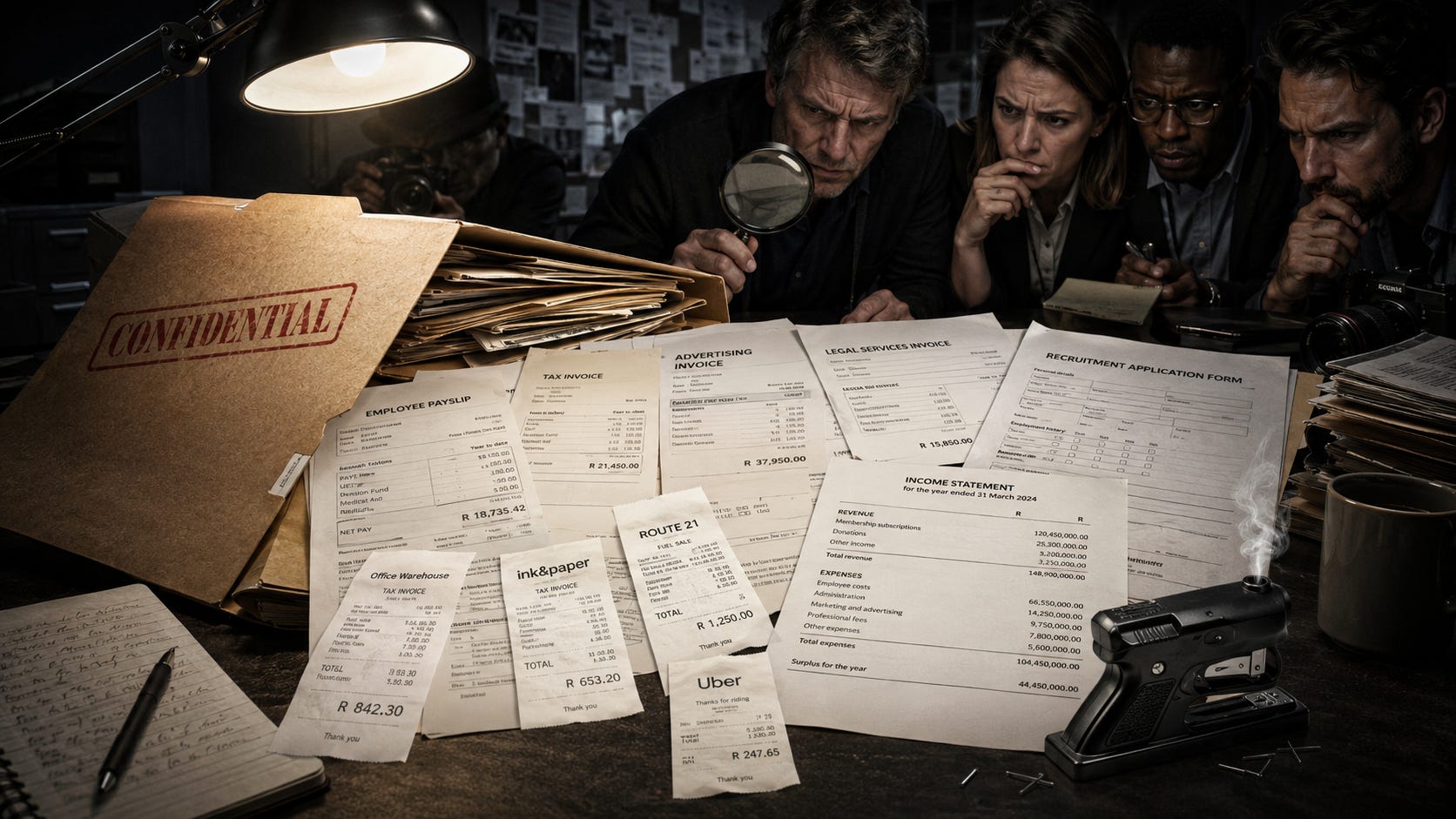
News24 has finally done it. After an extensive investigation into AfriForum’s finances, its bombshell revelation is that organisations with hundreds of employees spend money on salaries.
Groundbreaking stuff.
Readers are breathlessly informed that almost 60% of AfriForum’s expenditure went towards salaries, marketing, advertising and recruitment, while only a portion was classified by News24 as “actual projects.”
Apparently, the lawyers arguing court cases, the staff coordinating neighbourhood watches, the researchers drafting policy submissions, the campaign managers organising public participation, the administrators keeping a national organisation running and everyone else required to deliver those “actual projects” somehow don’t count.
The article also seems astonished that a voluntary membership organisation spends money recruiting members. Imagine that. An organisation funded almost entirely by voluntary contributions advertises itself to attract new supporters. Would News24 criticise a charity for fundraising? A political party for campaigning? A media company for advertising subscriptions?
The underlying assumption appears to be that salaries and recruitment are somehow separate from the mission. They aren’t. They are how the mission is carried out. Organisations don’t litigate, campaign, conduct research or coordinate volunteers by magic. They employ people to do it.
What’s most remarkable is how little scandal there actually is. There is no allegation of fraud, corruption or theft. That doesn’t mean AfriForum’s spending should be beyond scrutiny. Any organisation handling hundreds of millions of rand should expect legitimate questions about efficiency, priorities and whether it delivers value for money.
But that isn’t the analysis News24 provides. Does AfriForum’s litigation succeed? Do its neighbourhood watches make communities safer? Are its campaigns effective? Does it deliver value for the money it receives? Those would all be legitimate questions.
Instead, ordinary operating expenses are presented as though they are inherently suspicious. Rather than asking whether those costs are justified by the organisation’s results, readers are encouraged to see routine organisational expenditure as evidence of misconduct.
The closest the article comes to evaluating value for money is highlighting executive salaries of between R2 million and R3 million a year.
But compared to what?
Running a national organisation with more than 300,000 members, 182 full-time employees, an annual revenue of hundreds of millions of rand, multiple legal divisions, community projects and international advocacy operations carries significant responsibility. If those salaries are excessive, prove it. Compare them with executives at organisations of similar size and complexity. Compare them with NGOs, trade unions, media companies or other advocacy organisations. Instead, readers are simply presented with large salary figures and invited to conclude that they must be outrageous.
The same principle applies elsewhere. News24’s parent company, Naspers, disclosed a remuneration package of more than R1 billion for its CEO, Fabricio Bloisi, in 2025. Few would argue that the size of that package alone proves wrongdoing. Context matters. Executive remuneration should be judged against responsibility, performance and organisational scale, not simply because it is a large number.
The same standard should apply to everyone. Accountability should not be a one-way street.
This is a framing exercise rather than an exposé. Nor does it exist in isolation. It follows a string of highly critical reporting on AfriForum. There is nothing wrong with scrutiny. But when repeated investigations keep uncovering ordinary business practices dressed up as scandal, readers are entitled to ask whether the reporting is driven by evidence, or by a predetermined narrative.
Perhaps the most telling aspect of the article is its reliance on loaded language such as “splurges” and “money machine” to create the impression of wrongdoing. Strip away the rhetoric and what remains is remarkably ordinary: an organisation funded by voluntary donations employs people, recruits supporters and pays salaries.
That is the “investigation”.
Investigative journalism serves an essential role in a free society. It exposes corruption, uncovers abuse of power, follows money trails and reveals facts that those in authority would rather keep hidden. South Africa needs more of that journalism, not less.
Which is precisely why articles like this are so disappointing.
Good investigative journalism changes what we know. It asks difficult questions, tests assumptions and follows the evidence wherever it leads. Had this investigation shown that AfriForum was misusing funds, or consistently failing to achieve the outcomes it promised its members, that would have been a story. Instead, it presents ordinary operating expenses as though they are evidence in themselves.
Readers are promised a smoking gun and handed an income statement.
Perhaps News24’s next investigation should examine how much of its own budget is spent on salaries rather than “actual journalism”.
Leigh-Ann Hallak is a Rational Standard contributor, a critic of mainstream media, censorship, and a proponent of free speech and liberty.
Yes, News24’s dirty underpants clearly showed in that reporting of no real value; once again published in an attempt to discredit a citizens’ movement they seem to deeply resent. Since I stay far away from Media24, I must wonder if they dished up the same useless reporting in the Afrikaans stream, Nuus24? They are usually very careful to do double reporting: one line of attack in the English version, and careful avoidance of repeating the same version in the Afrikaans channel. If they did deviate from their old two-faced approach this time, I am sure it has already — or will soon — explode in their faces. MANY Afrikaans Media24/Nuus24 paid subscription readers happen to also be AfriForum supporters. If I were them, I would have realised by now that subscriptions to Media24/Nuus24 could rather be very fruitfully and productively channelled to where they as readers are REALLY respected and not simply seen as milking cows to be misled by means of changing Media24 messaging and tone aimed at placating them, but at the same time belittling them via their Afrikaans channel. Sies!
Media24’s lates IDAC scandal, irresponsibly revealing Safe Houses that compromised individuals safety, shows how arrogant they are.