


Written By Piet du Plessis
We in South Africa stand on the threshold of a greater watershed moment than during the 1994 transition. The possibility of massive instability is, in my view, therefore a reality that must be seriously contemplated.
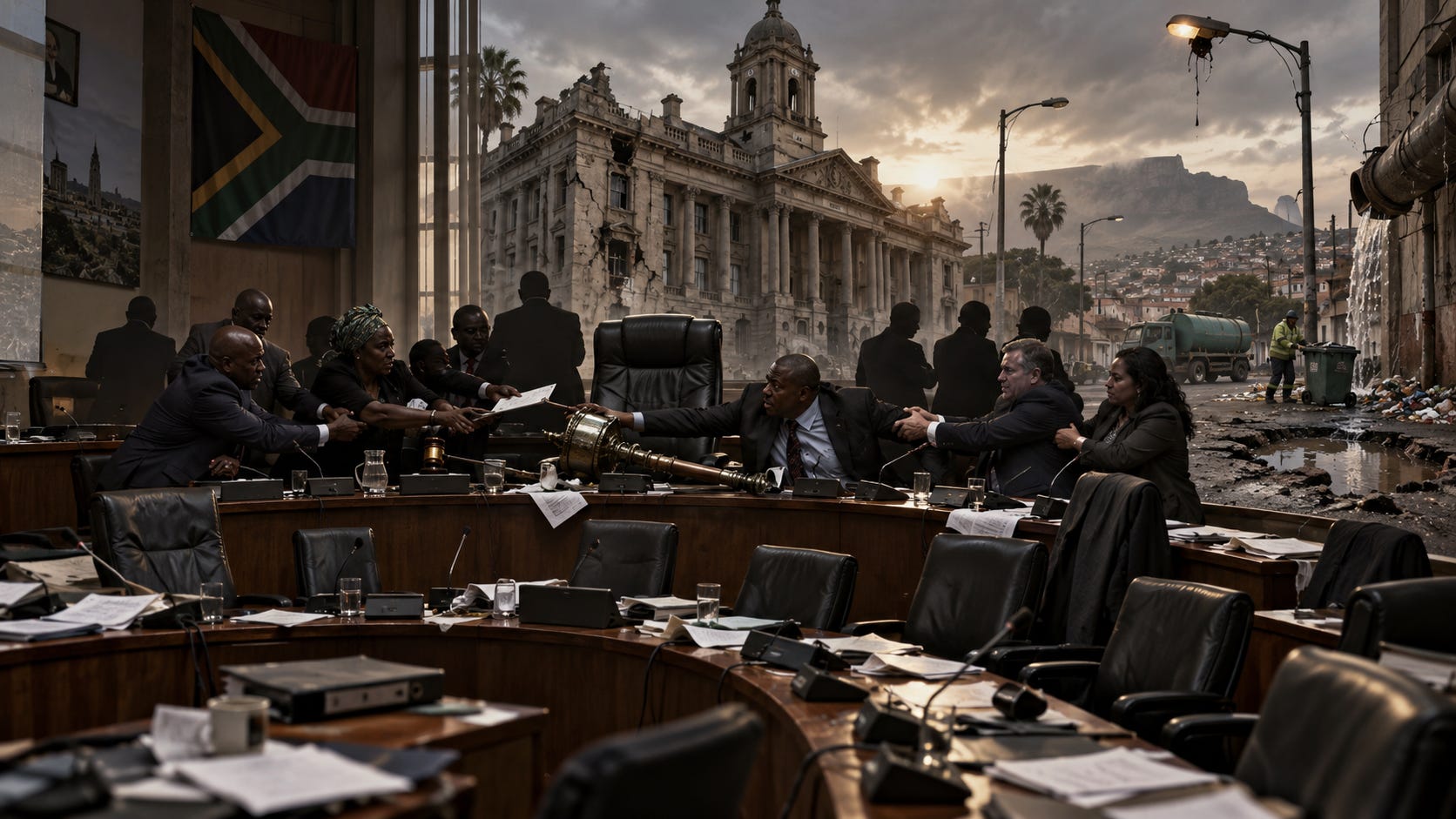
The reason is that the outcome of the municipal elections of November 2026 will cause seismic shifts with serious practical consequences. Hundreds, perhaps into the thousands, of councillors will lose their positions and their only sources of income.
Remember, councillors’ packages usually include a basic salary component, plus structured elements such as cellphone costs, travel and accommodation or motor vehicle allowances, housing allowances, municipal contributions to pension or provident funds, often up to approximately 15% of the basic salary, and medical aid.
This means that ordinary part-time councillors typically receive total packages in the low to mid-hundreds of thousands of rand per year, with higher packages in metros, while full-time executive positions in larger municipalities easily exceed R1 million, plus the mentioned allowances and insurance cover.
But even worse, many hundreds of councillors will also lose their access to patronage, such as, for example, obtaining or sharing in inflated tenders through front companies, with the inflated and unearned incomes that flow from them.
Opinion polls and predictions also indicate that approximately 50% of our municipal councils will have no absolute majority, resulting in “hung councils”.
Readers can listen to this podcast discussion to hear one of our leading analysts’ views on the matter first-hand, and then try to digest it.
The possible consequences range from severe unrest to total chaos.
Remember, these are possible outcomes in municipalities that are almost all already dysfunctional. This is then the extremely uncomfortable and unacceptable starting point for councils trying to reverse the massive backlogs and disintegration of their municipalities.
To make everything worse, the said scenario unfolds within larger provincial and national environments where state failure is the rule rather than the exception.
The laws that allow provincial and national intervention in collapsing municipalities are, in that case, not worth the paper of the statute books on which they are written.
In any event, the history of municipal administration over the past few decades in South Africa shows that such interventions have generally made little difference. Mostly, only the deckchairs on the Titanic’s deck were rearranged, and the further decline simply continued once the intervention ended.
The reason is that the symptoms of the problem were addressed and not the problem itself.
Old ANC cadres who failed were simply replaced by new ANC cadres who later also failed because meritocracy was not the consideration in their appointments or nominations, and because no end was put to cadre deployment and political interference in municipal administration.
Here follows how I sometimes try to explain my fear in a simplified way by attempting to simulate the persona of an ANC municipal councillor:
“I am an ANC cadre. I do not have any academic qualifications or any noteworthy work experience. I have, however, succeeded in having myself nominated because of my membership of the ANC to make myself available for election as a municipal councillor.
“I was successful, in the past almost guaranteed, that I would be elected because the ANC enjoyed the greatest support among the electorate in my municipality. My term as municipal councillor brings me into contact, indeed forces me into contact, with municipal financial affairs, among other things.
“Eish, I was lucky! My municipal manager obtained a knowledgeable consultant on financial oversight and what is expected of councillors in that regard to inform us as new councillors about it.
“What follows here is an exposition of our duties regarding financial oversight at municipal level, as shared in writing by the consultant after the information session with us as the newly elected council.”
Briefing Session for Councillors on Financial Oversight Responsibilities
“Honourable councillors, the main elements of municipal finances in South Africa under the oversight responsibility of the municipal council are primarily regulated by the Municipal Finance Management Act (MFMA, Act 56 of 2003), the Municipal Systems Act (MSA), the Constitution and related legislation.
“It centres on policy determination, approval of key plans and budgets, and ongoing monitoring and accountability, while officials, especially the municipal manager as accounting officer and the chief financial officer, handle day-to-day implementation.
“Councillors, collectively as the council and often via committees, must understand and exercise oversight over the following core elements.”
1. Strategic Planning and Alignment
The Integrated Development Plan (IDP) is the municipality’s primary strategic plan for development and service delivery.
The council must ensure that the annual budget and Medium-Term Revenue and Expenditure Framework (MTREF) are fully aligned with the IDP and its priorities.
Oversight includes:
Reviewing community input.
Realistically prioritising needs.
Approving revisions to the IDP and related plans.
2. The Municipal Budget
The council must approve a realistic, funded annual budget by 30 June, covering the budget year and the following two years through the MTREF.
The budget must distinguish between capital and operating components, set out expected revenue by source, and allocate expenditure by vote.
Budgets may only be funded from realistically anticipated revenue, cash-backed surpluses and, for capital expenditure, borrowed funds under strict conditions.
Adjustment budgets may be approved when necessary for unforeseen or unavoidable expenditure or other material changes.
The council is also responsible for related resolutions concerning:
Property rates.
Tariffs and taxes.
Measurable performance objectives for revenue.
Performance objectives for each vote.
Councillors must consider affordability, sustainability, alignment with community needs and IDP priorities, the future operating costs of capital projects, and the avoidance of unfunded mandates or overspending.
3. Revenue Management
Municipal own-source revenue includes:
Property rates.
Electricity charges.
Water charges.
Sanitation charges.
Refuse charges.
Levies.
Other fees and taxes authorised by legislation.
Municipalities also receive transfers and grants, including the equitable share from national government and conditional grants from national and provincial government.
Policies falling under council oversight or approval include:
Tariff policies.
Rates policies.
Indigent policies.
Credit-control policies.
Debt-collection policies.
Collection performance, billing accuracy and strategies to improve collection rates and reduce outstanding debt are critical to financial sustainability.
4. Expenditure Management
Operating expenditure includes staff costs, councillor and official remuneration, bulk purchases, repairs and maintenance, finance costs and depreciation.
Capital expenditure includes infrastructure and the acquisition or renewal of assets, with long-term financial implications.
Councillors must ensure that:
Expenditure remains within approved budget votes.
Unauthorised expenditure is prevented.
Irregular expenditure is prevented.
Fruitless and wasteful expenditure is prevented.
Salary and benefit costs for political office-bearers and senior managers are properly overseen.
Spending represents value for money.
5. Asset and Liability Management
Council oversight extends to the acquisition, protection, maintenance and disposal of municipal assets.
Council approval is required for the disposal of significant assets.
Cash, investments and municipal bank accounts are subject to strict MFMA rules.
Councillors must also oversee liabilities and debt, including:
Short-term debt, which is limited and generally must be repaid within the year.
Long-term loans, which require council approval and affordability assessments.
Security over debt and guarantees.
Risk management.
Insurance.
Contingency planning.
6. The Service Delivery and Budget Implementation Plan
The Service Delivery and Budget Implementation Plan (SDBIP) translates the budget and IDP into quarterly targets, performance indicators and service-delivery plans.
The council oversees its approval through the mayor and monitors implementation against those targets.
7. Financial Reporting, Audit and Performance Oversight
Councillors must monitor:
Monthly Section 71 reports.
Quarterly Section 52 reports.
Mid-year Section 72 reports.
Annual financial statements.
Annual reports.
Auditor-General reports.
The council must adopt an oversight report on the municipality’s annual report, either approving it with or without reservations, rejecting it or referring it back.
Oversight also includes monitoring municipal entities, where applicable, and ensuring compliance with audit findings and corrective action.
Internal audit functions and audit committees provide further advice on controls, risk and governance.
8. Supply Chain Management
The council oversees the municipality’s supply chain management policy, which must provide for procurement that is fair, equitable, transparent, competitive and cost-effective.
Councillors must also oversee contracts with multi-year financial implications and work to prevent irregular expenditure arising from procurement.
9. Budget-Related Policies and the Oversight Framework
The council approves or oversees key policies relating to:
Tariffs.
Rates.
Credit control.
Cash management and investments.
Asset management.
Long-term borrowing.
Indigent support.
Free basic services.
Delegations of powers.
Codes of conduct.
Ethical requirements for councillors and officials.
10. Financial Sustainability, Problems and Interventions
Councillors have a responsibility to identify financial problems early through reports and financial indicators.
They must ensure that the municipality can meet its financial obligations and avoid a financial crisis.
They must also oversee financial recovery plans and understand the circumstances under which provincial or national intervention may be triggered under the MFMA and the Constitution.
The Key Principles for Councillors
“Honourable councillors, as consultant I wish to conclude by once again reminding the honourable council of the key principles for councillors that run like a golden thread through legislation at all spheres of government.”
Separation of roles: The council determines policy, approves budgets and plans, and exercises oversight. The executive, including the mayor and mayoral committee, provides political direction and monitors the administration. Officials implement. Councillors may not interfere in operational financial management.
Accountability: The council is ultimately accountable to the community. Regular use must be made of reports, public participation and committee structures. A Municipal Public Accounts Committee is essential.
Sound oversight: Transparency, realistic budgeting, sustainable revenue collection, controlled expenditure and the preservation of assets support long-term service delivery.
“These elements are set out in detail in the National Treasury’s A Guide to Municipal Financial Management for Councillors and the MFMA itself.
“Councillors must familiarise themselves with the latest MFMA circulars, the municipality’s specific policies, and ongoing training from SALGA or provincial treasuries, as practical application and financial health indicators evolve.
“I thank the honourable members for the opportunity afforded me to familiarise them with their legal obligations with which they will have to comply for the next five years.”
At this point, I end this article as its writer.
To add anything else, or to try to explain it further, would be to underestimate the intelligence of Rational Standard readers.
Piet du Plessis is a retiree with a long history of applied socio-economic development. A liberated Afrikaner who has moved beyond self-flagellation, he believes that he has been freed to live out his cultural pride and values and to proclaim them openly when appropriate.
