


The recently published Our World in Data chart showing nine African countries that more than doubled real average incomes since 1990 should give every South African pause. Mauritius, Egypt, Cape Verde, Ghana, Rwanda, Ethiopia, Uganda, Burkina Faso and Mozambique achieved this under the same global conditions South Africa faced.
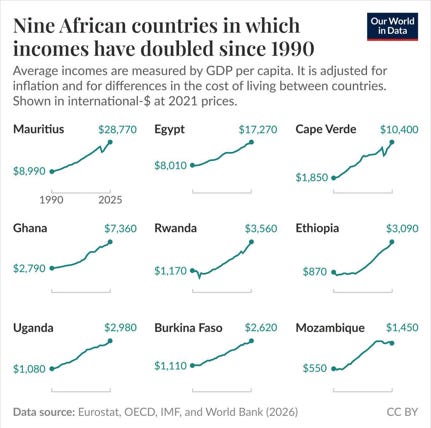
South Africa did not achieve this. Our real GDP per capita rose by roughly 35–40 percent over the same period. We began richer than most of them, and have been overtaken or matched by several in relative dynamism.
The difference is not destiny; it is institutions. Specifically, it is the degree to which people are free to own, trade, innovate and keep the fruits of their labour. The Fraser Institute’s Economic Freedom of the World index measures exactly that: size of government, legal system and property rights, sound money, freedom to trade internationally, and regulation.
In the latest ranking South Africa sits 8th in Africa and 83rd globally. That is respectable on the continent, yet it masks the areas where we systematically underperform the countries that grew fastest.
Start with the good. South Africa still scores relatively better than many peers on the legal system and property rights component. Our courts remain independent enough to check some executive excesses, and formal property title, however imperfectly enforced, is more widespread than in several of the lower-ranked growers. Sound money has also held up better than in high-inflation environments elsewhere.
These are not trivial advantages. They help explain why absolute living standards in South Africa remain higher than in Ethiopia, Mozambique or Burkina Faso even after those countries’ rapid catch-up. A functioning banking system, a sophisticated private sector in certain niches, and residual respect for contracts are genuine assets.
Yet these strengths have been steadily eroded by the areas where we lag. The size of government is our most persistent drag. South Africa ranks poorly here because the state consumes a large and growing share of economic output through high taxes, expansive welfare commitments and inefficient state-owned enterprises.
When government claims a large portion of the social product, less remains for private investment and experimentation. The countries that doubled incomes generally kept the state’s claim more limited or, in cases such as Rwanda and Uganda, improved their scores on this measure over time. We have moved in the opposite direction.
Regulation tells a similar story. Labour markets remain rigid, with hiring and firing practices ranked among the most restrictive globally. Business licensing, local content rules, and sector-specific interventions raise the cost of formal employment and entrepreneurship. By contrast, Cape Verde and Mauritius have maintained relatively lighter regulatory burdens that allow small firms to form, grow and fail without excessive bureaucratic friction. Rwanda’s deliberate improvements in the ease of doing business correlated with its strong growth trajectory. South Africa’s regulatory density has the opposite effect: it protects insiders while locking outsiders out of formal opportunity.
Freedom to trade internationally is another relative weakness. Although we are more open than some closed economies, protectionist impulses, unpredictable tariff changes and industrial policy that privileges politically connected firms undermine the gains from specialisation. On balance, the high-growth African examples have moved toward greater openness. We have often done the reverse under the banner of localisation.
The cumulative result is visible in the data. Economic freedom is not an abstract score; it is the practical ability of ordinary people to better their condition through voluntary exchange. When that freedom expands, investment follows, productivity rises, and average incomes climb. When it stagnates or contracts, growth slows even if commodity prices or global liquidity temporarily mask the problem. South Africa’s post-2010 per-capita stagnation is the predictable outcome of policy choices that enlarged the state’s economic footprint while complicating private coordination.
Critics will note that growth is multi-causal. Conflict, human capital, geography and resource endowments matter. Fair enough. Yet the comparative record within Africa is instructive. Countries with different starting points, colonial histories and resource profiles still show a consistent pattern: those that improved economic freedom tended to grow faster.
Mauritius has long topped African rankings and remains the continent’s income leader among the group. Cape Verde’s institutional progress accompanied its rise. Uganda’s large long-term gains in the index coincided with sustained per-capita improvement. South Africa’s failure to match these gains is not an accident of history; it is a consequence of political economy.
Acknowledging our relative strengths does not require complacency. An independent judiciary and residual property rights are necessary but insufficient when the tax and regulatory burden remains high and when state capacity is directed toward redistribution rather than the protection of productive activity.
The path out of stagnation is not more industrial policy or larger fiscal transfers. It is the deliberate expansion of the economic freedom that the successful peers, imperfect as they are, managed to secure.
South Africans are not uniquely incapable of growth. We are uniquely burdened by a policy consensus that treats economic freedom as a secondary concern rather than the foundation of broad-based prosperity. The nine countries that doubled incomes did not wait for perfect conditions. They improved the rules under which ordinary people make economic decisions.
Until we do the same, the chart will continue to record our march to serfdom.
Zakhele Mthembu, BA Law LLB (Wits), is Policy Officer at the Free Market Foundation.