


Written By: Robert Khumalo
The right to protest in support of Palestinians is not in dispute. South Africans are free to condemn the Israeli government, advocate for Palestinian statehood, demand a ceasefire, or argue that Israel’s conduct in Gaza is unjust. These positions may be controversial, but they are plainly part of legitimate democratic debate.
What is not legitimate is threatening South Africans because they support Zionism, glorifying armed extremist organisations, or calling for political opponents to be confronted “bullet to bullet”.
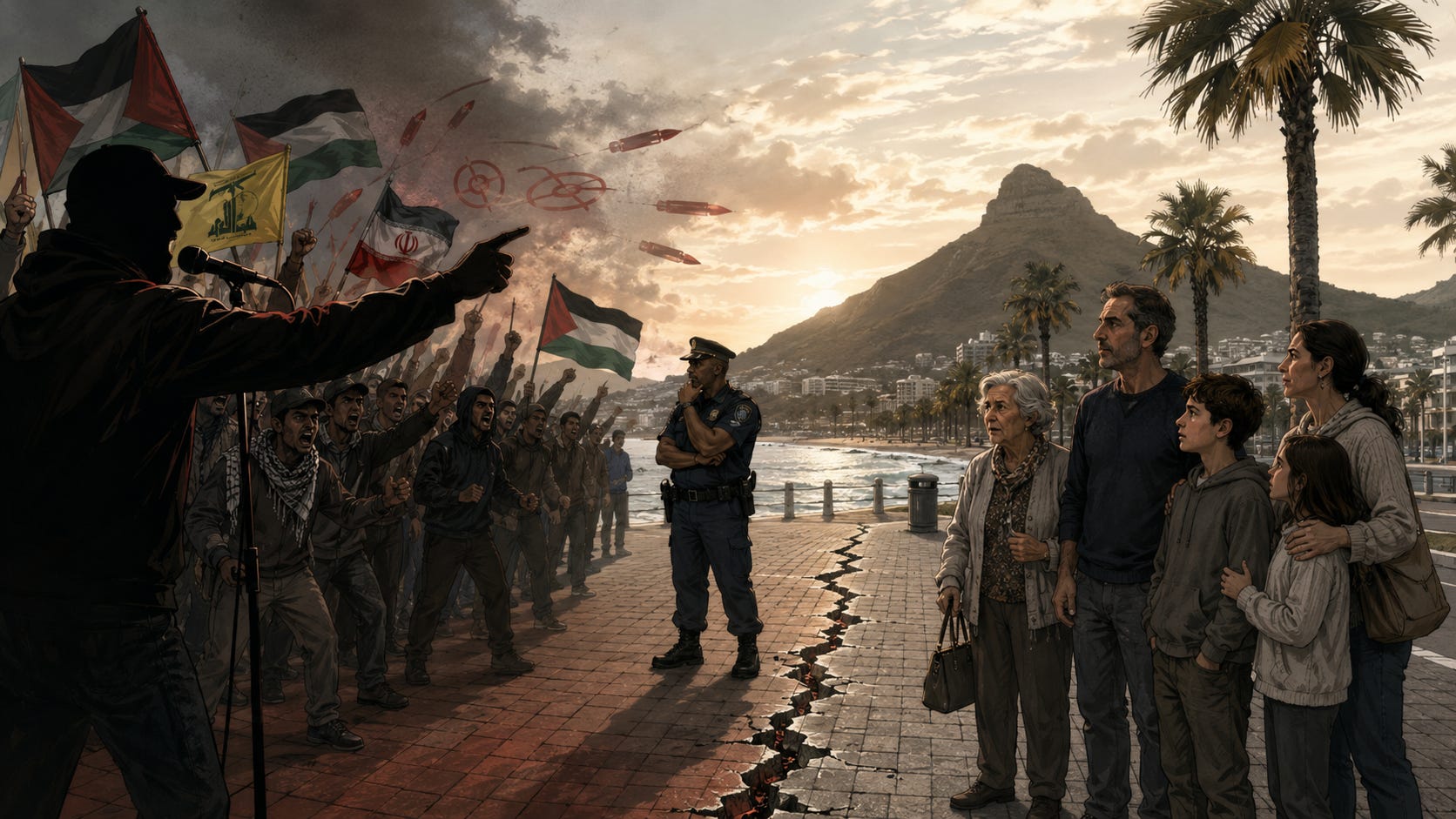
According to a statement issued by the South African Zionist Federation Cape Council, a demonstration held in Sea Point on 2 August crossed precisely that line. Hezbollah and Iranian regime flags were reportedly displayed, members of PAGAD were present, and speakers praised organisations engaged in armed violence while issuing threats against Zionists, their supporters, businesses and political parties.
The most alarming remarks were attributed to Haroon Orrie of PAGAD, a vigilante group responsible for the 1998 Planet Hollywood terrorist bombing. Orrie allegedly told “every Zionist”, as well as businesses, politicians and ordinary people who support Zionism, to “find yourself a rock to hide under”. He reportedly warned that the “party of Allah”, an apparent reference to Hezbollah, would be unleashed on the shores of Africa.
He then allegedly instructed the crowd to fight Zionists “wherever we find them”, “face to face” and “bullet to bullet”.
These are not abstract criticisms of Israeli policy. They are not expressions of solidarity with Palestinian civilians. They are not even merely inflammatory political rhetoric. They appear to be threats directed at people living in South Africa because of their political beliefs, communal identity or association with Zionism.
Another speaker, Uzair Mohammed, reportedly praised the “martyrs” of Hamas, Palestinian Islamic Jihad, Hezbollah, the Islamic Revolutionary Guard Corps, Ansarullah and Hashd al-Shaabi. He allegedly called for Israel to be eradicated, annihilated and destroyed, before the crowd chanted “Death to Israel”.
South Africans should not need to agree on the Israel-Palestine conflict to recognise how dangerous this language is.
The presence of PAGAD makes the matter especially serious. PAGAD is not an organisation that exists only in the realm of provocative slogans and angry social media posts. It has a well-documented historical association with political violence and vigilantism in the Western Cape. When figures connected to such a movement appear at a protest where militant organisations are celebrated and political opponents are told to hide, South Africans are entitled to be concerned.
Yet there is a persistent reluctance in sections of the media, civil society and political establishment to scrutinise extremism within the pro-Palestinian movement.
Much of the movement is treated as though it is morally beyond criticism. Its language is often interpreted as metaphorical, its excesses are dismissed as understandable anger, and its associations with extremist groups are downplayed as an unfortunate distraction from the Palestinian cause.
The same generosity is rarely extended to other political movements.
A right-wing protest displaying the symbols of a violent foreign organisation and calling for opponents to be confronted with bullets would rightly provoke national outrage. Politicians would demand investigations. Journalists would examine the networks, funders and ideological influences behind the event. Civil society organisations would warn of radicalisation and political violence.
The same standard must apply here.
Supporting Palestinian rights does not require defending Hamas. Opposing Israeli military action does not require celebrating Hezbollah. Believing that Palestinians have suffered injustice does not grant anyone permission to threaten Jewish South Africans, Zionists or people who merely refuse to endorse the destruction of Israel.
Too often, the term “Zionist” is used as a rhetorical loophole. Activists insist that they are attacking an ideology rather than Jews, even when their threats are directed at identifiable Jewish organisations, Jewish institutions, Jewish businesses or ordinary Jews who believe Israel has a right to exist.
This distinction cannot simply be accepted at face value.
Zionism, in its broadest and most common meaning, is the belief that Jews have a right to national self-determination in their historic homeland. One may dispute how that principle has been implemented, criticise Israeli governments or support the creation of a Palestinian state without treating Zionists as legitimate targets for intimidation.
When activists threaten “every Zionist” and “every human being who supports Zionism”, the practical effect is to threaten a substantial portion of the Jewish community. South African Jews cannot be expected to regard such language as harmless political theatre, particularly when it is accompanied by the symbols of armed organisations and rhetoric about bullets.
This is occurring in a climate in which many Jewish South Africans already feel increasingly isolated. They have watched political leaders speak warmly about movements committed to Israel’s destruction, seen Jewish institutions subjected to hostility and witnessed public discourse in which their concerns are frequently dismissed as propaganda.
The result is not merely a disagreement over foreign policy. It is an atmosphere in which Jewish South Africans may reasonably fear that hostility towards Israel is being redirected towards them.
That does not mean every pro-Palestinian activist is antisemitic, violent or supportive of terrorism. Many South Africans advocating for Palestinians are motivated by genuine concern for civilian suffering and sincerely oppose antisemitism. They should be among the first to condemn the conduct reported in Sea Point.
A movement demonstrates its moral credibility not only by the injustices it condemns, but also by the behaviour it refuses to tolerate within its own ranks.
Those who claim to stand for human rights cannot remain silent when speakers glorify organisations that target civilians. Those who oppose collective punishment cannot endorse threats against every person who holds a particular political belief. Those who demand that Palestinians not be equated with Hamas must equally reject the idea that every Zionist is a combatant or legitimate target.
South Africa’s authorities should investigate the Sea Point demonstration and determine whether any laws were broken. That assessment must be made carefully and according to the evidence. Political speech should not be criminalised merely because it is offensive, radical or deeply unpopular.
But the law is not the only standard that matters.
Political parties, journalists, religious leaders and civil society organisations should condemn the use of terrorist imagery and violent threats without qualification. They should also begin examining the pro-Palestine lobby with the same scepticism applied to other influential political movements.
Who is organising these demonstrations? Which organisations are being praised? What ideological commitments are being normalised? Where does legitimate advocacy end and support for violent extremism begin? Why are threats against Zionists so often treated as less serious than threats against other political or religious communities?
These questions are not an attack on Palestinians. They are a necessary defence of democratic politics.
South Africa cannot allow concern for Palestinian suffering to become a shield behind which extremists intimidate Jews and other political opponents. Nor can it permit the language of human rights to be used to sanitise organisations that openly embrace violence.
The country’s Jewish community is entitled to the same security, dignity and political freedom as everyone else. Jewish South Africans should not have to hide their beliefs, conceal their support for Israel or wonder whether a protest in their neighbourhood might become a threat against their families.
The most important line in this debate is not between supporters of Israel and supporters of Palestine. It is between those who accept democratic disagreement and those who believe political opponents should be threatened, hunted or confronted with bullets.
South Africa must decide which side of that line it is prepared to defend.
Robert Khumalo is a political commentator and concerned citizen.
And South Africans must stop excusing extremism in the settler and zionist movements. This cuts both ways.
Excellent. So important to say this loudly and clearly.