


Written By: Richard Tate
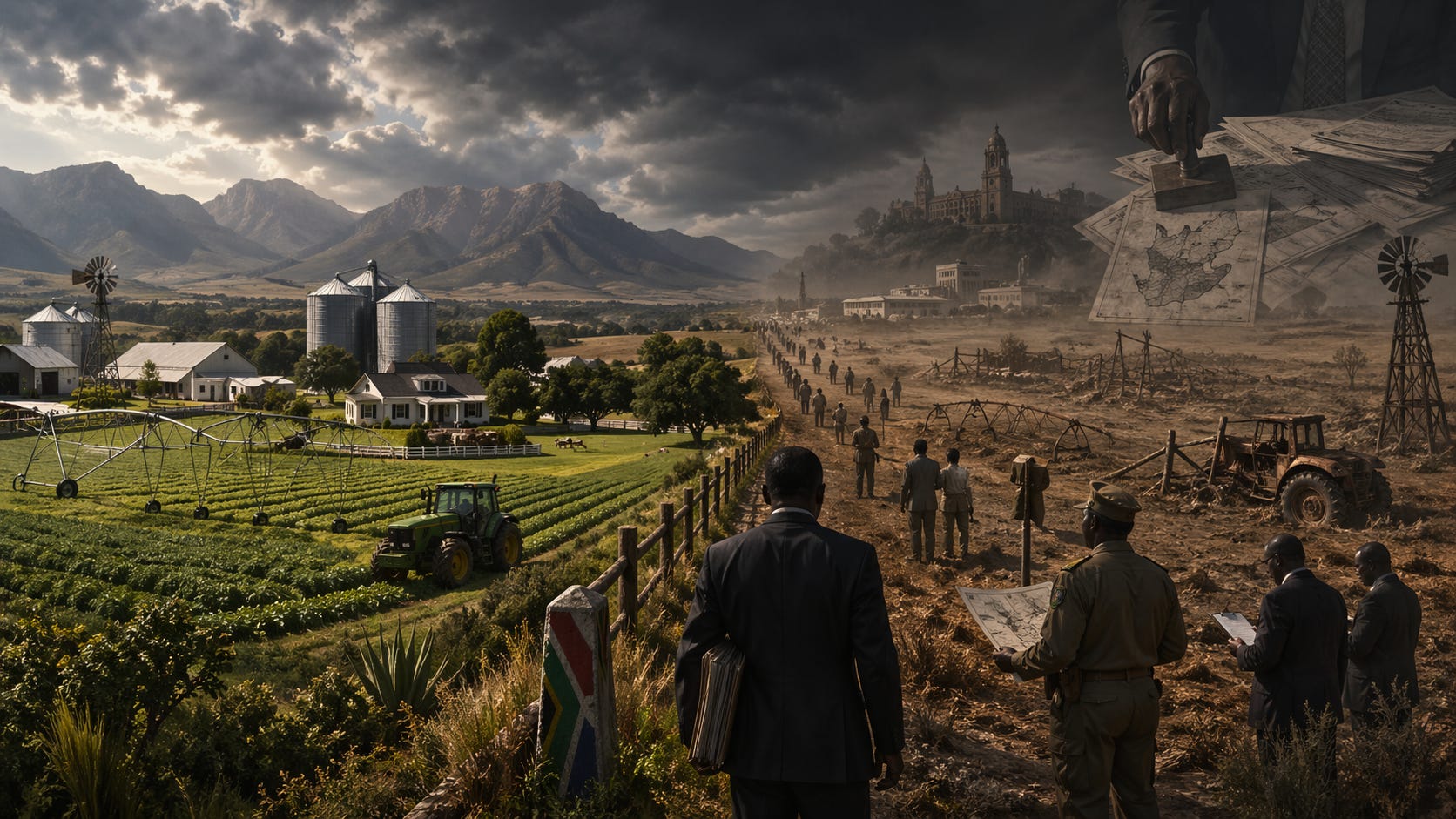
Every South African has their own set of woes, ranging from corruption and crime to power cuts and potholes. As an ex-Zimbabwean farmer whose farms were confiscated by the Mugabe government, and now living in Hermanus, my worry is that South African farmers could suffer the same fate. If the proposed property expropriation laws are not executed with extreme caution, the positive developments now appearing on the country’s economic front could sink back under the horizon.
Nearly 200,000 land claims have been lodged since 1995; only 34% have been settled. This seems like a total lack of commitment by the government. But no matter how many experts quote the percentages of land owned by white farmers, the land imbalance remains in dispute. No number of warnings of potential losses in export earnings or food shortages will help, should this issue be mismanaged.
The state may take property for public benefit, but it must be lawful, justified, and fair, and the owner must be compensated. Who decides justified and fair? In the event of expropriation, the most valuable tool for farmers is the valuation of their land as well as every single improvement on it, down to the fencepoles, boreholes, and pumping equipment.
We had professional valuations done in Zimbabwe, which were recognised and applauded by the World Bank.
South African farmers are skilled and able to feed the country. Many are helping their less fortunate neighbours get into production. But that won’t be enough to satisfy the voters under an African National Congress that is now clearly on the backfoot.
To put these storm clouds to rest, a national scheme, supported by all sectors, is crucial.
Firstly, we need new leaders of stature who understand the needs of the populace and can tell government: Look, we will fix your problem over, say, the next 10 years by, for example, identifying a number of keen young farmers every year and getting them properly settled on the land.
Next, we need buy-in from the agricultural unions. They must be part of the solution, even if farmers ask, “Why should we, what’s in it for us?” But if the unions can be positive about outcomes, the government should really be very happy, since the politicians simply don’t have the skills and know-how to make agriculture work.
In Zimbabwe, the tobacco trade finances the farmers (since banks refuse to provide loans without title deeds) from seedlings to point of sale, including capital items.
The unions should be supported by farmers’ co-ops, the big downstream agri industries, and banks.
And, of course, the government ministries need to be involved. All backed by a guaranteed fund of several billion rands aimed at expanding the farmer base.
But without the knowledge and skills of the current farmers, the scheme will fail. Training centres need to be built to draw new farmer-pupils. These pupils will learn the basics of farming, how to service a tractor, understanding the soil and fertiliser needs, weather patterns, horticulture, water & micro jets and stock management. Re-skilled agricultural extension officers should train and monitor the new farmers as they become established. Commercial farmers should be encouraged to employ new graduates with tax incentives.
A successful programme is a must to prevent chaos. Big Business may not quite appreciate the importance of farming, but if they don’t support a national scheme they must expect a rude awakening. Examples of success and failure are just across the border in Zimbabwe, for all to learn from.
Initially stability will have to be ensured by not interfering with the “super farmers” – the big food producers and exporters. Paint them green and leave them to feed us. First world farms are essential, especially in the face of changing international market demands and consumer pressures.
Then work through an accurate, up-to-date land audit to see where the viable spare land lies and how best to settle new farmers. There will be some difficult questions for existing farmers on vacant and unproductive land but that will be the price of a peaceful countryside.
As yet, war is a long way off. In fact, despite the difficulties, South Africa’s lights are coming on again after the downturn that followed the euphoria of the first democratic elections. Let’s not shoot out those lights for short-term political points.
Granted, there are some major differences between Zimbabwe and South Africa.
The economy of the latter is much more diverse and depends far less on agriculture. Also, South Africa’s high-potential soils are limited, with the vast, harsh, bone-dry interior consisting mostly of low-productive, environmentally sensitive semi-arid veld. In contrast, Zimbabwean commercial farmers were able to build 20 000 irrigation dams. And Robert Mugabe was strong on schools. He saw good education as non-negotiable and built 1,800 schools and nine universities.
To return to “land imbalance” regarding ownership percentage as perceived by millions of South Africans: The pattern has been the same throughout Africa since Harold McMillan’s speech, “Winds of change” in Cape Town.
As government views its potential losses at the ballot box, so the risk of the Expropriation Act being implemented increases. This can clearly be seen after the Government of National Unity meeting with the White House. Irrespective of pressure, the Act remains law.
I am anxious that when the tenure of the two DA ministers of agriculture and public works expires at the next general election, the incoming ministers will be prepared to operationalise the Act, resulting in lack of confidence, a falling rand, and uncertainty for the business community, let alone the farmers.
I think that government will be very wary of “food security”. High on the agenda of both farming unions and government should be the transfer of skills to new farmers. Without this agenda the new farmers will be at great risk of failure.
A further concern that I have is the valuation of farms in South Africa. There seems to be three levels. First is municipal valuation for rates and taxes, second the banks valuation on a higher level, and thirdly a professional valuation higher and more realistic for a sale. In Zimbabwe the farms were valued by professional valuers and applauded by the World Bank in the farmers’ quest for compensation.
Farmers with multiple title deeds will also experience pressure, in spite of these title deeds being essential to make farming profitable.
There is a lot of homework required by farming unions in dialogue with government to help them understand the issues required for a successful industry to feed the nation.
Richard Tate, during his tenure as President of the Zimbabwe Tobacco Association, settled 6000 small scale farmers, still farming today. Later, as President of the World Tobacco Association, he represented 35 million small scale farmers. His two farms were acquired by the Zimbabwe government. He is an Associate of the Free Market Foundation.
Well written. This issue worries me a lot. It may be time to involve the international community in resolving this issue, I believe the EU and the UN could help us come up with a good solution that preserves property rights (unfortunately America under Trump wouldn't be able to gain the confidence of all sides, but ideally US leadership could help). But the real issue is government delays that are making this into a crisis.
Agriculture is important, but property rights are even more important. We can buy agricultural land and give it to whomever we need to in order to have peace, but seizing land without payment will undermine the entire economy.