


(First published in Afrikaans on OntLaer on Jan 29, 2026)
We all know about the major development initiatives in South Africa that end tragically in unfinished infrastructure and half-completed, or completely unfinished, buildings. After that, as we also know, comes the exposure of corruption and fraud, theft and incompetence that repeatedly cause such project initiatives to collapse.
The losses amount to billions of rand nationally and are directly linked to South Africa’s increasing debt burden, poor economic growth, unemployment, poverty and social unrest, to name just a few of the negative consequences that have become characteristic of a so-called developmental state that does not develop.
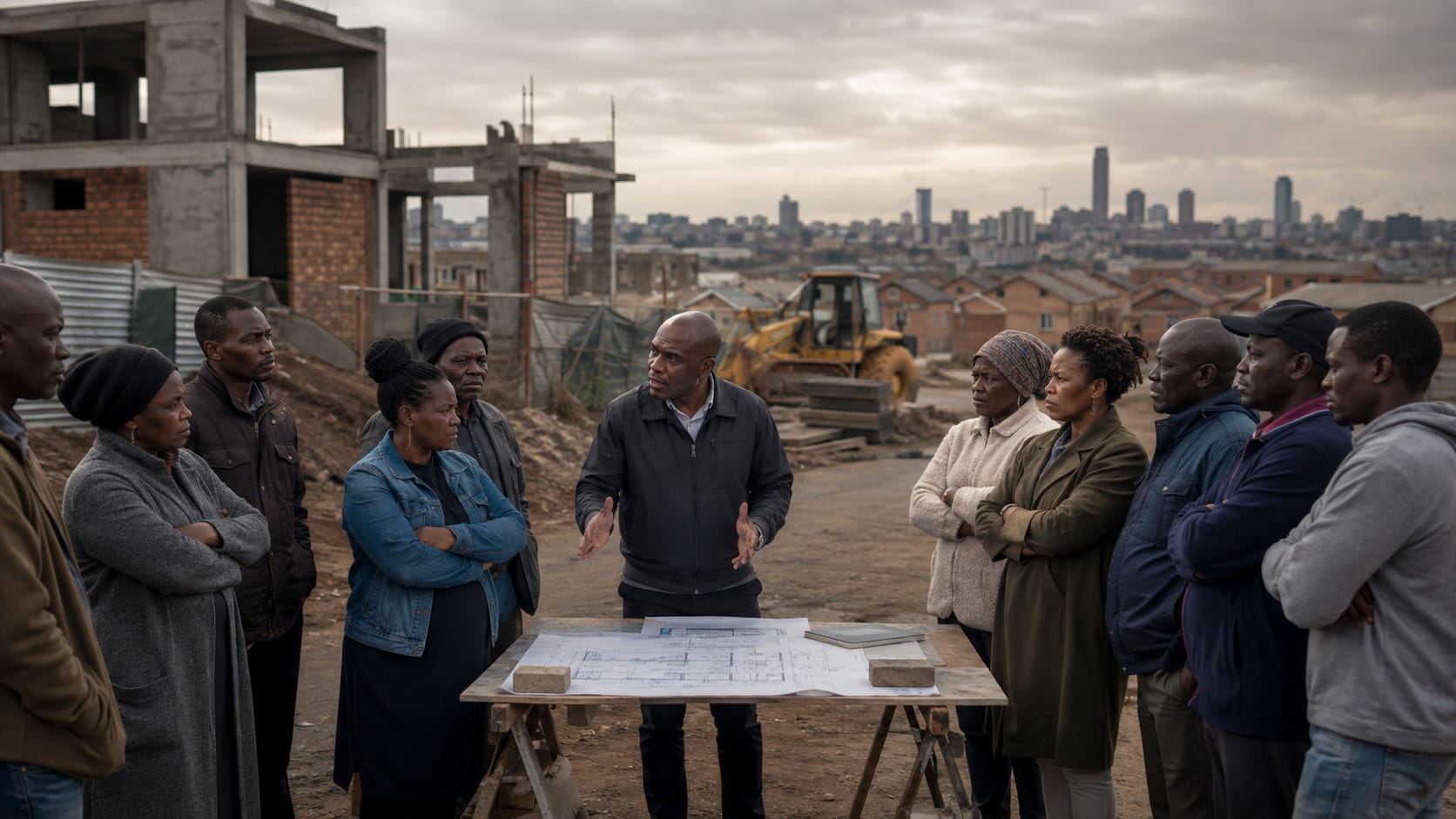
These large development initiatives or projects are, however, merely the visible manifestation of initiatives in the macro-development sphere. At community level, or ground level, sometimes even called grassroots level, there are hundreds of community initiatives that, without national media fanfare, struggle daily in the hope of bringing about development through local projects. In rural areas, for example, there are attempts to develop “traditional” or communal land for agricultural or tourism purposes. In urban areas, there is an enormous variety of initiatives, such as infrastructure maintenance and the construction or improvement of community facilities, among others.
Ironically, such community projects often stumble as a result of serious conflict, sometimes violent, among community members themselves. This significantly delays development initiatives and frequently leads to projects never starting or being completed, with the accompanying waste of money. More serious violent conflict often follows as well, since failed projects drive community members apart rather than promoting cooperation.
Lessons for initiating development initiatives
Since this happens so frequently, it has convinced me that the development methodology being followed is extremely flawed. It is often dominated by political agendas, although this need not necessarily be the case.
This led me to recall a particularly successful “historical” development initiative from not too long ago, in which I myself was able to take a co-leadership role and which, in my opinion, still holds relevant lessons today for development initiatives that begin at ground level and can ultimately lead to success at national level.
In the stormy early 1990s, I had the dubious privilege of being appointed at national level as one of two facilitators tasked with trying to resolve the bitter and deadly conflict between the ANC and the IFP in the hostel context. It was simultaneously challenging and terrifying, although the real fear only began to grip me later in the process.
The hostels in the townships, with their tens of thousands of so-called “migrant workers”, mainly employed in the mining sector, were an ideal breeding ground for contestation between the ANC and the IFP. Both parties competed at ground level for the “hearts and minds” of township residents.
I use the term “migrant workers” with reservation, since many of the hostel residents had long since ceased to be migrant workers in the full sense of the word. They often still had primary families in their areas of origin, especially in the then Natal and Eastern Cape, but over the years had established second families in the townships.
These relationships, on the one hand, served as emotional relief for men who had long had to manage without their spouses, but at the same time created various tensions. Financially, it was extremely difficult to maintain two families, and it also caused conflict with surrounding township residents. The source of companionship for hostel residents was, after all, the surrounding township population. Without doubt, hostel residents were looked down upon, an attitude that continues to this day, and when it further appeared as if they were “taking other people’s wives and daughters away”, it was not conducive to community relations.
Furthermore, hostel residents were often accused of crimes such as rape, assault, theft, burglaries and even murder, especially in areas near the large hostels. As a result of the numerical dominance of Zulus in the hostels, the impression took hold that Zulus, and by implication the IFP, were hostile towards township residents.
Since the ANC had strong ground-level structures in the townships, especially through well-organised street and neighbourhood committees, resistance against hostel residents could be mobilised relatively easily. To remove the political sting from their counter-strategy, action was increasingly taken under the banner of so-called “civic organisations”.
According to the information available to me, a decision was then taken in high IFP circles in Ngoma, Natal, to begin arming Zulu hostel residents. Shortly thereafter, a particular hostel in Soweto began to function virtually as the military headquarters of the IFP in the then Transvaal. This was the beginning of a serious escalation of armed violence and cold-blooded murder campaigns. Boipatong was but one of the many bloody battlefields that later, because of their brutality and scale, would attract major national and international attention.
Attempts at peace
Against this background, and later from within the continuing and escalating conflict, I and the other facilitator to whom I referred earlier had to try to bring about peace.
As an Afrikaner with a development-economist background and without outspoken political loyalties or prejudices, it was a unique opportunity for me to gain access to the ground-level inner circles of both the IFP and the ANC.
Remarkably, there was little resistance to the appointment of two Afrikaners as mediators. Both of us were appointed by major national development agencies that, at the time, were not regarded as extensions of the government. This conferred legitimacy, but was also helped by the fact that the conflict was literally claiming lives and there was little room to be overly particular about mediators.
Without being arrogant, it can also be said that the mediators were well chosen and possessed the necessary attitude, knowledge and approach to bring two extreme poles closer together.
Without going into all the details, the process began with numerous preliminary discussions, mostly between the two mediators and one representative of a contending party. This made it possible to identify points of contact in an environment where participants could speak more freely.
Thereafter, individuals from both sides could be persuaded to sit at the table together with the mediators, after which larger groups followed and, eventually, direct meetings between the two groups became possible.
The tension was high. There were mutual insults and accusations, but fortunately no physical confrontation. This was largely thanks to the fact that more sophisticated and less impulsive ground-level representatives were involved on behalf of both hostel residents and township communities.
At the end of this phase, it was decided to shift the focus to the broader housing question in South Africa. This helped to depoliticise the agenda and place common development needs, specifically housing, at the centre. Politics was thereby partially shifted into the background.
The outcome was the establishment of a Hostels Forum, which eventually developed into the National Housing Forum. To the best of my knowledge, it was the first completely new development policy for South Africa that rested on consensus and was accepted by all extra-parliamentary parties, as well as the government of the day, even before the 1994 transition was finally concluded.
Political ambitions must not hijack development facilitation
In conclusion, I am of the opinion that even in present-day democratic South Africa, where community conflicts daily hamper local development initiatives, professional, non-political development facilitation and conflict resolution can be of inestimable value in turning socio-economic and social development at ground level into success stories.
One of the greatest challenges remains convincing competing community groups, which almost always arise when work and money are at stake, not to allow political ambitions to hijack their development agendas.
This is more difficult today than ever, especially in a context where communities are conditioned to believe that development can only follow from loyalty to a particular political party. Ironically, it is often precisely this political starting point that causes a local initiative to fail, since it immediately activates established interests.
This makes objective decision-making virtually impossible: Who should the beneficiaries be? How should the best developer be appointed at the best price? How should workers be selected? And so forth.
To ensure true equal treatment for all community members, independent facilitators are an absolute requirement. Such facilitators must be able to convince participants that the “rules of the game” will be determined by shared development goals: Who benefits first, who later, and why?
Since not everyone can benefit simultaneously, there must also be a credible prospect for the so-called “losers” to be able to participate in future developments. Development initiatives should therefore not be once-off events, but form part of a transparent and sustainable development policy.
This is exactly how the hostel initiative of the turbulent and bloody early 1990s was transformed into a national housing policy that even enjoyed international recognition.
Piet du Plessis is a retiree with a long history of applied socio-economic development. A liberated Afrikaner who has moved beyond self-flagellation and believes that he has been freed to live out his cultural pride and values, and to proclaim them openly when appropriate.
