


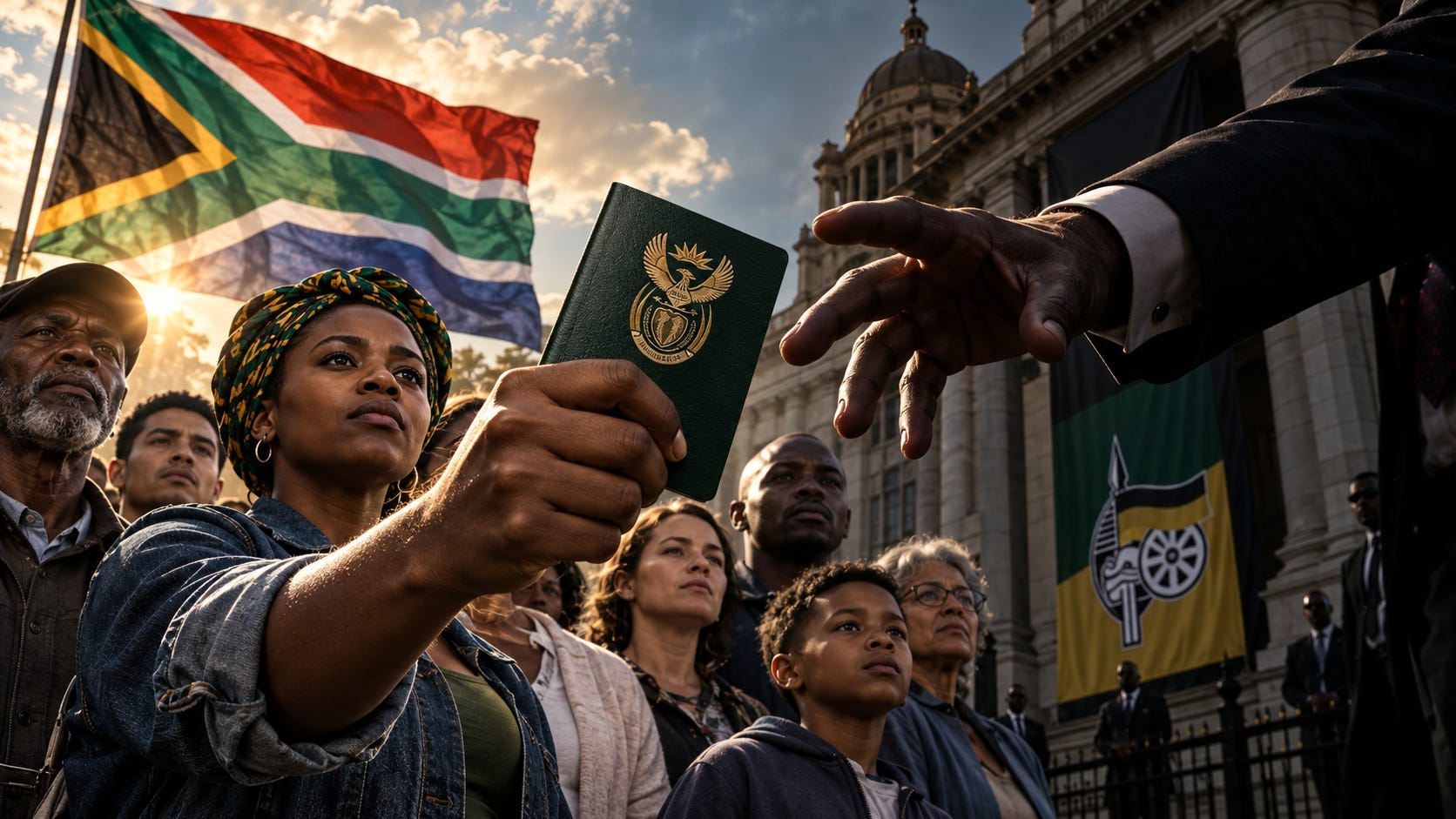
South Africa does not belong to the African National Congress (ANC), no matter how convinced it has become that this country is its own personal fiefdom. The ANC itself does not get to decide who deserves citizenship and the rights attached.
Yet this is precisely what is being suggested by Supra Mahumapelo, chairperson of Parliament’s Portfolio Committee on International Relations and Cooperation, who has proposed legislation that could strip South Africans of their citizenship for allegedly spreading misinformation about the country abroad.
Mahumapelo specifically targeted AfriForum, Solidarity, Lex Libertas and the Freedom Front Plus, accusing them of undermining South Africa’s relationship with the United States through their international lobbying. He even suggested that their engagements with American politicians could constitute treason.
Minister of International Relations Ronald Lamola supported investigating measures against those allegedly spreading misinformation internationally, although he did not explicitly endorse citizenship deprivation. Nonetheless, his willingness to entertain punitive measures against political critics is concerning.
Apparently, criticising the ANC government and seeking international support for political change is now being treated as a potential betrayal of South Africa.
But since when did loyalty to the ANC become a requirement for citizenship?
Citizenship is a right, not a privilege
The South African Constitution is abundantly clear on the matter. Section 20 states:
“No citizen may be deprived of citizenship.”
This is reinforced by Section 16, which protects freedom of expression, and Section 19, which guarantees citizens the right to make political choices and campaign for political causes.
These protections are not merely technical legalities. They exist because citizenship is fundamental to the relationship between an individual and their country.
In a liberal democracy, citizens are not subjects who exist at the pleasure of their rulers. Government derives its authority from the people, not the other way round. Politicians are entrusted with administering the state, but that does not grant them ownership over the country or its citizens.
Citizenship is not a membership card that can be confiscated when someone disagrees with the leadership. It is a legal and political status that recognises an individual’s place within a political community, with rights and protections that government is obligated to respect.
This distinction is essential. A citizen must be free to criticise their government, oppose its policies and campaign for its removal from office. Without these freedoms, citizenship becomes little more than a conditional privilege granted in exchange for obedience.
The Constitutional Court reinforced the importance of this protection in May 2025, when it struck down a provision that automatically removed South African citizenship from people who acquired another nationality without prior permission. The Court found that this unjustifiably infringed the constitutional right to citizenship.
While existing citizenship law contains certain provisions for deprivation in specific circumstances, lawful political disagreement is not a legitimate reason to arbitrarily exclude people from their own country.
The ANC may dislike what AfriForum, Lex Libertas or the Freedom Front Plus have to say. It may dispute their claims or consider their international lobbying harmful. But disagreement does not constitute treason, and criticism of the government does not constitute a renunciation of citizenship.
South Africans do not cease to be South African simply because they embarrass the ANC.
The ANC’s convenient memory loss
What makes these proposals particularly remarkable is that the ANC itself built much of its international influence through precisely the sort of foreign lobbying that its politicians now condemn.
During the struggle against apartheid, the ANC regularly appealed to foreign governments, international organisations and political movements to pressure the South African government.
It actively campaigned for sanctions and international isolation, arguing that foreign intervention was necessary to force political change.
On 26 June 1990, Nelson Mandela addressed a joint session of the United States Congress, explicitly calling for American sanctions against South Africa to remain in place until apartheid had been dismantled.
Mandela also met President George H.W. Bush and requested continued American pressure against the South African government.
The ANC was not merely criticising the government to foreigners. It was actively encouraging foreign powers to take measures that would impose economic and diplomatic costs on South Africa.
Yet today, ANC politicians suggest that organisations appealing to the same foreign government could be committing treason.
Of course, the struggle against apartheid and contemporary political disputes are not morally or historically identical. But that is not the point. The issue is whether South Africans possess the right to seek international support for their political causes, regardless of whether the government approves of those causes.
If the ANC believed that appealing to foreign governments was legitimate when it was fighting apartheid, it needs to explain why that principle should no longer apply to its contemporary critics.
The crimes of the apartheid government cannot be used to justify the ANC adopting comparable abuses of state power. The purpose of South Africa’s democratic transition was not merely to replace one ruling party with another, but to establish a constitutional order that protected individual rights against whoever happened to wield political authority.
The ANC’s historical contribution to that transition does not place it above the principles it helped establish.
South Africa is bigger than the ANC
The government’s justification for these proposed measures is that organisations are spreading misinformation internationally. But if these organisations are genuinely making false claims, the appropriate response is to identify those claims, present evidence and correct the record.
Freedom of expression does not protect every unlawful act, and demonstrable falsehoods can have consequences under applicable law. But the government cannot simply declare an opposing political narrative to be misinformation and thereby justify threatening fundamental rights.
More importantly, the interests of South Africa are not necessarily the interests of the ANC. A policy that benefits the governing party may harm the country, while criticism that embarrasses the government may ultimately serve the interests of South Africans.
Patriotism does not require obedience to politicians. It certainly does not require silence when citizens believe their government is acting against their interests.
The ANC is entitled to defend its policies and criticise its opponents. It is not entitled to decide that those opponents no longer deserve to belong to South Africa.
South Africa belongs to its citizens, not the ANC. And no political party should ever be allowed to forget that.
Nicholas Woode-Smith is the Managing Editor of the Rational Standard and a senior associate of the Free Market Foundation. He writes in his personal capacity. You can follow him on X: @NWoodeSmith.
Spot-on, Nicholas.