


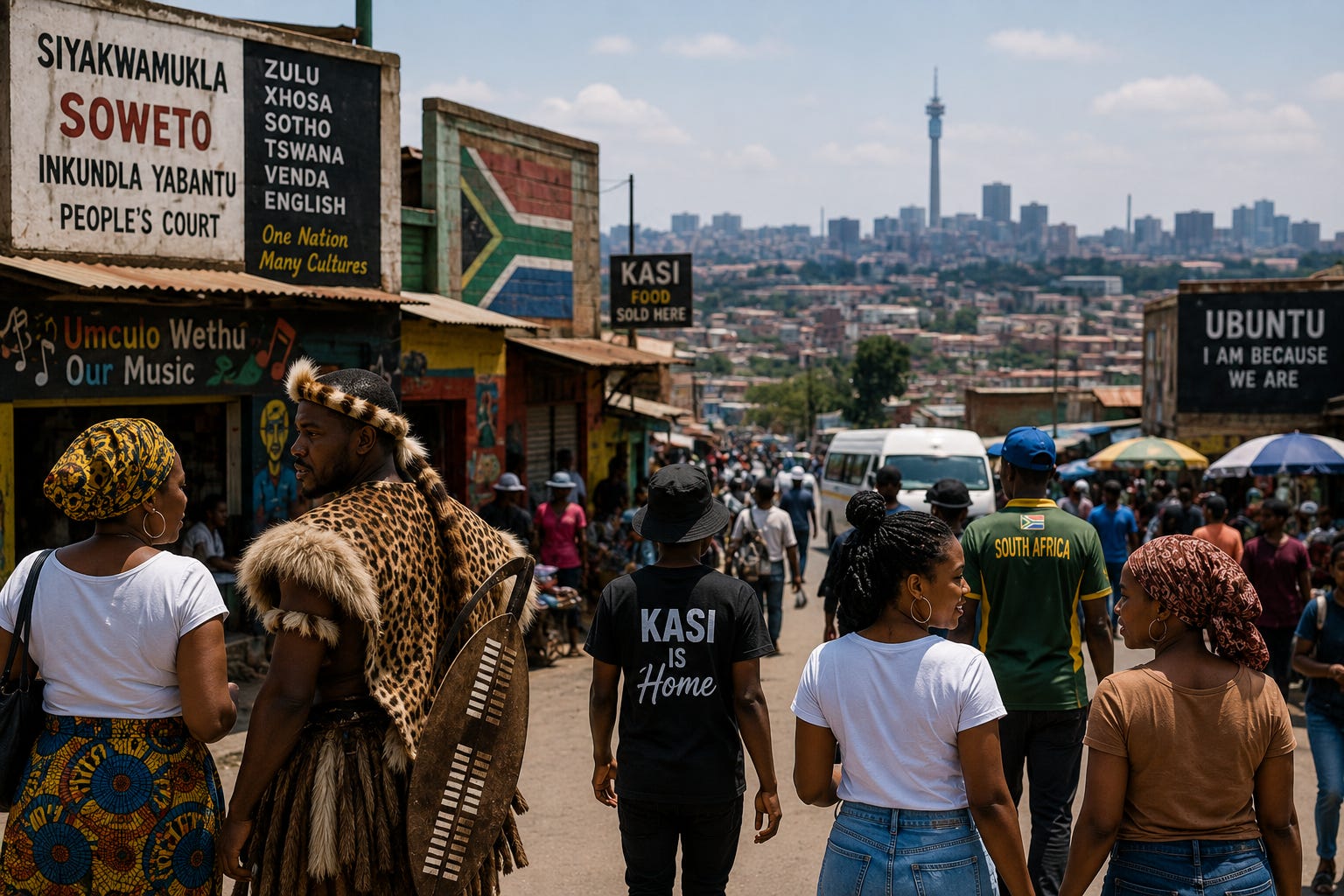
Let’s say a Zulu from KZN travelled to a rural area in the Eastern Cape, which is almost exclusively populated by Xhosa South Africans.
There’s a good chance that some – if not many – of the Xhosas in that area would psychologically file the Zulu as an ‘outsider’ who isn’t one of them, even though they are legally ‘South African’.
They would listen to the Zulu speak isiZulu, or try to speak isiXhosa in a different accent, and deduce: “this person is not one of us. They are not from around here.”
There wouldn’t necessarily be anything wrong with this behaviour. It would be a practical example of a social in-group and out-group dynamic. Humans are innately tribal creatures, and they are incredibly quick to recognise someone who doesn’t form part of their group. Someone who doesn’t speak their language, share their culture, and in some cases, possess the phenotypical features they associate with their own group.
To balance the point, the situation would be no different for a Xhosa who travelled to a rural area in KZN. A number of the Zulus in that area would almost instantly recognise that the Xhosa is an outsider, even though they are South African. Again, there wouldn’t necessarily be anything wrong with this.
Identity beyond the rural context
To understand this social phenomenon in the urban, cosmopolitan context, consider what happens in social circles at tertiary institutions. While all students are part of the same student community, many of them naturally tend to cluster with those who share their background, culture, and/or language. When you are on campus, it is not uncommon to see Zulus, Xhosas, or other ethnic groups clustered together.
While MK Party MP Andile Mngxitama would likely argue otherwise, this phenomenon is not inherently indicative of hatred, prejudice, or intolerance. Humans naturally gravitate towards other humans who are part of their group because they find it easier to connect with them socially. This does not mean that they do not associate with other groups, but familiarity matters, and it often shapes the social circles they form. This also does not mean they do not form social circles on the basis of other factors such as shared interests, religion, and political beliefs.
Townships and the complexity of belonging
It is necessary to extend this analysis of identity and belonging to townships, where the picture is even more complicated, yet still revealing of how these factors find expression in people’s social lives.
Notwithstanding examples of largely homogeneous townships in other provinces, Gauteng has the most diverse townships in South Africa that can be best described as cultural melting pots.
These are deeply integrated communities where people from different backgrounds, cultures, and languages across the country live side by side. They work together, share the same public amenities, participate in social life, and in many cases form relationships and intermarry. Beyond this, they also share common ‘kasi’ cultures that manifest in food, music, lifestyle, kasi lingo, and fashion.
While identity and belonging are layered in the respective examples of rural areas and tertiary institutions, they are even more layered in townships where people navigate multiple identities and forms of belonging simultaneously. A person can be South African, Zulu, a resident of Soweto, a member of a particular political party, and part of a particular friendship circle all at the same time.
One person can navigate multiple forms of identity and belonging while still identifying strongly with their ethnic group and feeling a deep sense of connection to its members. Another can identify far less strongly with their ethnic group and instead feel a much stronger sense of belonging to a political, racial, or religious community. The picture is indeed a highly complex one.
Integration and the question of ethnic belonging
Nevertheless, the mistake that some analysts and political theorists have made is to flatten this complexity and argue that deep integration either equates to, or naturally leads to, the dissolution of ethnic identification and the strong sense of connection that many people have to it. This kind of thinking is reflected in the words of renowned political analyst Prince Mashele in a 2018 Sowetan article titled “Cyril, Juju, Maimane must give Gauteng a competent premier.”
Among other things, he argues that:
“Gauteng is the first province to reach state-level consciousness in South Africa. Being Zulu, Sotho or Swati means nothing there. State failure in the North West troubles the people of Gauteng just as state capture at the national level gives them sleepless nights. People in Gauteng don’t support Jacob Zuma because he is Zulu or Cyril Ramaphosa because he is Venda.
The multicultural and multiracial character of the population of Gauteng serves to dilute the tribal consciousness of new arrivals. You arrive as a Tswana in Gauteng and go back to the Northern Cape as an elevated South African.”
This view, which essentially assumes that integration naturally replaces ethnic identification and belonging with a broader South African consciousness, is overstated. While deep integration can undoubtedly complicate the picture of identity as this article has demonstrated thus far, it does not necessarily eliminate the strong sense of ethnic identification and belonging that many people retain alongside other forms of identity.
Beyond the example of individuals who strongly identify with their ethnic identity, it is also worth considering the phenomenon of ethnic clustering in diverse townships. While this is admittedly not a prevalent trend, it remains a social phenomenon that demonstrates the continued relevance of ethnic identity even within deeply integrated communities.
Another important factor to consider is the persistence of what can be termed the homeland phenomenon - the continued significance of rural areas across multiple provinces that remain cultural anchors of ethnic identity for many township residents who feel a deep sense of connection and belonging to them. In many ways, for many people, South Africanness still feels incomplete without these areas, which helps explain (at least partly) why the December holidays, in particular, continue to be characterised by a widespread return to them.
A Tswana who is a resident of Soweto and returns to their home village in the Northern Cape for Christmas does not simply return as an “elevated South African”. They return as a person who lives within a diverse and deeply integrated township environment, while still maintaining a meaningful connection to an area that represents a critical component of their identity.
Conclusion
While deep integration is undoubtedly a reality, and its role in complicating how identity is navigated and understood is equally real, ethnic identity remains socially meaningful for many people. Many people continue to maintain a strong attachment to it, and it remains an important marker of identity and belonging.
Closely tied to this is the idea that humans naturally recognise difference, and that belonging is not experienced only through the state and legal citizenship. Belonging is also socially constructed and is grounded in factors such as a shared culture and language.
Accepting, or at the very least understanding this foundational premise of the article, is crucial for engaging with the next pieces, which will explore the political implications of these social dynamics for the South African polity.
Note: This is the first article in a series exploring identity, belonging, and their broader political implications in South Africa.
Ayanda Sakhile Zulu holds a BSocSci in Political Studies from the University of Pretoria and is a Policy Officer at the Free Market Foundation.

A very well structured and rational report, as well as most informative thank you. Look forward to the next step
Ayanda, once again a common sense article reflecting reality and not wishfull thinking. But your train of thought is also borne out by the social sciences. Indeed we as humans are part of many social and other groupings, and when that starts to be prescribed, or enforced, the ugly social engineering head rises up again. We surely do not want to see that once again, but unfortunately our dominant political forces simply love that - in spite of having demonised it in a previous context, and rightly so. It was wrong then and it is wrong now. People must be given free choice regarding the groupings they feel they want to be part of. As long as those groupings do not cause real harm (contrasted with perceived harm) to others, they should be allowed freedom of choice.