


Written By: Thando Nzimande
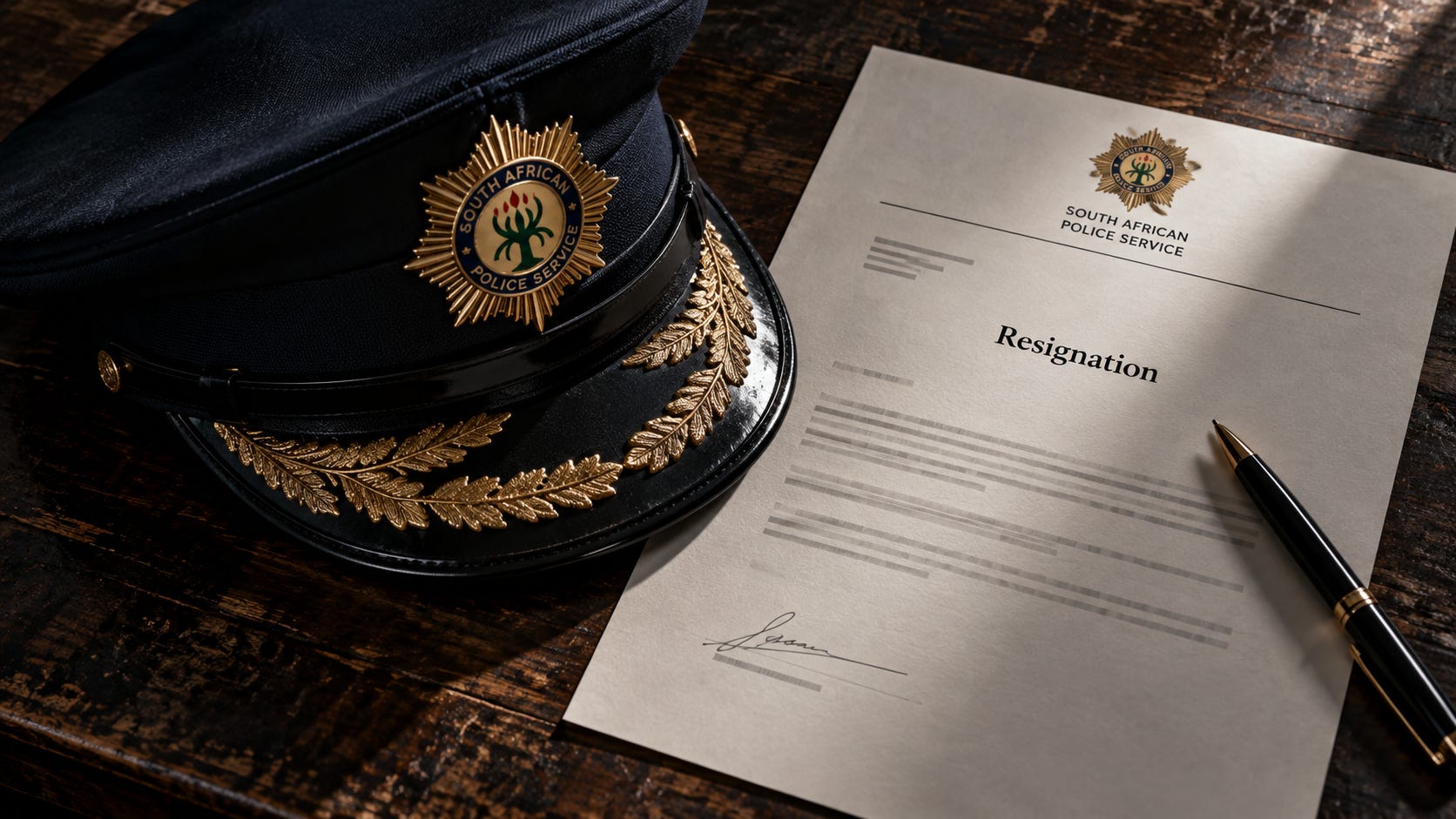
There is a particular kind of silence that follows a resignation delivered by lawyers. It carries no farewell speech, no handover and no pretence of a graceful exit. When Lieutenant-General Shadrack Sibiya’s legal team informed the South African Police Service (SAPS) that he was resigning on 12 October, the disciplinary hearing against him ended almost as soon as it had begun. For a man who once occupied one of the country’s most senior crime-fighting positions, as deputy national commissioner for crime detection, it was an inglorious departure.
SAPS confirmed that Sibiya’s employment had been terminated with immediate effect. Because disciplinary proceedings were already underway, the service classified his departure as a dishonourable discharge.
The expedited disciplinary process concerned seven counts of alleged serious misconduct arising from evidence presented to the Madlanga Commission of Inquiry. Among the allegations were that Sibiya received R800,000 and 20 impalas from businessman Vusimuzi “Cat” Matlala, improperly shared confidential information and interfered with police investigations. Sibiya has denied wrongdoing.
His resignation prevented the hearing from reaching a formal finding on those allegations. It was not an admission of guilt, but neither did it resolve the questions raised by the commission.
Sibiya is also not the first senior officer to leave the police service amid the commission’s revelations. Former KwaZulu-Natal Hawks head Major-General Lesetja Senona resigned in June, while Brigadier Rachel Matjeng was dismissed following an internal disciplinary process linked to her dealings with Matlala.
These departures suggest that the commission’s work is having institutional consequences, even before the courts have completed their examination of the allegations.
The Madlanga Commission and the Matlala connection
Sibiya’s relationship with Matlala has become one of the most significant threads running through the inquiry.
During his February testimony, Sibiya acknowledged knowing Matlala and meeting him several times. He maintained that their relationship was professional rather than personal, insisting that acquaintance did not constitute friendship.
Sibiya testified that their first meeting occurred at his office in early 2024 and involved matters relating to police facilities and Matlala’s business dealings with SAPS. However, questions arose about inconsistencies in his account, including the date of their first meeting and the fact that Matlala’s multimillion-rand police health-services contract had not yet been awarded.
His explanation for the attempted disbandment of the Political Killings Task Team also came under sustained scrutiny.
Sibiya maintained that he had acted on instructions from then national police commissioner Fannie Masemola. Yet, when questioned on 19 February, he conceded that the documents he relied upon did not expressly order the task team’s disbandment.
That concession did not establish criminal wrongdoing, but it exposed a serious weakness in his explanation for a consequential policing decision.
The commission’s interim findings have added institutional weight to these concerns.
Its first interim report, delivered to President Cyril Ramaphosa on 17 December 2025, identified prima facie evidence warranting urgent investigation into several officials. A special police investigations task team was subsequently established.
The second interim report, submitted on 29 May 2026, largely confirmed the earlier recommendations after implicated individuals had been given opportunities to testify.
In an official statement issued on 6 August, the Presidency confirmed that the commission had recommended disciplinary proceedings and immediate criminal investigations concerning Sibiya, suspended Sergeant Fannie Nkosi, Brown Mogotsi and a protected witness identified as Witness G.
Criminal proceedings were recommended where investigators established sufficient evidence.
The distinction is important. A commission of inquiry can expose apparent misconduct, recommend investigations and refer matters to law enforcement. It does not determine criminal guilt. That responsibility remains with the courts.
The arrest and the criminal charges
Separate from the commission’s corruption allegations, Sibiya now faces serious criminal charges.
On 21 September 2026, members of the Commission’s Recommendations Task Team arrested the 59-year-old at a venue in Sandton. He appeared in the Randburg Magistrate’s Court the following day.
He initially faced five charges: three counts of sexual grooming, one of human trafficking and one of rape. A further charge concerning the negligent handling of a firearm was subsequently added, bringing the reported total to six.
The prosecution alleges that Sibiya raped an 18-year-old woman at a Sandton hotel in May 2026 after she had consumed alcohol and lost consciousness.
In a separate set of allegations, prosecutors contend that he sexually groomed a 16-year-old girl through WhatsApp communications between July and August, including requests for sexually explicit material.
Sibiya denies the charges. He maintains that his sexual encounter with the 18-year-old was consensual and disputes the allegations involving the minor. He has indicated that he intends to plead not guilty.
The allegations have not been proved at trial.
Although the criminal case is separate from the commission’s investigation, the bail proceedings have introduced another dimension to the controversy: recordings that prosecutors say raise concerns about possible interference with witnesses.
The recordings and their implications
One recording played during the bail application allegedly captures Sibiya confronting a man identified as Mr M, the father of the 16-year-old complainant and a former associate of the general.
In the recording, Sibiya tells Mr M that he could deal with him quickly and easily.
The prosecution interprets those remarks as an indication of intimidation. Mr M has also alleged in an affidavit that Sibiya threatened him and his family after he sought to pursue a criminal complaint.
The defence disputes that interpretation, arguing that the remarks have been taken out of context and arose from a personal disagreement rather than an attempt to obstruct justice.
Another recording involved Bishop Azwihangwi Maumela, an associate of Sibiya, discussing the possibility of locating and speaking to the 18-year-old complainant. Prosecutors have characterised the conversation as evidence of possible interference. Sibiya’s family maintains that Maumela acted independently and was not instructed to contact witnesses on its behalf.
The most far-reaching recording emerged on 13 October, when the state played approximately 25 minutes of a telephone conversation between businessman Serge Cabonge and Mr M.
The conversation ventured well beyond the sexual offence allegations.
Cabonge discussed alleged dealings involving Sibiya, Matlala and suspended Sergeant Fannie Nkosi. He claimed that Sibiya and Matlala conducted business through Nkosi while denying that he personally collected money from Matlala to pass to Sibiya.
Reports differed in their characterisation of the recording, with some emphasising alleged payments to Sibiya and others highlighting Cabonge’s denial of acting as a financial intermediary.
The recording also contained claims that Cabonge had used police connections to assist the family of a person allegedly associated with the Madlanga Commission in securing the withdrawal of a criminal case following a vehicle collision.
None of these claims has been independently established.
The allegations nevertheless attracted the commission’s attention. On 13 October, commission spokesperson Jeremy Michaels confirmed that investigators intended to obtain a statement from Cabonge and examine matters falling within the inquiry’s terms of reference.
The defence questioned the relevance of the Cabonge recording to Sibiya’s bail application, particularly because Sibiya was not a participant in the conversation. His lawyers argued that the recording required proper context and should not be treated as proof of allegations made by third parties.
That objection highlights a central difficulty with the material.
A recorded conversation may establish that particular statements were made, but it does not necessarily establish that those statements were truthful. Claims made outside a courtroom require investigation and, where necessary, testing through formal evidence.
What the recordings could mean for bail
The immediate significance of the recordings lies in the bail proceedings rather than any determination of guilt.
The prosecution has argued that the charges fall under Schedule 6 of the Criminal Procedure Act, which imposes a demanding threshold for release. An accused facing a Schedule 6 offence must establish exceptional circumstances that, in the interests of justice, justify bail.
Sibiya’s legal team has challenged the application of the Schedule 6 provisions, while maintaining that he should qualify for release even if the stricter test applies.
South African bail law also requires courts to consider whether an accused person might intimidate witnesses, interfere with evidence or otherwise undermine the administration of justice.
The recording involving Mr M is therefore particularly relevant to the prosecution’s argument. If the court accepts that Sibiya’s remarks amounted to intimidation, they could weigh against his release.
The Cabonge recording raises different questions. Much of its content concerns alleged financial dealings and relationships beyond the sexual offence case. Its relevance to the immediate bail decision is therefore less direct.
On 14 October, the court heard affidavits from both complainants expressing fears for their safety should Sibiya be released.
The defence rejected the suggestion that those fears alone justified continued detention. It offered R20,000 bail, proposed conditions restricting contact with witnesses and argued that Sibiya was neither a flight risk nor a threat to the investigation. His lawyers also raised concerns about his health, finances and ability to prepare for trial while in custody.
By 15 October, the prosecution was presenting its final arguments against bail, maintaining that the evidence supported its concerns about possible witness interference.
Whatever the magistrate ultimately decides, a bail ruling will not establish whether Sibiya committed the offences.
Refusing bail would mean that he remains in custody while the case proceeds. Granting bail would mean that the court considers his release compatible with the interests of justice, subject to any conditions imposed.
Neither outcome would constitute a verdict.
Accountability must survive the headlines
There is a larger story here, one that extends far beyond Sibiya’s personal circumstances.
South Africans have watched numerous commissions expose corruption, misconduct and institutional failures. Too often, gripping testimony and substantial reports have been followed by disappointing prosecutorial results.
The Madlanga Commission is being measured against that experience.
Already, its proceedings have contributed to disciplinary action, dismissals, resignations and criminal investigations. These are meaningful developments, but they are not substitutes for successful prosecutions where criminal wrongdoing can be proved.
The challenge is to translate the commission’s revelations into legally sustainable accountability.
Fairness also demands that Sibiya’s position remains part of the public record.
He denies having an improper relationship with Matlala, disputes allegations concerning surveillance equipment and maintains that his actions regarding the Political Killings Task Team followed legitimate instructions. He rejects the sexual offence allegations and has accused investigators of abusing their powers.
Those denials deserve examination through the appropriate legal processes, just as the allegations against him deserve thorough investigation.
A recommendation is not a conviction. An arrest is not a verdict. A democracy that insists on due process for the powerful must continue to insist upon it when those individuals have fallen from power.
There are now two major processes to watch.
The first is the criminal case and the court’s determination of Sibiya’s bail application. The second is the Madlanga Commission’s final report, scheduled for submission to President Ramaphosa on 16 November 2026.
The outcome of one will not automatically determine the other.
For Shadrack Sibiya, the resignation letter may have ended his career in the police service, but it did not close the investigations surrounding him.
For South Africa, the more important question is whether the institutions responsible for investigating and prosecuting wrongdoing can establish the truth, uphold due process and deliver justice.
That, rather than the resignation itself, will be the real test of accountability.
Thando Nzimande is a University of the Witwatersrand alumnus, Future Voices scholar and researcher at the Middle East Africa Research Institute (MEARI). His interests span neuroscience, economics and geopolitical analysis. He aims to bring scientific reasoning, critical thinking and rigorous research to public debate and the analysis of global affairs.