


Written By: Robert Khumalo
South Africans have every right to protest Israel. They have every right to criticise Zionism, call for boycotts, condemn Israeli policy, and express their anger about the war in the Middle East.
That is not in dispute.
What is in dispute is whether the language of protest can be used to excuse harassment, intimidation, obstruction, reputational warfare, and the public smearing of Jewish South Africans who refuse to apologise for their identity or beliefs.
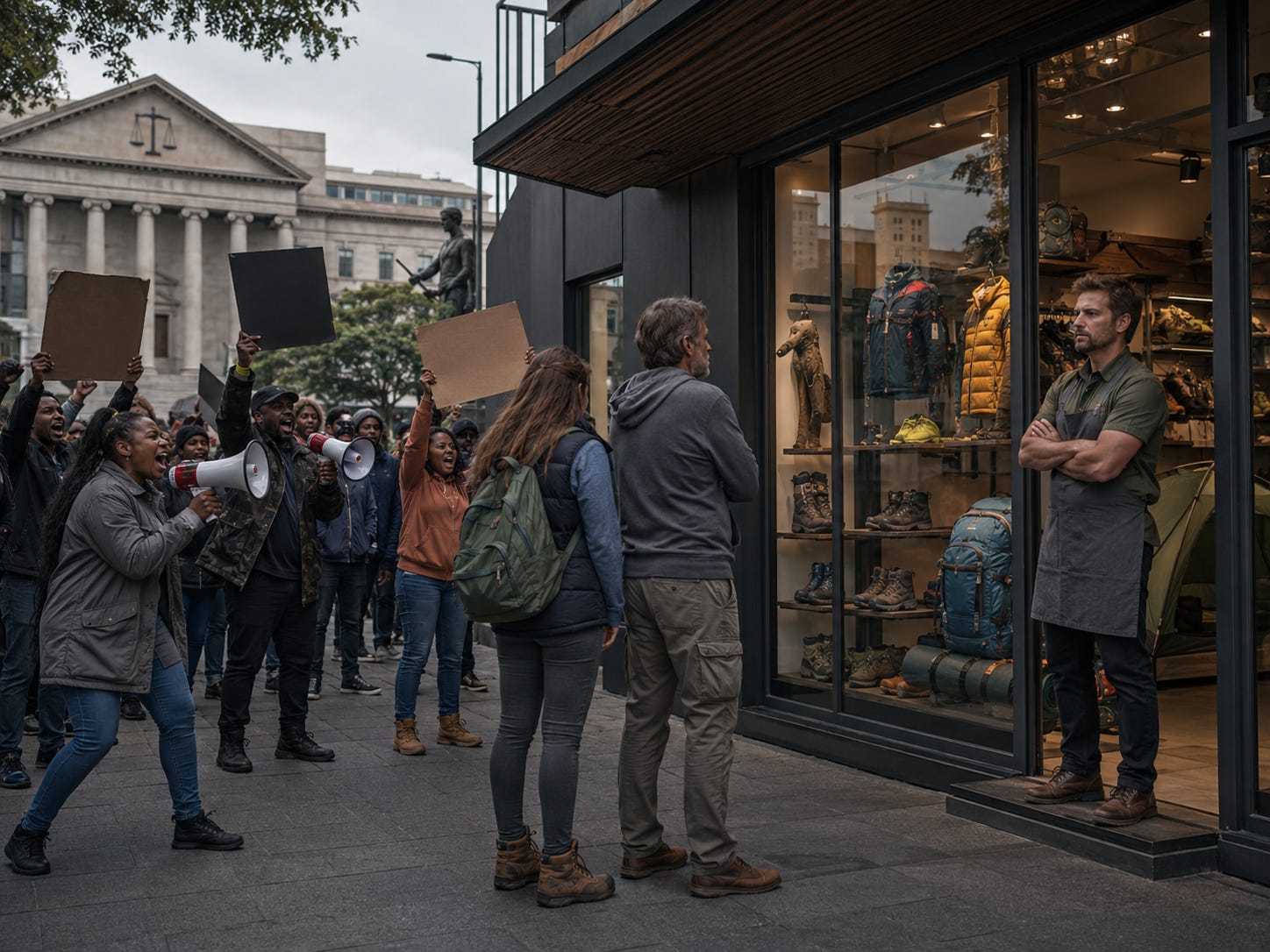
The matter involving Cape Union Mart and Philip Krawitz, now before the Western Cape High Court, should not be treated as a mere extension of the Israel-Palestine culture war. It is a test of something much closer to home. It is a test of whether South Africa still believes in lawful protest, equal citizenship, property rights, free association, and the rule of law.
In a constitutional democracy, no cause is placed above the law simply because its supporters believe themselves to be righteous.
Philip Krawitz is a prominent South African businessman who has openly expressed support for the State of Israel. Activists are entitled to disagree with him. They are entitled to criticise him. They are entitled to refuse to support his business. They are entitled to persuade others to do the same.
But they are not entitled to intimidate staff, harass customers, obstruct access to stores, or spread serious allegations that have not been proven.
That distinction matters.
Too often in South Africa, protest is treated as a magic word that sanitises all conduct. Once a group calls itself activists, almost anything becomes permissible in the eyes of sympathetic commentators. Blocking entrances becomes “direct action.” Targeting a business becomes “accountability.” Smearing individuals becomes “raising awareness.” Intimidation becomes “resistance.”
This is not constitutionalism. It is mob politics with better branding.
The right to protest is real. It is precious. It must be defended, especially in a country with South Africa’s history. But the right to protest does not abolish the rights of everyone else.
Freedom of expression does not cancel dignity.
Political activism does not cancel property rights.
A boycott campaign does not cancel the right of ordinary employees to go to work without being threatened or abused.
And opposition to Israel does not cancel the right of Jewish South Africans, including Zionist Jews, to participate openly in public life.
This is the line that must be defended.
There is, of course, nothing inherently antisemitic about criticising the government of Israel. Israelis do it every day. Jews around the world argue fiercely about Israeli policy, Zionism, the war, the settlements, the conduct of the Israeli state, and the future of the region.
But it is dishonest to pretend that anti-Israel activism never crosses into antisemitism.
When Jewish-owned or Jewish-associated businesses are singled out for special hostility, when Zionism is treated as a civic disqualification, when Jewish South Africans are expected to answer collectively for a foreign war, and when swastika imagery appears outside stores connected to Jews, the line has been crossed.
At that point, the issue is no longer criticism of a state. It is collective blame.
It is the transformation of Jewish identity into a political offence.
This is especially dangerous in South Africa, where public debate is already too easily captured by racialised scapegoating, conspiratorial thinking, and performative outrage. The more activists frame local Jews as stand-ins for Israel, the more they import an overseas conflict into South African civic life in a way that makes Jewish citizens less safe, less equal, and less free.
That should concern every liberal, regardless of their view on Israel.
The proper liberal position is not that Israel must be beyond criticism. It is that Jews must not be treated as fair game.
The same principle should apply to all communities. A Muslim South African should not be harassed because of the actions of a foreign government or militant group. A Russian South African should not be treated as personally responsible for Vladimir Putin. A Chinese South African should not be punished for the Chinese Communist Party. An American business owner should not be targeted as a proxy for Washington.
So why should a Jewish businessman be treated as a legitimate target because he supports Israel?
The answer, too often, is that Israel has become the exception to the rules that activists claim to uphold. When Israel is involved, the standards change. Conduct that would be condemned in any other context is excused as solidarity. Hostility that would be recognised as bigotry if directed at another minority is rebranded as anti-Zionism.
That double standard must be rejected.
There is also a practical South African dimension that should not be ignored. Campaigns designed to damage South African businesses do not liberate Palestinians. They threaten South African livelihoods.
Cape Union Mart employs South Africans. It pays rent to South African landlords. It supports suppliers, logistics networks, retail workers, shopping centres, and ordinary families. A campaign to destroy or damage such a business may make activists feel powerful, but the people most likely to suffer are not ministers in Jerusalem. They are workers in South Africa.
This is one of the great moral vanities of activist politics. It assumes that destruction is the same as justice.
It is not.
If a protest movement harms shop workers, scares customers, damages local commerce, and inflames communal hostility, while doing nothing meaningful to advance peace or improve the lives of Palestinians, then it is not a serious human rights campaign. It is theatre at the expense of ordinary people.
The court does not need to decide the Israeli-Palestinian conflict. Nor should it. South African courts are not foreign-policy seminars. The question before the court is far more basic: whether protest activity may cross into intimidation, obstruction, defamation, and harassment without consequence.
The answer should be no.
A free society can tolerate fierce disagreement. It can tolerate boycotts. It can tolerate offensive signs, angry chants, and unpopular views. What it cannot tolerate is the idea that one group’s political passion gives it a veto over the rights of others.
The Constitution does not create a hierarchy where the loudest activists receive rights and their targets receive obligations.
It protects protest, but it also protects dignity, trade, movement, property, reputation, and equal citizenship.
That balance is not a technicality. It is the whole point of constitutional democracy.
The Cape Union Mart case is therefore about more than one company, one businessman, or one protest campaign. It is about whether South Africa can still distinguish between lawful dissent and political intimidation.
A healthy society must protect the right to protest.
But it must also protect the right of Jews, including Zionist Jews, to live, work, trade, speak, and participate in public life without being treated as enemies of the people.
There is no contradiction between those principles. There is only the rule of law.
And if the courts can reaffirm that protest is not a licence to harass Jews, they will have done more than settle a dispute. They will have defended the basic terms of a free society.
Robert Khumalo is a political analyst and classical liberal commentator.