


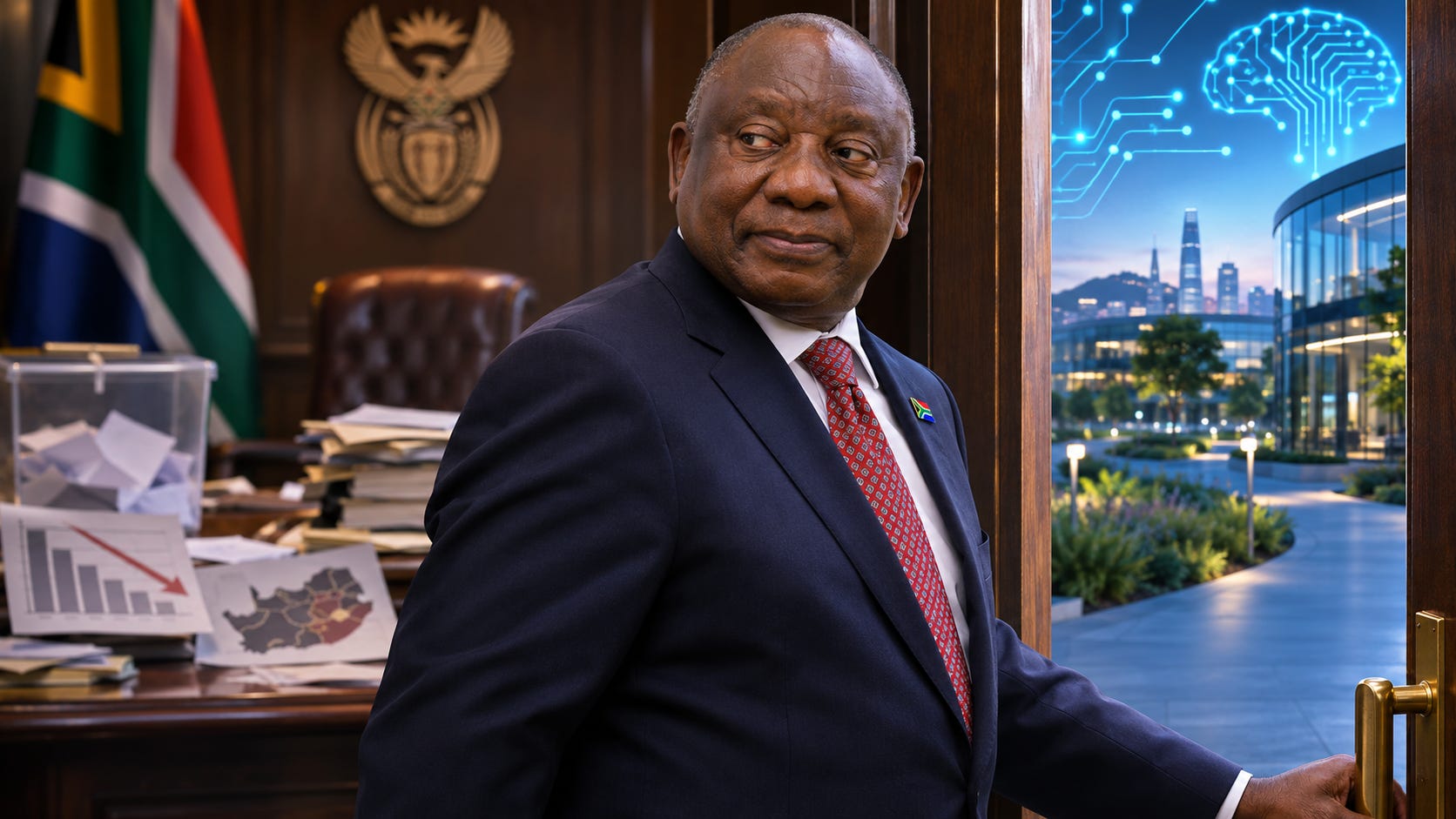
Readers will remember how, in our school days, we had to ask the teacher for permission to “leave the room” when nature called. Well, now our president also suddenly developed an urgent need to “leave the room”, soon after the announcement of the local government election results. The fact that the President developed an urgent need to “leave the room” after hearing how badly his political party was defeated at the polls naturally comes as no surprise. What is surprising, however, is that the Honourable President then reacted by giving himself permission to “leave the room” — and invited 299 other South Africans to leave with him.
Of course, some people around the world are of the opinion that Silicon Valley — the destination of the president and his delegation when they “left the room” — is not an entirely inappropriate metaphor for the destination we had in mind when we received permission from the teacher at school to leave the room when nature called. I would rather not expand too much on this, because readers are surely aware of the growing scepticism of certain individuals and communities about the destructive role of the big technology companies, especially regarding the ecological footprints of their data centres. Electricity consumption and water consumption, light and air pollution, the displacement of land uses away from, for example, agriculture, forestry and essential housing. All of this is accompanied by the creation of particularly few permanent jobs. Then we are not even talking about the secondary effects associated with data centres: the well-known fears about AI’s potential to destroy humanity, or to further violate humanity’s privacy through so-called data scraping.
It is there — from a certain point of view — that the President hastened while intense negotiations are taking place back home in the hope of saving our sunk municipalities from further collapse. I still remember from my school days how I very suddenly developed a very serious need “to leave the room” when the strict teacher came closer and closer to my desk with questions aimed at testing whether I had indeed done my homework. The President’s actions therefore sound rather suspicious.
But let us for the moment give the President the benefit of the doubt. Perhaps he opened many doors for our country. After all, he had eight or nine cabinet ministers at his side. Not to mention the honourable South African ambassador in America, none other than Roelf Meyer himself. If my information is correct, Roelf was, however, unable to get President Trump to at least answer our President Ramaphosa’s phone call. I am not an expert in the field of protocol with regard to international relations, but I would be surprised if it is normal for one president to visit another president’s country without at least a conversation on the “sidelines”, as such informal discussions are referred to.
One is, of course, very much in favour of business-to-business interaction across international borders, but is a President who could not succeed in convincing the president of the country he is now visiting of his government’s bona fides on the diplomatic terrain now trying to play businessman?
It inevitably makes one think of what obstacles caused the diplomatic relations between South Africa and America to collapse. One also wonders whether any progress has been made in removing those obstacles since the two presidents met in May 2025 at the White House in Washington, DC. Our readers are informed people. We know that there has still been no substantial change in the attitude of the ANC-in-Government with regard to farm security in South Africa, nor with regard to the incitement of violence against the farming community. On the contrary, the Americans’ decision to give preference status as American immigrants to minority groups who feel physically threatened — or who have already suffered physical harm — was made to look suspicious by the ANC-in-Government. What has been done with regard to America’s justified objections to the ANC-in-Government’s threat to property rights and discriminatory race-based legislation? Have the requirements for renunciation of ownership and control by American companies that want to invest in South Africa been amended? Yes, it is “being worked on”, but Starlink’s presence in South Africa is still as far removed from us as the stars are from us. And then our President still has the arrogance/presumption to ask Musk to “give back to South Africa”!
To return to the details of the President’s delegation visit: Firstly, how was the decision made on the chosen ones whom the President promoted to Silicon Valley? Do we still remember the arms deal scandal — which then apparently became not a scandal — when ANC-in-Government buddies were paired with foreign (accommodating) buddies by the highest political offices in South Africa? Do we remember the outcomes of the profitable pairings that took place? How much of the very meagre harvest of war equipment that was the result of the “non-scandal” still flies, still floats or still drives?
Apart from the fact that the President — precisely now, after the election results and during the heat of coalition negotiations — developed an urgent need to “leave the room”, is it even possible in terms of any kind of logic that he could think that he should lead a delegation to the leading country, with the leading technology companies in the world, to relieve them of their ignorance about opportunities in South Africa? Even if one turns the reasoning around — let us place the emphasis on the mission’s objective of going to Silicon Valley to learn — then it is still an absolute farce to fly 300 South Africans, most of whom are highly informed people, all the way at enormous cost to America to try to find out what Elon’s Grok told me when I typed in a question or two from my armchair via my tablet computer’s keyboard. Really, honoured Rational Standard readers, the ANC-in-government and so-called leaders like Ramaphosa beat the country’s name with a plank every day. Just think what the mission’s attentions and expenditures could have meant if they had instead been applied to removing obstacles to fixed foreign investment in South Africa. A number of them have already been mentioned above, but there are at least five more serious obstacles for foreign investors to begin to take an interest in South Africa again: our electricity network, our growing water crisis, our crime levels, and our dilapidated municipal infrastructure and very bad service delivery. Add to that also our dysfunctional and dilapidated transport and harbour facilities.
One may ask what high technology and AI have to do with it. The answer is: everything. Just as Maslow presented his well-known hierarchy of human needs in the form of a pyramid, with the most basic needs filling the broad bottom of the pyramid, and self-actualisation only being attainable at the narrow top of the pyramid — once all the lower and more basic needs of the human being have first been satisfied — in the same way, modern technology and AI can only exist at the top of the economic pyramid where the lower-order infrastructure has already been established. Sorry to have to say, Mr President of South Africa, but the bottom of the economic pyramid cannot be filled with a vacuum or partial vacuum or with wishful thinking. Only hard infrastructure that is in working condition and is properly managed and maintained will allow the wishful thinking that you have pursued in Silicon Valley — of trying to convince the high-technology companies to invest significantly here with us — to come to fruition. Your discriminatory policies will also have to change and property security will have to be guaranteed.
As they say: something very suspicious is happening again — watch this space...
Piet du Plessis is a retiree with a long history of applied socio-economic development. He describes himself as a liberated Afrikaner who has moved beyond self-flagellation and embraces the freedom to express his cultural pride and values openly when appropriate.
