


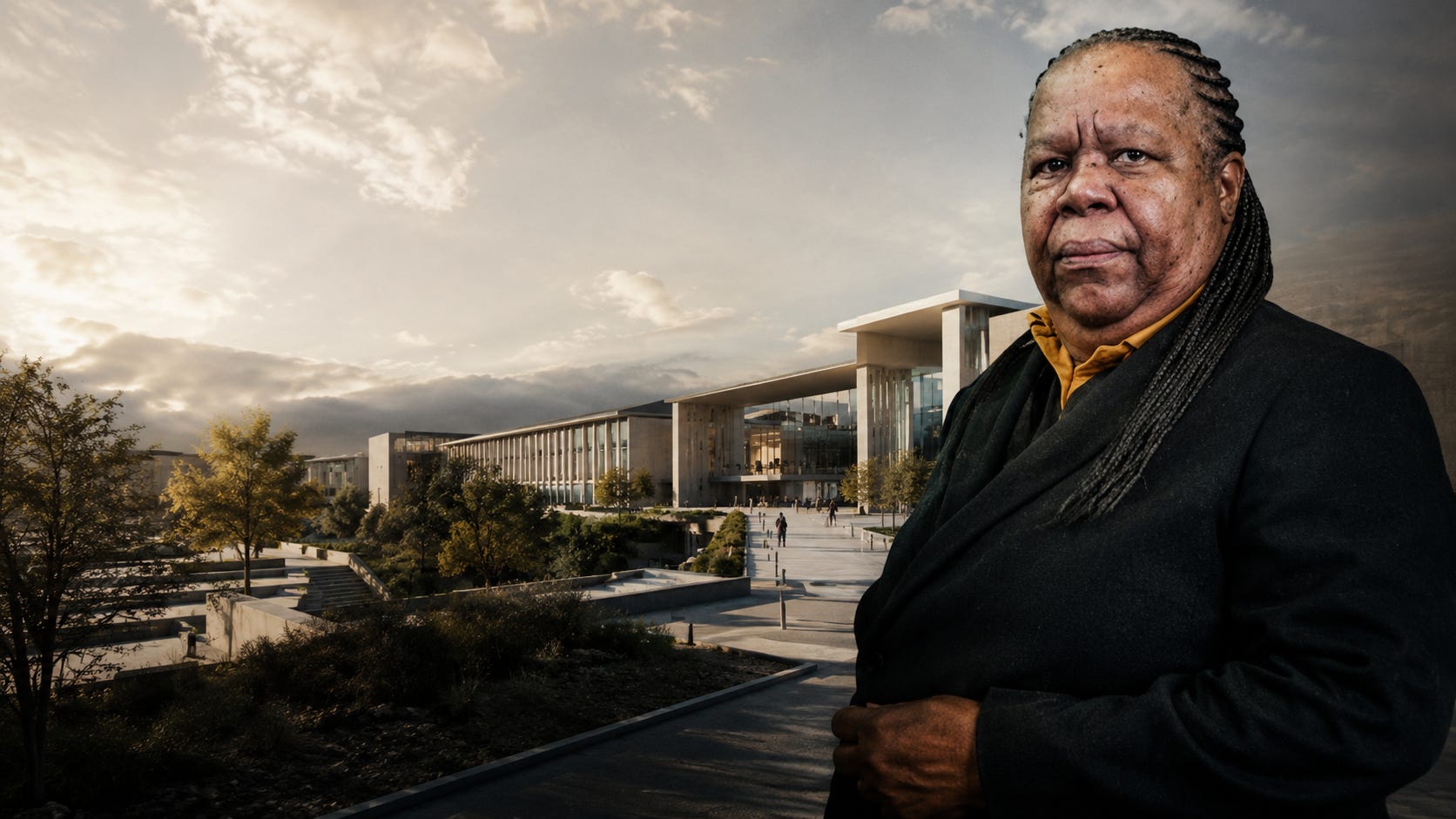
Dr. Naledi Pandor’s remarks about AfriForum and the multi-million-rand Akademia university project highlight deep ideological, historical and psychological fault lines in contemporary South Africa in a very blatant way.
Watch the video below for a good summary of the good doctor’s way of thinking:
Under a sub-heading, “South Africans exercising their right to exit”, David Ansara, CEO of the Free Market Foundation in The Common Sense Newspaper, August 16, 2026, also said the following:
“This week, we witnessed the unedifying spectacle of Naledi Pandor attacking Akademia, an independent Afrikaans-medium university founded by the Solidarity Movement. Akademia is using private funds to build a massive campus in Pretoria East estimated to cost up to R3.2 billion.
Somehow this is unacceptable to Pandor, a former minister of education, who during a podcast interview called for the government to use its regulatory power to shut Akademia down.”
I am going to try here to make sense of her extremely flagrant remarks that have by now gained widespread notoriety. It was one of those unguarded Freudian slips, in my opinion, which Wikipedia so beautifully defines as “an unintentional error in speech, memory, or physical action that is believed to reveal a person’s subconscious thoughts, hidden desires, or internal anxieties.”
The definition of a Freudian slip as set out already points to many of the reasons why those words were uttered thoughtlessly by Pandor.
First of all, no one is surely more aware of the total failure of the ANC’s dream of building institutions, or of reforming them in such a way that a unified, integrated state could come into being in the post-apartheid years. Indeed, Pandor herself was responsible for her failures as former Minister of Basic Education and Higher Education, respectively, to get our schools and universities to function in an integrated manner.
She missed the mark hopelessly with her wishful thinking that integration could be forced by, for example, promoting the Anglicisation of universities and schools. On the contrary, it precisely exposed her wrong assumption that differences can simply be swept under the carpet. The less room she and her successors and predecessors were willing to allow Afrikaans-speakers to maintain their language rights, the more the Afrikaans-speakers objected.
The attempts to kill off Afrikaans in the schools and universities then had her greatest nightmare as a result: Afrikaners build their own technical training institution, Sol-Tech, and now also their own Afrikaans university, namely Akademia. What a shock. Afrikaners fight BELA and establish their own tertiary institutions without asking her failed government for a cent.
That hurts. It also emphasises the ANC-in-government’s loss of authority, their decline and failures. Indeed, it points to their increasing irrelevance. Those truths she could not give recognition to in her account, and so she condemned what can be seen as a huge achievement as unacceptable – without providing reasons for her attitude that carry any weight. On the contrary, the Afrikaans community should precisely have been complimented for their resourcefulness in mobilising private-sector funds and expertise to lighten the burden for taxpayers and to promote future expertise at tertiary level to the benefit of the South African economy as a whole.
For Pandor and other cadres like her, it is a bitter pill to swallow that a group of people who were once oppressors, but then were completely politically disempowered for no less than 32 years, are not prepared to allow socially, culturally or psychologically that they stop performing in everything and on all terrains – even where they are prevented from actively participating in them.
The same psychosis we also observed during the American outreach to Afrikaners in particular. It is as if the unspoken wish of many South Africans is that it is bad when things go well with Afrikaners, or if they perform or receive recognition from abroad. It is as if a sickly wish exists among people that it is only good if things go badly with Afrikaners.
That is extremely petty, because the majority of Afrikaners have, after all, for the last 32 years accepted their position as merely ordinary citizens of the country who no longer govern the country and are quite content to live themselves out in a country where everyone is supposed to have equal opportunities. I think it is a sign of inferiority feelings when people do not grant success to other people.
Afrikaner achievements expose the failures of the ANC-in-government and instead of saying to the government, “Look what can be done!”, the achievers are rather condemned with empty arguments or insinuations without foundation. It is truly pathetic to condemn achievement simply because you yourself do not achieve. Fortunately it is not sustainable to try to maintain such a negative attitude towards better performers. It underestimates ordinary people’s ability to judge for themselves. In time they come to the realisation that some just talk and promise, while others achieve real results.
Feel free to look at the video clip at the following link for a fascinating take on the issue by someone who surely or unlikely can carry the writer’s possible own biases:
Recent opinion polls these days also show that the ANC’s support is declining incredibly. The performing DA ministers in the GNU and Helen Zille’s fantastic election campaign in Johannesburg are also reasons why ordinary people are beginning to see the leaders of the ANC-in-government as the parasites that they are. But more important than anything else is what ordinary people have to go through because of the state’s decay.
It is bread-and-butter issues that are now making them realise more and more that it is no longer the consequences of apartheid that can be blamed. And no matter how hard Naledi Pandor and others like her try to cover up ANC failures by trying to cast suspicion on others’ achievements, the less those attempts succeed. The ANC and its cadres have become their own greatest enemies.
Piet Du Plessis is a retiree with a long history of applied socio-economic development. A liberated Afrikaner who has moved beyond self-flagellation and believes that he has been freed to live out his cultural pride and values, and to proclaim them openly when appropriate.
