


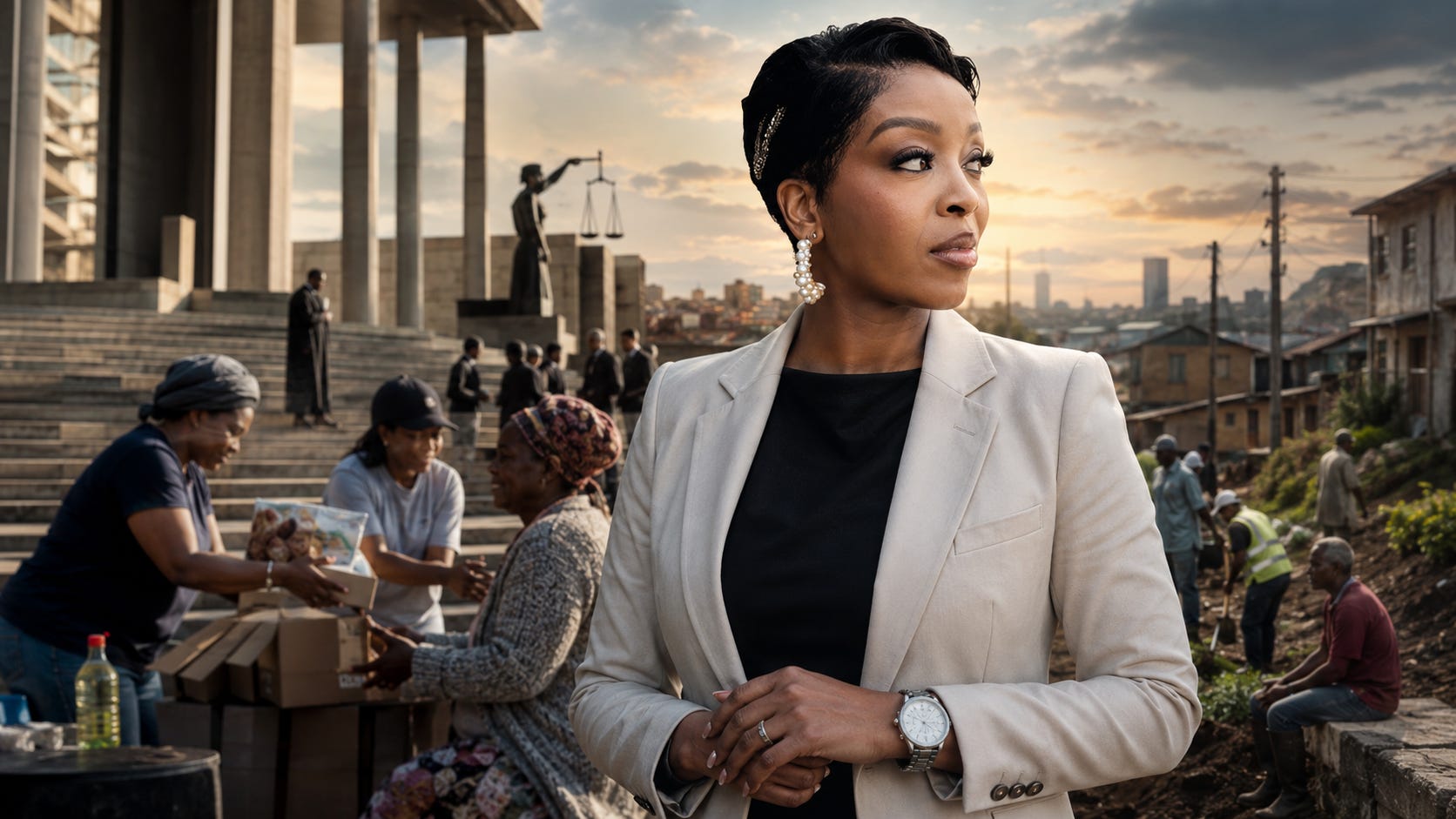
While I still have reservations about the March and March movement, I welcome its launch of the South Africa First Forum, a litigation organisation, and the March and March Foundation, a humanitarian organisation.
Its leader, Jacinta Ngobese-Zuma, has noted that both organisations are geared towards transforming the movement, over the medium to long term, into an Afriforum-type organisation that litigates in the public interest and focuses on empowering poor black South Africans at a grassroots level. Ngobese-Zuma has also made it clear that March and March has no intention of becoming a political party, even as there have been calls for it to do so.
Since its rise to prominence, I have taken a nuanced position on March and March. While I have not dismissed it entirely as a xenophobic grouping or embraced its thinking around immigration uncritically, I have noted that it is a grassroots movement engaging the state on genuine socio-economic issues affecting poor black South Africans.
Building on this, I have also argued that it is an exemplary model of grassroots activism, which is arguably a neglected form of participation in a democracy where political parties are seen as the only vehicles of change and voting as the only meaningful kind of political engagement.
Civil society in a failing state
As the Head of Public Relations at Afriforum, Ernst van Zyl, has correctly observed, the collapse of a state that remains intent on expanding its power over the lives of South Africans has been both a blessing and a curse.
On the one hand, it has generated a socio-economic crisis of massive proportions that is, in part, characterised by decaying infrastructure, astronomical levels of unemployment, porous borders, and rampant crime. On the other hand, it has created a vacuum that is increasingly being filled by citizens who are recognising the importance of becoming self-reliant and building parallel institutions that can insulate themselves from state failure and address socio-economic issues.
The civil society organisation van Zyl represents, Afriforum, is arguably one of the most effective organisations of its kind in South Africa, boasting over 300,000 members who make monthly contributions to support its work. It has used, and continues to use, its resources to litigate against harmful state policies in the interests of both its members and the broader public. It has also built, and continues to build, parallel institutions, including neighbourhood watches and educational institutions that are responding to the effects of state overreach and decay.
March and March, a grassroots movement that intends to transform itself over time into an effective civil society organisation, certainly does not yet have the resources, track record, or scale of membership that Afriforum has. That will likely remain the case for some time as the difficult work of institution-building commences.
That said, I believe it is moving in the right direction and positioning itself to potentially become an incredibly useful instrument for poor black South Africans in the years ahead.
The limits of formal politics
For far too long, many poor black South Africans have been duped by political opportunists who view politics as little more than an instrument of self-enrichment and them as little more than fodder to be manipulated with disingenuous political rhetoric. Some of these opportunists are in the ANC, which has broken the back of the state. Others are in the EFF and MK, while others can be found in smaller parties and still others are simply plotting to repackage the same empty promises that black South Africans have heard for more than three decades.
What all of these opportunists have in common is their commitment to a highly centralised approach to political governance that lies at the heart of the country’s socio-economic crisis.
Given that their combined electoral support is sufficient to keep them in power for the foreseeable future, black South Africans are, frankly, in serious trouble politically. Short of some unforeseen political realignment, they have little reason to expect real change through formal politics alone.
March and March has a mammoth task ahead of it in making black South Africans appreciate the importance of civil society as a counterweight to a collapsing state and as a force that can potentially influence the direction of politics positively in the years ahead.
Ngobese-Zuma herself has remarked that many black South Africans remain bound to political parties, so it will not be easy to convince them that a civil society organisation can play an important role in holding power to account and addressing some of the socio-economic issues confronting them.
The challenges and possibilities ahead
It will certainly not be easy to raise the kinds of resources needed to finance initiatives that can make a real difference in addressing socio-economic issues ranging from poverty to unemployment. There will be hesitance and doubt. But the impressive humanitarian work of Ayanda Msweli through his foundation should remind Ngobese-Zuma and those around her that it is possible to get many people to contribute even small amounts of money towards work that makes a meaningful difference in people’s lives.
It is my hope that, going forward, March and March will focus more on litigating against the government in the public interest, getting it to repeal harmful policies, and holding it accountable for its responsibility to serve South Africans. While protest action will remain an important tool, advancing its immigration policy agenda through legal and institutional channels is likely to be more effective in the long run.
I have no illusions about March and March’s position on immigration, so I understand that the public scapegoating of immigrants for the country’s socio-economic issues, as well as the routine harassment and dehumanisation of immigrants by some of its members, will likely continue.
This is deeply unfortunate because it risks further poisoning public discourse while shielding a government that has failed to create an environment in which many poor black South Africans can be free, prosperous, and safe in their own communities. It may also have the unintended effect of alienating people who might otherwise be open to listening to the movement’s broader arguments and supporting its work.
Nevertheless, March and March’s intention to evolve into a civil society organisation over time is positive, and it could potentially become something genuinely useful in the years ahead. This is why I think its development should be viewed with cautious optimism.
Ayanda Sakhile Zulu holds a BSocSci in Political Studies from the University of Pretoria and is a Policy Officer at the Free Market Foundation.

"March and March has a mammoth task ahead..." True, Ayanda, but they chose very useful and competent "partners" to learn from. I salute Jacinda for her bravery and good judgement...