

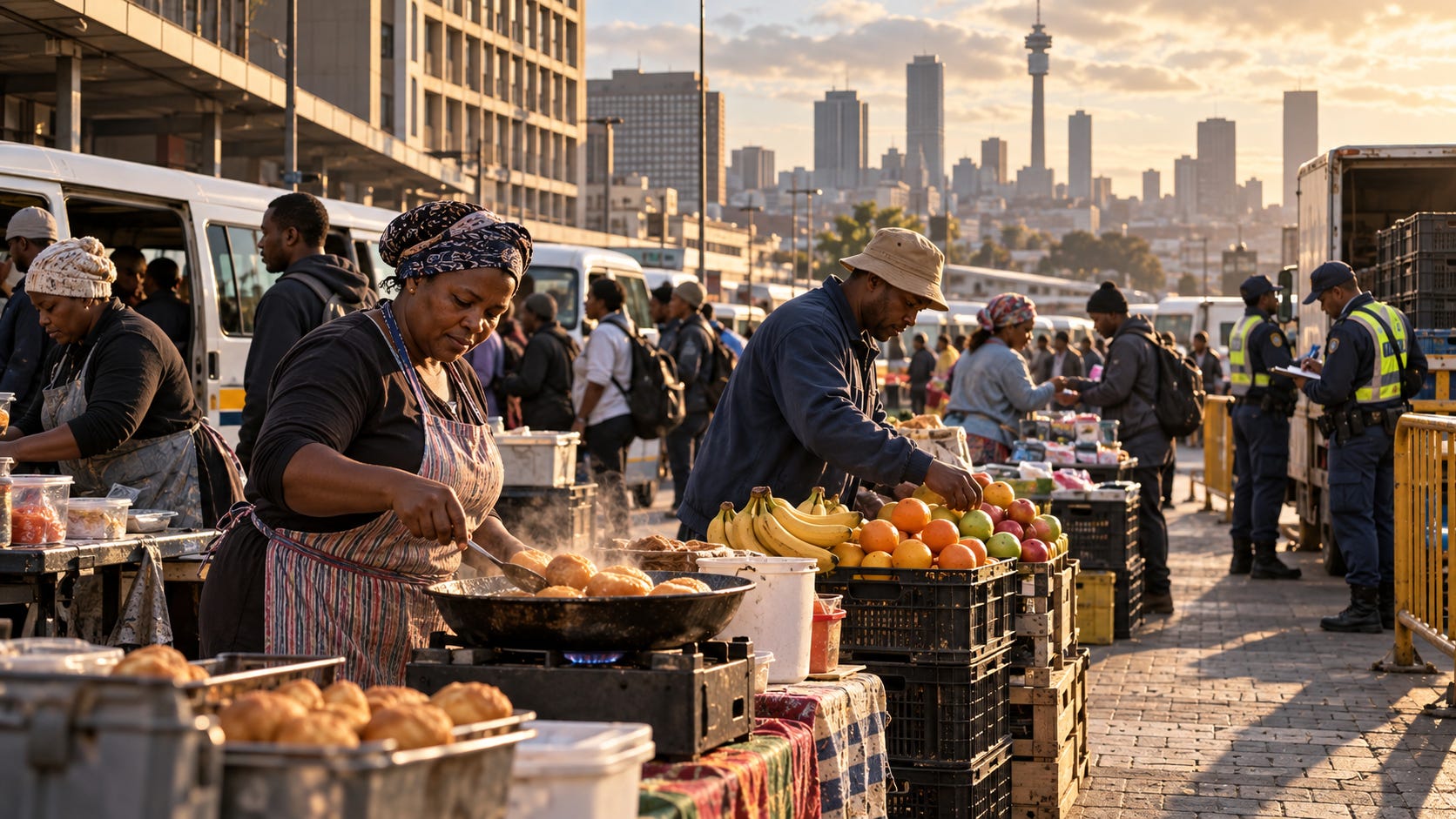
Walk the pavements of Johannesburg’s CBD or the ranks of Alexandra, and you are sure to encounter entrepreneurship in its rawest, most adaptive form. A woman cooks vetkoeks on a gas burner, while a man arranges fruit with an eye to the morning rush.
These are not mere residual “survivalists.” In the Austrian School tradition, they are alert entrepreneurs engaged in discovery, coordinating scarce resources, satisfying genuine consumer preferences, and creating value amid the truly dynamic uncertainty of the Johannesburg market, as well as many other locations across the country.
Despite the invaluable service provided by informal traders, the City of Johannesburg’s default response remains punitive. Clearance operations by the Johannesburg Metropolitan Police Department continue to remove traders from the streets, confiscate stock, and treat peaceful exchange as disorderly conduct.
The October 2025 operation, which began on De Villiers Street and spread to other inner-city areas and townships, is a relatively recent major example of this punitive rather than facilitative approach. Officials justify such actions by citing by-law compliance, pavement obstruction, and the maintenance of “order.” Traders, however, suffer lost livelihoods, court battles, and prolonged uncertainty as verification processes continue to drag on.
The 2012 Informal Trading By-laws and the more progressive 2022 Informal Trading Policy form the basis upon which the City of Johannesburg takes its actions. Although trade is not inherently harmful and should be regulated by those engaged in it through their conduct, these laws exist, and this piece does not argue against them per se. The issue, rather, lies in the decision to enforce these laws through a punitive lens rather than a facilitative one.
Formalisation is often presented as the solution for these informal traders. In practice, however, it frequently acts as a barrier.
For example, traders selling cooked food require a Certificate of Acceptability under Regulation R.638 of the Foodstuffs, Cosmetics and Disinfectants Act. In Johannesburg, this certificate is issued free of charge following an inspection of the premises by an Environmental Health Practitioner.
On paper, the process is clear. In practice, it clashes with reality.
Regulation R.638 requires washable surfaces, dedicated hand-washing facilities with soap and hygienic drying, potable water, proper drainage, temperature control, and effective pest management, all standards designed for fixed premises.
A pavement stall, owned and operated by someone who likely lacks substantial capital or access to it, rarely meets these standards without infrastructure that the City seldom provides. What appears on paper to be a “reasonable” standard entrenches an economic structure in which the only formally recognised enterprises by the state are those with high capital outlays, either because they are long established or for other reasons.
The certificate is non-transferable and specific to the site. If the location or the person in charge changes, the process must be restarted.
In practice, this means a food vendor cannot relocate or follow their entrepreneurial instincts to areas with higher foot traffic, such as sports or community events held occasionally, without reapplying for a new certificate for that particular location.
Evidence from Alexandra highlights the challenges of compliance.
In a 2023 study of 39 informal food traders in the township, only six held permits authorising them to operate in public spaces. Of the 33 without permits, twelve had previously attempted to apply but abandoned the effort because the process was cumbersome and costly; twenty-one had never applied.
These entrepreneurs described administrative delays, inconsistency, and a lack of transparency. During the state lockdowns of 2020, additional requirements for “essential service” permits extended waiting times to over a year for some, forcing many to revert to unauthorised trading simply to survive.
The study concluded that the City’s licensing and infrastructure measures remain fragmented, uncoordinated, and focused more on control than on enablement.
From an Austrian economic perspective, these hurdles are significant. Formalisation is desirable only when it is voluntary and when the costs of compliance do not exceed the benefits.
High fixed costs, such as certificates, layout plans, proof of training, fire certificates for open flames, annual renewals, and limited demarcated sites, increase the price of entry and hinder the discovery process.
Large formal operators can absorb these costs, whereas the micro-trader in Jabulani or Alexandra cannot.
The trade-off for the intention, since the results are not guaranteed, of wanting safer food or orderly streets is that there are fewer traders and entrepreneurs. This then leads to less competition in the market, culminating in higher prices for low-income consumers, who must obtain their goods and services from those businesses that complied with the costly regulations and passed those costs on to them.
What can be done, though?
For starters, the Council for the City of Johannesburg, along with any other municipality, can direct officials to prioritise enablement. This involves expanding demarcated trading areas through transparent, trader-involved planning, simplifying documentation, and providing shared basic infrastructure at ranks and markets owned by the City.
It is also crucial that the City regards health standards as graduated and practical, rather than as absolute barriers, given the disparity between these standards and the realities faced by street food vendors.
Lastly, the City must cease and discourage the routine confiscation of stock as the initial response by law enforcement to non-compliance. A revised by-law that reduces, rather than increases, compliance costs would better align formalisation with the realities of township and street economies.
Johannesburg’s informal sector already employs hundreds of thousands and supplies goods that formal retail often fails to provide at the right price and in the right place. Criminalising or over-regulating peaceful trade does not create order; rather, it destroys capital and agency for those who need them most.
The path forward is not through more enforcement campaigns or increasingly stringent formalisation thresholds. Rather, it involves removing artificial obstacles so that ordinary people can accumulate capital, expand their enterprises, and serve their customers.
This is how entrepreneurship strengthens the capital structure. This is how a city, a province, or a society becomes prosperous.
Zakhele Mthembu, BA Law LLB (Wits), is Policy Officer at the Free Market Foundation.
Exemption is the key. Certiain areas should be exempted from these draconian regulations. If exemption does not meet the regulators need for control, the officials should only act when customers complain. Regulations just open the door for corruption. Cost of compliance is killing business in South Africa.