


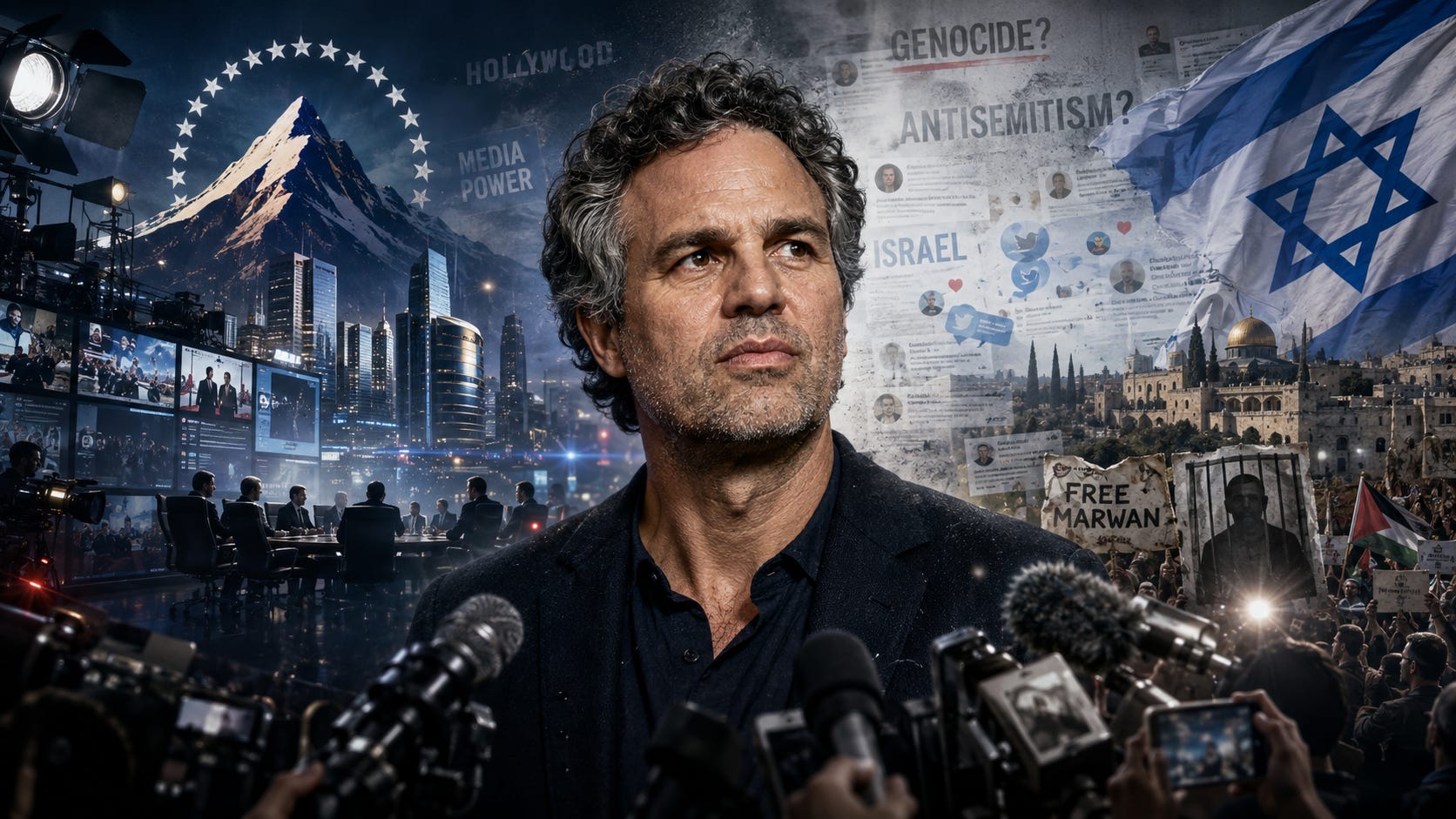
Israel and the Jews have, once again, been at the centre of some controversy over the past fortnight. Or more specifically, Israel and the Jews in relation to acclaimed actor and outspoken activist, Mark Ruffalo (The Hulk, Poor Things). The actor made some comments about the controversial merger between Paramount Skydance and Warner Brothers Discovery – the two major entertainment behemoths that make up a sizeable portion of the American media landscape whose monopoly-forming merger has cleared its required regulatory reviews but is still being challenged by a coalition of US states – that seemed to draw on classic antisemitic canards about “Jewish power” against Paramount CEO David Ellison and his father Larry, while also bizarrely bringing the so-called “genocide” in Gaza into his criticisms of a business merger. This resulted in quick condemnation by Paramount and a just as speedy rebuttal by Ruffalo against allegations of antisemitism.
Meanwhile, at the same time this was happening, Ruffalo and some twenty other actors known for their work in Marvel movies made news by signing a petition calling on the United Nations and the international community to force Israel to release Marwan Barghouti: the infamous Palestinian leader, known by supporters as the “Palestinian Mandela”, who sits in jail after being convicted for the murder of five people during the Second Intifada and the attempted murder of another.
That Ruffalo and his Marvel comrades in arms have made millions of dollars playing characters created by Jews (usually Stan Lee and/or Jack Kirby – the latter of whom was an especially proud Jew and listed a three week visit to Israel as one of the highlights of his life) is an irony that appears lost on them.
Ruffalo: Antisemitic, Antisemite or Something Else?
Barghouti is the rather more complicated case, so to start off with something slightly more straightforward, let’s look at what exactly Mark Ruffalo was accusing Ellison of, whether those statements are antisemitic, and what, if anything, they reveal about Ruffalo, who has been constantly and virulently anti-Israel over the past decade.
This latest controversy all started on Friday, 21 August, when Ruffalo posted on social media an old clip of Paramount board member, Safra Catz talking about the “really profoundly scary technologies” developed by Larry Ellison’s database management company, Oracle, that were used to assist the Israeli military in its war against Hamas. In his commentary on the video, Ruffalo remarked, “look how she revels in what we now have come to see as a genocide, which was built on an apartheid system of oppression powered by Oracle... [which] will probably be merged into one of the largest media corporations in the world, and one day be used against you.” Oracle is a database company; he talks of them as weapon manufacturers.
He also accused the Ellisons of being “classic oligarchs” and of “powering some of the most destructive and inhuman forces in the world” whose influence would only grow with the merger of Warner Brothers and Paramount. Again, Oracle makes database software.
Now, it has to be said, there are a great many reasons for why Ruffalo and many others like him are vehemently opposed to the Paramount/ Warners merger. There’s the alleged influence of Donald Trump on Ellison and how he runs his company. There’s the real risk of massive job losses that would come with such a merger. There’s the gross violations of anti-trust laws that would inevitably accompany one family controlling such a large chunk of the entertainment and news industries. These are incredibly persuasive arguments and have all but entirely persuaded me of the merger being a bad idea.
But, as a spokesperson for Paramount said, “[we are] troubled when antisemitic tropes are invoked in purported service of a business dispute. Words like ‘genocide’ and ‘apartheid,’ applied to a corporate transaction, aren’t just wrong – they’re a bridge too far, and they cheapen the very real suffering those words are meant to describe.”
I would love to be able to write off Ruffalo’s statements as an unfortunate but well-intentioned plea against corporate greed if not for the simple inescapable truth that he has a very long history of singling out the Jewish state and only the Jewish state for the greatest evils in the world. Does this make Mark Ruffalo an antisemite? Well, as a fan of his work, I certainly hope not. It’s entirely possible that he is just another sincere but not-very-smart celebrity sounding off about something he doesn’t know much about.
Worth noting too is that this particular conflict had caught his attention by 2014. By 2016, the year that Donald Trump was first elected, the left took a turn to the extreme in response; taking increasingly hard-line positions against anything even remotely associated with Trump – including and most especially Israel. And whatever else you may say about Ruffalo, he’s a hell of a lefty.
At this point, though, I’m not even sure if that matters. There is, after all, only so much that someone can claim ignorance for their actions. And Ruffalo has proven, repeatedly, that he has absolutely no intention to educate himself beyond his cheap, ignorant activism.
In his response to Paramount’s allegations, where he wrote off claims of antisemitism as “appalling and fundamentally dishonest”, he noted that criticisms of the Israeli government do not make him antisemitic and that he was well within his rights to warn of the many real dangers of this merger. He is right on both points, but demonization is not the same as criticism and there are more than enough valid reasons to be against the merger without reverting to conspiracy theories built around Jewish power and money.
At the heart of his open letter, though, was the insistence that, “my views come from my own political convictions and should never be interpreted as hostility toward Jewish people, for whom I have deep love and respect. Everything I know about acting, activism, and humanism has been profoundly shaped by the Jewish friends, colleagues, and loved ones who have been integral and family throughout every point of my life.”
Even if we assume that he’s not just employing the “my best friend is Jewish” response to allegations of antisemitism, there’s a real irony at the heart of that statement when, in September 2025, he joined notorious anti-Israel pundit, Mehdi Hasan, on his podcast and spoke, with some pride, at how he refused to listen to Jewish and pro-Israel voices who dare to offer contrary views about Israel being an apartheid state and the war in Gaza being a genocide.
Well, Mark, which one is it? Or are you “profoundly shaped” only by those Jews that already agree with you?
Celebs for Terrorism?
And then there’s the matter of his involvement with the petition to free Marwan Barghouti. Barghouti himself is far too complicated to get into here – his case deserves, at the very least, a dedicated article by itself – and, frankly, for all that I’ve read up on him, I’ve yet to entangle the various threads that have caused Barghouti to be considered either a bloodthirsty terrorist or the last great hope for the two-state solution. Or both.
But that’s the point.
These celebrities are quick to readily accept the positive spin on Barghouti, without properly reckoning with the fact that he was convicted of orchestrating the murder of five civilians and the attempted murder of another during the Second Intifada, of which Israeli intelligence sees him as one of its main architects. This is not something to swipe under the rug and if you are to talk about “freeing Marwan”, it has to be properly reckoned with and understood. Which, I’m sorry, none of the celebrities have shown the vaguest interest in doing so.
It’s really besides the point that for many, if not most, if not all, of these celebrities, this is not about hatred of Jews or even of Israel. I’m sure for many of them it comes from being rightly horrified by the photos and videos coming out of Gaza or from jumping onto the latest virtue-signalling bandwagon to bolster their public image or from deferred hatred of Donald Trump.
Because even if we assume the very best of intentions on their part, that doesn’t change how dangerous their ill-informed, reckless, grossly simplified rhetoric continues to be. It gives permission to attack “Zionists” worldwide and to underestimate antisemitic hate. Perhaps even worse, by creating false or simplistic narratives to fit into their limited moral view of the world, they empower the most extremist voices on both sides and end up hurting those most directly affected by the conflict.
Celebrities constantly talk about having the responsibility to use their platforms to speak out against what they see as injustice, but when they try tackle tricky subjects like the Middle East without understanding its nuances, conflicting narratives, and myriad complexities, perhaps the most “responsible” thing for them to do is to shut up and listen.
Ilan Preskovsky is a Johannesburg-based freelance writer, who has covered everything from international politics to Jewish culture/ religion to film and TV reviews. His work has been featured online on the likes of News24, Popverse and BizNews, and in print in Business Day, Jewish Life Magazine and the Star, among others.

Mark Ruffalo is most definitely in the something else category. I mean that with an enormous amount of respect. He is perhaps in the belief of anti-stupidity. But only in a respectful of ways. His belief system is righteous and dignified. Listen to him when he speaks. Intelligence and Grace. I truly believe it will benefit everybody to take the high road on this. There is alot of work that needs to be done to get out of the heap of mess that has been created in the last decade. BTW Biden worked hard to get out of the mess created the first term. This second term is a doozie. Glory Be!
For clarity Israel does not equal Jews and vice versa. Criticism of Israel is not attacking Jews per se, but can be if mixed with remarks meant to imply all Jews. I am an American, there is plenty of criticism of the policies of the United States but that is not an insult to the American people, most of whom seem to agree with such criticism saying it is deserved.
Now, anti-Semitism has grown. It is largely a result of being powered-up by the policies of Netanyahu, a man who like Putin should be brought to justice in a court.