


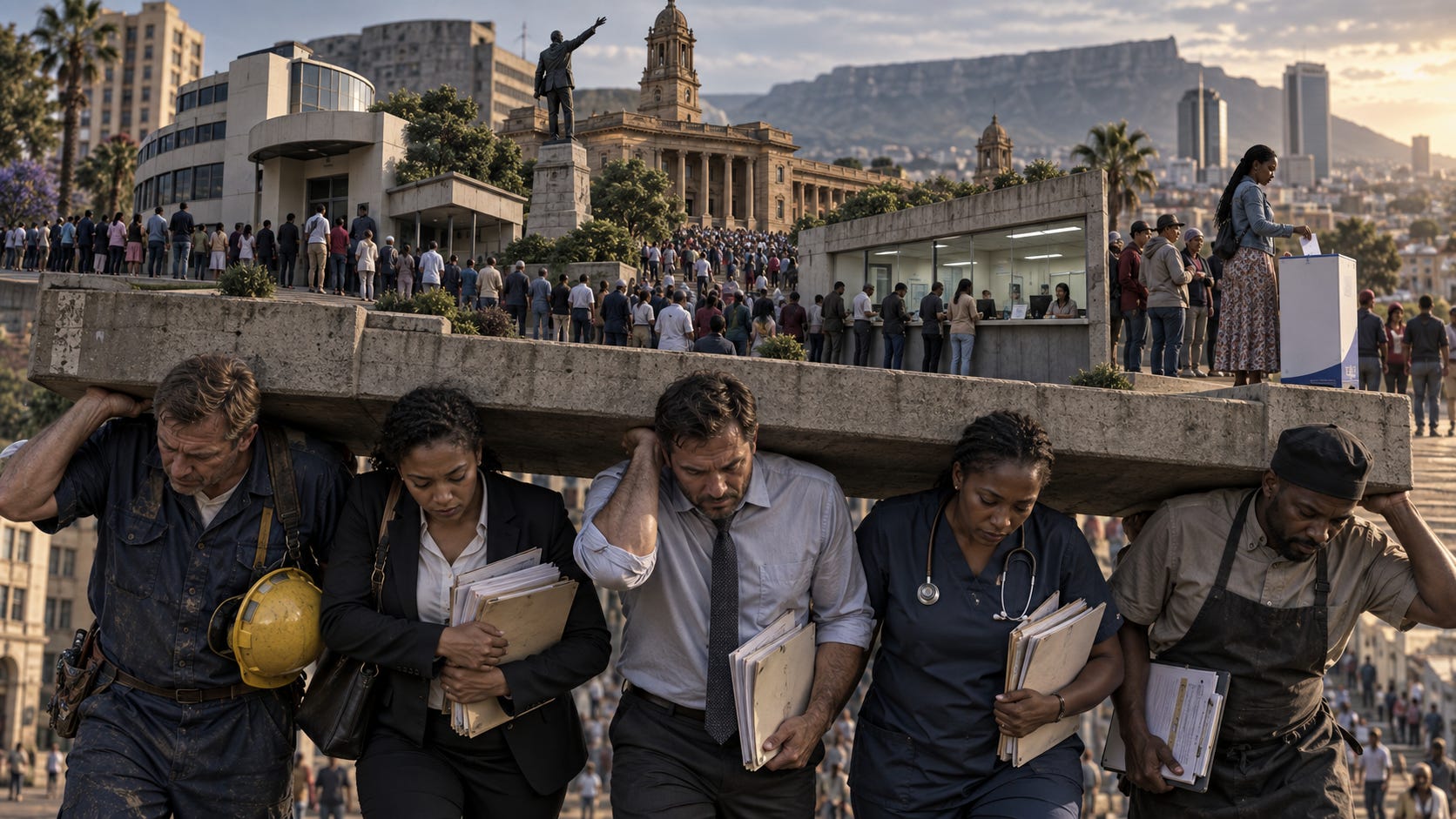
There are just under 30 million registered voters in South Africa. There are approximately 26.5 million social grant beneficiaries, with an estimated 13.55 million being working-age adults. The Social Relief of Distress (SRD) grant, which was meant to be temporary, supports approximately 8 million working-age people alone.
There are only 14.2 million registered taxpayers in South Africa. Only around 8.3 million people pay personal income tax. Of those 8.3 million, approximately 645,000 are responsible for paying half of all personal income tax.
A tiny and constantly diminishing tax base is expected to prop up an increasingly expensive government and welfare regime that is growing at an unsustainable pace. Rather than embracing free-market reforms to enable job creation, generate more tax revenue and reduce the number of people dependent on welfare grants, the government is content to milk these taxpayers for more money.
And while the government only exists thanks to these taxpayers, they represent less than a third of registered voters. So, despite truly having skin in the game and contributing towards the funding of the government and the consequences of an election, the taxpaying public has no substantial say over how its money is spent.
How is that fair?
How can we expect millions of people who don’t pay the price to truly make responsible decisions with other people’s money? As it stands, there is a perverse incentive for millions of voters to milk productive income earners for increasingly more money. This is unjust and counterproductive.
The Social Research Foundation (SRF) found that 51% of ANC supporters lived in households earning less than R2,999 a month, putting those households and their residents firmly below the personal income tax threshold. If we generously assume that the remaining 49% of ANC voters pay income tax, which is a gross overstatement, as many may merely live with an income-taxpaying individual, then roughly 3.2 million ANC voters would pay income tax.
If only income taxpayers voted, then the ANC would likely reach a ceiling of approximately 38.55% of the vote, if that.
As it stands, this is not the case. Most voters go to the polls without true skin in the game. Their wallets don’t directly suffer the excesses of government. And it shows.
South Africa’s government refuses to pass common-sense reforms that would help not just taxpayers, but all citizens. And politically uneducated voters who have no real incentive to rein in government behaviour keep granting it their mandate.
This is not the recipe for a healthy democracy. It is the foundation of a populist dictatorship where tyrants rule by the mandate of bribed masses.
Functional societies are built around good incentives. They are built around accountability mechanisms. Giving the ability to elect rulers to a population with no skin in the game, no direct accountability and perverse incentives is not how you create a functioning society.
Franchise Through Tax Compliance
If you fund government spending, you get a say in how the government spends. It should be as simple as that. Taxpayers are best equipped to decide how their money should be spent and will hold a government far more accountable for corruption and mismanagement than a non-paying voting public ever would.
Some may fear that this would incentivise taxpayers to implement policies to dissuade other people from paying tax and therefore becoming voters. But there is a built-in incentive for taxpayers to want more taxpayers. The more people who pay tax, the lower the individual tax burden can be. If a tax base wants greater public spending or wishes to lower its individual tax burden while maintaining the fiscus, it has an incentive to encourage as many people as possible to become taxpayers.
Before the notion that the franchise had to be universal became an arbitrary rule of modern democracy, there were plenty of examples of successful polities that restricted voting rights based on taxation, property or other qualifications.
The Serene Republic of Venice maintained a stable and flourishing republic for centuries under a restricted, aristocratic franchise, before being brought down by Napoleon. Pennsylvania historically maintained a successful local republic with voting qualifications linked to taxpaying. Both Belgium and the Netherlands had stable, constitutional governments that, for significant periods, restricted the franchise according to tax qualifications.
Even the Cape Colony had a qualified, formally non-racial franchise based on property and income requirements. This enabled the development of a representative political system that was unfortunately undermined by subsequent discriminatory legislation.
What must be added is that none of these systems was simply a case of capricious, wealthy taxpayers lording over the poor masses. They functioned because the people who governed and elected the government had a vested interest in keeping society functioning.
Strong constitutional restraints, powerful rights and respect for the rule of law were strengthened by these qualified franchises, not weakened by them.
A taxpayer franchise aligns political power with political cost. Voters who must personally bear the consequences of waste, corruption and reckless spending have a stronger incentive to demand competent government, sound finances and limits on state power. Universal franchise weakens that feedback loop by allowing large voting blocs to demand benefits for which they bear little or no direct fiscal cost, making populism and redistribution at someone else’s expense politically easier.
Will We Ever Get a Taxpayer Franchise?
Unfortunately, the genie is out of the bottle, and non-taxpayers will never allow a taxpayer franchise to exist again, despite its moral and practical superiority.
But that doesn’t mean we shouldn’t work towards making as many voters taxpayers as possible. This isn’t to benefit the government itself, but rather to ensure that as many voters as possible have the incentive to hold the government accountable and not simply support endless welfare increases.
To improve tax compliance, the system needs to be completely simplified and overhauled. There shouldn’t be dozens of different, overlapping taxes that require the hiring of experts to make sense of them.
Tax should be levied at a flat rate on individuals and corporations. Percentages already scale, and there is no need for a sliding-scale, so-called progressive tax system. All this encourages is the hiding of income to avoid paying a higher percentage.
Countries like Mauritius, which historically maintained a comparatively simple, low-rate income tax system, have demonstrated the appeal of straightforward taxation, although Mauritius has since moved towards a more progressive structure.
Ensuring that there is only one simple tax also encourages the government to deregulate and pass laws that enable wealth creation, rather than finding creative ways to extract more revenue from an already overtaxed public.
South Africa may never return to a taxpayer franchise, but we can still pursue the principle behind it: giving as many voters as possible genuine skin in the game. That means simplifying tax, lowering the burden of compliance, enabling economic growth and turning grant recipients into workers, entrepreneurs and taxpayers.
A healthy democracy is one in which more citizens contribute to the state, feel the cost of bad government and have every incentive to demand accountability in return.
Nicholas Woode-Smith is the Managing Editor of the Rational Standard and a Senior Associate of the Free Market Foundation. He writes in his personal capacity.
Perhaps if a future SA constitutional dispensation allows for greater self-determination by local communities and smaller groups with shared interests, local taxes could be paid locally for the develoment needs of those specific communities. A Federal Tax on all can be levied, but with the various self-determining communities still having a say in the extraction and expenditure of those taxes in accordance with their proportional contributions to the federal tax pool.
In effect, the forgoing is already happening in South Africa, but informally. Communities established organisations to properly do what the governmental sector fails to do or fails to maintain properly. Those communities also pay a "federal tax", which they have little say over because of all that was explained by Nicholas in the article...
Excellent article, Nicholas. Well argued and well written.