


Written By: Phenyo Matabane
History rarely announces itself politely. In this instance, it did not knock; it arrived violently, when the long-standing tensions between Israel and Iran finally ruptured into open confrontation.
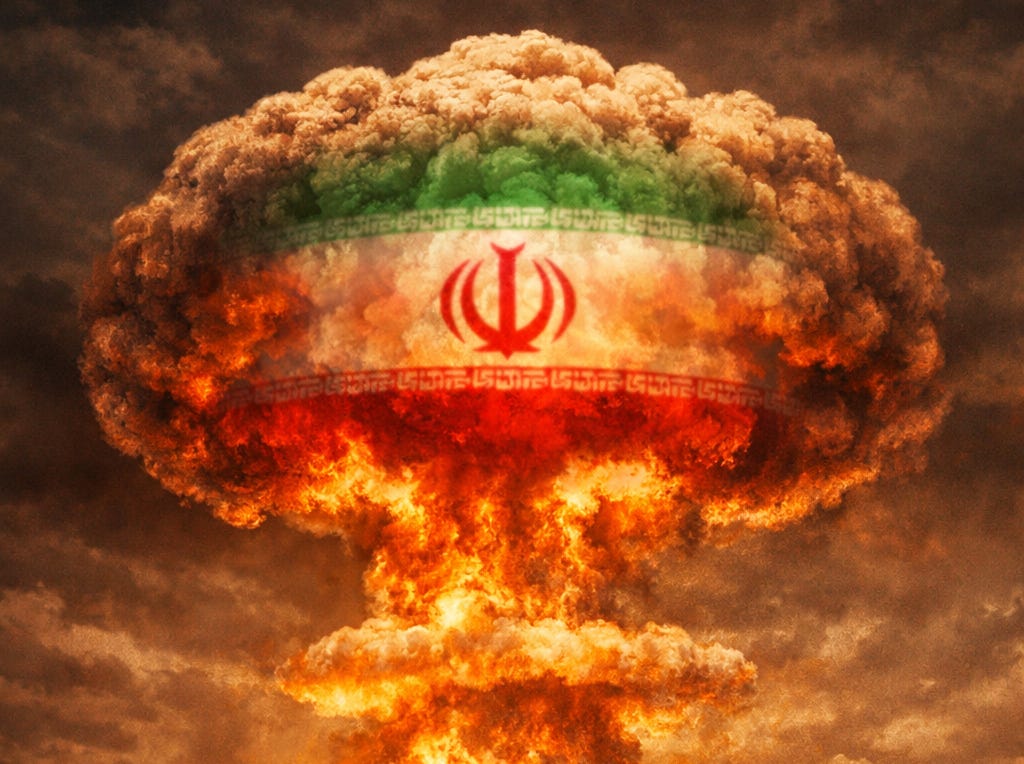
What the world is now witnessing - the direct conflict involving Israel, the United States, and Iran - is not the sudden eruption of chaos. It is the delayed consequence of decades of strategic denial, diplomatic procrastination, and moral hedging. Within the opening days of the campaign, international security analysts reported more than 2,000 combined strikes across Iranian military infrastructure, with Israel leading the majority of operations in the initial phase. The scale and speed of the strikes dramatically degraded Iran’s military capabilities.
To understand why this moment feels historically decisive - why it carries the weight of irreversibility - we must look beyond the missiles and rhetoric. The roots of this confrontation run deep, long before the airstrikes, long before the spiralling escalation, and long before reports emerged that Iran’s Supreme Leader, Ayatollah Ali Khamenei, may have been killed in an air strike during the opening phase of the conflict.
Iran’s nuclear programme has long sat at the centre of global suspicion. Since the establishment of the Islamic Republic in 1979, the programme has existed not only as a technological ambition but as part of a broader ideological worldview that blends revolutionary grievance with regional power projection. The Islamic Republic did not merely seek the prestige or deterrence associated with nuclear capability; it sought strategic leverage across the Middle East and beyond.
For years, the international community attempted to manage this challenge through diplomacy, sanctions relief, and inspection regimes. The 2015 Joint Comprehensive Plan of Action (JCPOA) was the most ambitious attempt to place verifiable limits on Iran’s nuclear programme. Yet every agreement rested on a fragile premise: that Tehran ultimately preferred normalisation with the world over ideological confrontation.
By the mid-2020s, that premise had begun to collapse. Reports from the International Atomic Energy Agency (IAEA), echoed by Western intelligence assessments and widely reported by outlets such as The New York Times and Reuters, warned that Iran had significantly accelerated uranium enrichment, reaching levels approaching weapons-grade purity. Underground facilities were expanded and hardened. Inspections were increasingly restricted. Diplomatic deadlines became ritualistic exercises rather than enforcement mechanisms.
For Israel, this trajectory transformed the issue from a strategic concern into an existential calculation. Israeli security doctrine has always been shaped by historical memory. When Iranian leaders repeatedly call for the elimination of the Jewish state - language documented across years of speeches and state media broadcasts - Israeli policymakers interpret those threats not as rhetorical theatre but as strategic intent.
This helps explain why Israel has long reserved the right to act pre-emptively against emerging existential threats. The current military confrontation is therefore less a sudden escalation than the culmination of a long-standing doctrine: that ambiguity and deterrence have limits when adversaries move toward nuclear capability.
In Washington, the decision to participate alongside Israel appears to reflect a similar strategic calculation. According to reporting by The Wall Street Journal and Politico, U.S. officials characterised the joint operation as a preventative effort aimed at halting four converging threats: a potential nuclear breakout, Iran’s expanding ballistic missile infrastructure, its network of regional proxy forces, and the risk of escalating instability across the Middle East.
The confirmed killing of Iran’s Supreme Leader, Ayatollah Ali Khamenei, during the opening day of the strikes - alongside dozens of senior Islamic Revolutionary Guard Corps (IRGC) commanders - marked a profound shift in operational doctrine. For decades, military strategy largely focused on degrading infrastructure while leaving the regime’s ideological leadership intact. The decision to strike directly at the apex of Iran’s power structure signalled that this longstanding restraint had ended.
Whether one supports this escalation or not, its underlying logic is unmistakable: deterrence without consequences had reached its limits.
Yet any honest assessment of Iran must distinguish between the regime and the people who live under it - a distinction often blurred in superficial commentary. The Islamic Republic has governed through repression for decades, and waves of protest have repeatedly challenged its authority. Demonstrations in recent years, widely covered by international media and human-rights organisations, have been driven by economic collapse, generational frustration, and resistance to social restrictions imposed by the state.
Those protests were met with severe crackdowns. Thousands were massacred. Even more arrested. Internet access was restricted. Security forces used lethal force against demonstrators. Human Rights Watch and Amnesty International have documented widespread abuses linked to these crackdowns.
Beneath that repression lies a very different Iran. One that is young, urban, technologically connected, and increasingly alienated from clerical rule. Surveys of the Iranian diaspora, independent polling, and testimony from dissidents consistently point to a society that desires dignity, opportunity, and freedom from ideological control.
In that context, the possibility of regime change is often framed internationally as a geopolitical objective. For many Iranians, however, it has long been an internal aspiration.
The operational details of the conflict matter because they shape the legitimacy debate. According to multiple defence analysts cited in international reporting, the opening phase of the campaign targeted nuclear facilities at Fordow, Natanz, and Isfahan, alongside missile infrastructure at military sites including Khojir and Parchin. The strikes also disrupted key IRGC command networks and naval assets.
Iran’s retaliation, waves of missile and drone attacks aimed at Israeli cities and regional targets across the Gulf, underscored the broader regional stakes. Civilians in places such as Beit Shemesh, Dubai, Kuwait City, and Bahrain were suddenly drawn into a conflict whose strategic centre lies far beyond their streets.
As casualties mounted and the strikes continued, the debate inevitably turned to international law. Critics have invoked the UN Charter’s principles governing the use of force. Yet Article 51 recognises a state’s right to self-defence when an armed attack is imminent.
The legal question, therefore, becomes a matter of timing and evidence: at what point does a gathering threat justify pre-emptive action?
That question has no universally accepted answer. War is never clean, never morally uncomplicated. But the deeper issue is not legal interpretation alone. It is responsibility. When diplomacy fails, inspections collapse, enrichment accelerates, and threats grow increasingly explicit, policymakers must confront a difficult dilemma: when does restraint become complicity?
For South Africans, the moment is particularly uncomfortable. The country’s diplomatic tradition emphasises mediation, non-alignment, and solidarity with liberation movements. Yet South Africa also knows, from its own history, how regimes can cloak repression in revolutionary language.
Acknowledging Israel’s right to defend itself against existential threats does not negate the suffering of Palestinians or the need for regional justice. The Middle East’s tragedies are not mutually exclusive.
The most difficult phase of this conflict still lies ahead. Military force can destroy infrastructure and disrupt regimes, but it cannot by itself build legitimacy or stability. If any post-conflict leadership in Iran simply rebrands authoritarian control under a different banner, the cycle of confrontation will resume.
The international community, including South Africa, will eventually face a stark choice: whether to engage with an Iran that reforms, or isolate one that doubles down on ideological confrontation.
The Iranian people have already signalled their aspirations in the streets, through protests and acts of resistance that carry enormous personal risk. The question is whether the world will listen once the noise of war fades.
This conflict marks the end of an era. The era in which the international community could pretend that Iran’s nuclear ambitions were indefinitely negotiable, that genocidal rhetoric was merely theatrical, and that time alone would moderate revolutionary ideology.
History has intervened.
Whether this moment becomes the beginning of regional recalibration or merely another chapter of prolonged instability will depend not only on military outcomes, but on political courage, diplomatic clarity, and moral resolve.
And courage, as South Africans know from experience, is never abstract. It is chosen - or avoided - one moment at a time.
Phenyo Matabane is a consultant and economics master’s candidate, passionate about Africa’s development. He has served in student governance at the University of Pretoria and continues to support community-based projects in townships for the youth.
I do not normally like to comment on these articles, but I just want to draw your attention to the fact that you must please not rely on the official media for the truth nor the rantings of expats with a grievance. The US has gone and killed the one man that was stopping Iran from making a nuclear weapon and now they will learn from North Korea, if you have a nuclear weapon they leave you alone! As Alexander Mercurius would say "just saying"
Your statement: "Yet South Africa also knows, from its own history, how regimes can cloak repression in revolutionary language."
The Iranian regime does exactly that, cloaking repression in revolutionary language.
South Africa has its problems but it remains nonetheless a global beacon of democracy, the women of South Africa who are the backbone of the country enjoy arguably one of the highest levels of women rights in the world, they can be sovereign individuals.
The women of Iran?
Iran is a strange bedfellow.