

Written By: Tonderai Godknows Mapfumo
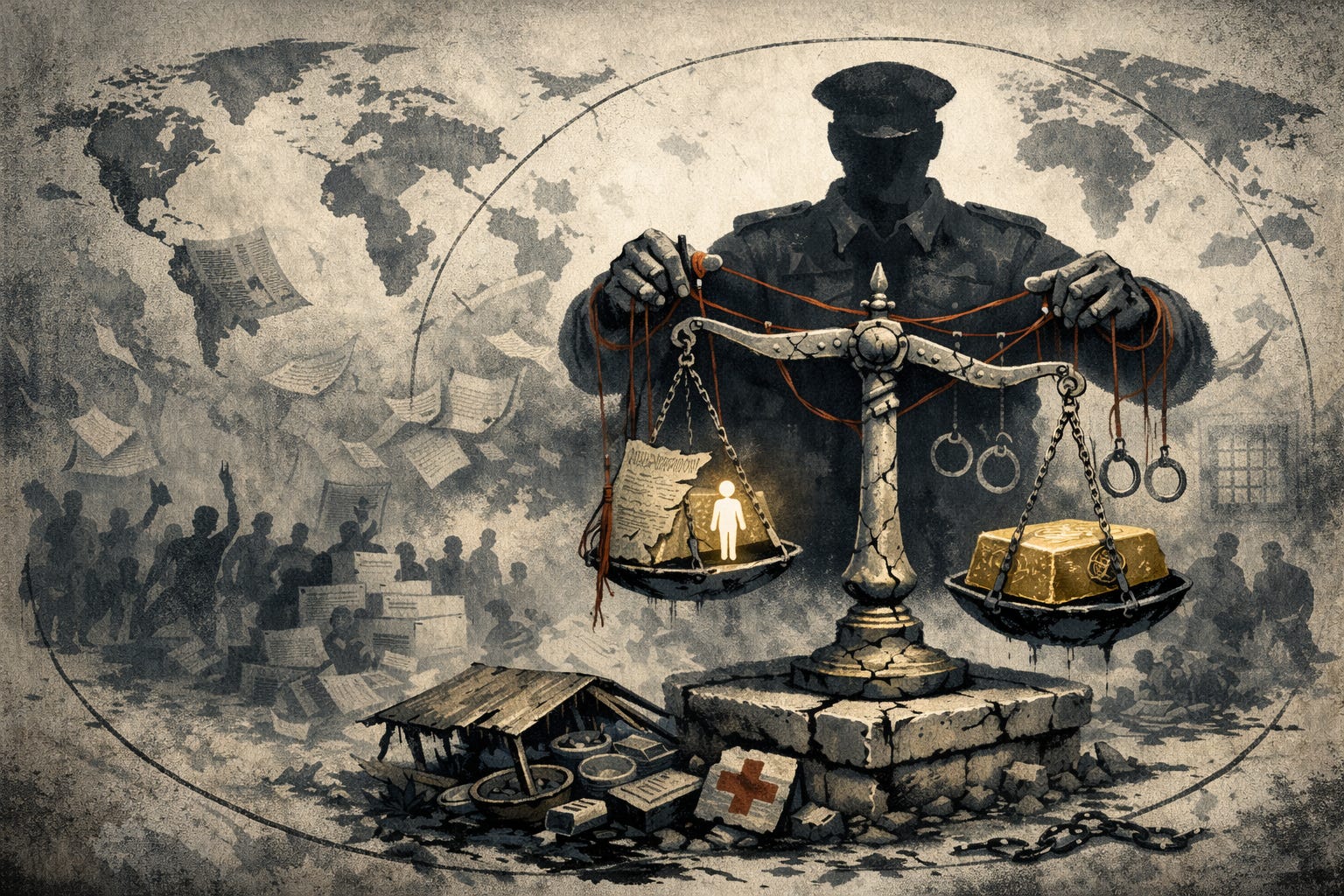
International law exists to foster peace, security, and respect for human rights across sovereign nations. However, the actions of dictators like Nicolás Maduro in Venezuela challenge these principles, showcasing a blatant disregard for the rule of law and human rights. As noted by various international observers, including representatives at the UN, the conduct of powerful nations can undermine these essential legal frameworks. This article seeks to analyze Maduro’s actions in the context of international law and argues that he not only disrespects international norms but also the very foundations of human rights and constitutionalism.
Human rights violations under Maduro
Under Nicolás Maduro’s regime, Venezuela witnessed egregious human rights abuses. Reports from reputable organizations like Human Rights Watch outline systematic violations, including arbitrary detentions, torture, and extrajudicial killings. For instance, the Venezuelan security forces have been implicated in numerous cases of enforced disappearances, where individuals are detained without legal proceedings, never to be seen again. These actions not only breach human rights obligations but also contravene Venezuela’s own constitution, which ostensibly protects individual liberties.
Moreover, the government’s suppression of dissent became a hallmark of Maduro’s rule. Peaceful protests advocating democracy and economic reform have been met with brutal crackdowns. The use of excessive force against civilians merely expressing their discontent represents a clear violation of the right to free speech and assembly, both protected under international law. These human rights abuses indicate that Maduro’s government is not merely indifferent to legal frameworks; it actively seeks to dismantle them to maintain its grip on power.
Additionally, the humanitarian crisis in Venezuela underscores the regime’s failure to uphold basic rights. With millions facing food shortages and inadequate healthcare, the government’s policies directly undermine the right to life and health. Instead of addressing these critical issues, Maduro’s government has redirected resources toward military and repressive measures. This prioritisation of state control over citizens’ needs reveals a profound disrespect for human rights and international legal commitments.
Corruption and breach of constitutionalism
Corruption has flourished under Maduro’s administration, further eroding the rule of law and constitutionalism in Venezuela. Investigations by various international bodies highlight widespread graft, with Maduro and his inner circle allegedly embezzling billions from state resources. Such actions create a culture of impunity, where the ruling elite operate above the law, contributing to the state’s collapse. By prioritising personal gain over the welfare of the citizenry, Maduro’s regime not only violates its constitutional duties but also defies international norms against corruption.
Moreover, the dismantling of Venezuela’s democratic institutions has provided fertile ground for corruption. The Constitutional Assembly, convened by Maduro in 2017, effectively undermined the National Assembly, which was the last bastion of democratic governance. This move illustrated a blatant disregard for the constitutional framework, as the assembly’s purpose was to legitimize a series of increasingly authoritarian measures. By circumventing constitutional processes, Maduro undermines the very rule of law that is supposed to safeguard democratic principles.
The economic mismanagement that accompanies this corruption presents another violation of both human rights and international standards. The World Bank reports that the Venezuelan economy has plummeted due to a combination of state mismanagement and corruption, leading to hyperinflation and widespread poverty. As resources dwindle, the government’s inability to perform its constitutional obligations endangers the citizens’ rights to work, health, and security. This persistent refusal to adhere to the foundational principles of governance illustrates a clear breach of both domestic and international law.
A libertarian argument against dictatorial governance
From a libertarian perspective, the principle of non-aggression is foundational to a just society. Dictatorships, like Maduro’s regime, contrast starkly with this principle, as they often employ violence and coercion to maintain power. Maduro’s actions illustrate a blatant infringement not only on individual liberties but on the social contract intended to guide state-citizen relationships. The continuous breach of international laws exacerbates the suffering of the Venezuelan people, who are stripped of their rights through state-sponsored violence and repression.
Additionally, the argument against Maduro’s rule can be supported by emphasising the necessity of voluntary cooperation among citizens. Dictatorship disrupts the harmonious exchange that a free society depends upon, replacing it with fear and oppression. The lack of respect for human rights under Maduro’s leadership illustrates how totalitarian regimes impede personal liberty and economic prosperity. The contrast between the flourishing of free-market solutions in more democratic settings highlights the failures of dictatorship and its disregard for individual and collective rights.
Finally, the libertarian viewpoint advocates for the promotion of constitutionalism as a safeguard against tyrannical governance. The sequence of legal violations perpetrated by Maduro’s regime serves as a cautionary tale about the dangers of enabling authoritarian governance. Upholding constitutional protections and promoting respect for human rights are critical components for any society committed to liberty and justice. A commitment to these principles is essential not only for the betterment of Venezuelans but for the global community in holding power to account.
Conclusion
The breach of international law by dictators like Maduro poses significant challenges not just to those living under their regimes but to the global order itself. Through systematic human rights violations and rampant corruption, Maduro exemplifies the antithesis of the constitutional and legal norms essential for a free and just society. The libertarian perspective highlights the imperative of safeguarding individual rights against the encroachment of state power, reminding us that the rule of law must prevail to ensure a brighter future for all. The call for accountability against such breaches is stronger than ever, as the world must unite to uphold human dignity and the principles of justice against tyranny.
Tonderai Godknows Mapfumo is the Research and Advocacy Officer for COMALISO (Coalition for Market and Liberal Solutions) in Zimbabwe and an Associate of the Free Market Foundation.
According to the Cambridge and Oxford dictionaries, a dictator is a political leader with complete power over a country. This is a violation of the separation of powers principle, it does not inherently imply abuse but in practice it always leads to abuse because humans are flawed and even tr best people, in the most liberal countries will sometimes abuse power.
But it's important to not conflate liberty, constitutionalism and international law. Under international law, human rights are only paid lip service to. Only the very "worst" violations (i.e the ones impacting the most number of people, not the most serious violations against one person) are actually criminalized and even thennthe enforcement is very uneven and highly politicized.
International law does just about the worst job you can imagine protecting human rights. We must rely on libertarian philosophy and one of its practical implementations in constitutionalism and the rule of law, and even this is also unsatisfactory in the best case scenario countries (e.g Switzerland, the USA).
As long as you accept the need for a state you will have some violations, the most common being the routine property rights violation (theft) known as taxation.
Good article, may Marduro rot in an American jail and may Argentina lead the way forward for Latin America.
Well said Tonderai ... We live in a real world, that is inescapable even for us libertarians ...