


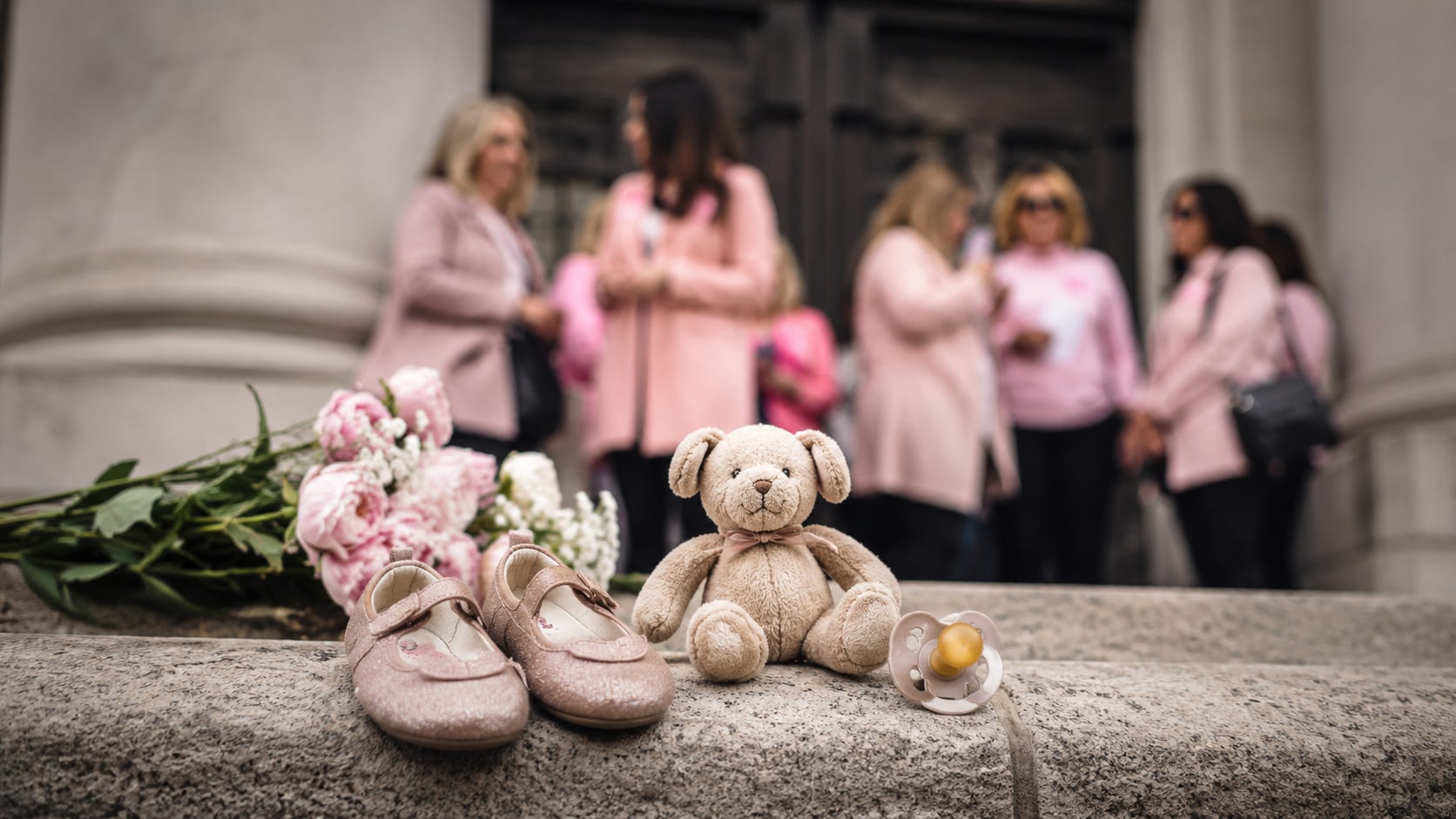
Something bizarre is happening outside a courthouse in Massachusetts.
Lindsay Clancy is on trial for killing her three children. Cora was five. Dawson was three. Callan was eight months old. According to the evidence presented in court, on 24 January 2023 she sent her husband out to run errands. Once he had left, she systematically strangled the three children one by one with exercise bands in the basement.
Clancy’s defence does not dispute that she killed them. She herself admits to killing them. The only question before the court is whether she was criminally responsible. Her lawyers argue she was suffering from postpartum psychosis and bipolar disorder. Prosecutors say the killings were deliberate.
Yet outside the courthouse, hundreds of supporters, many of them women dressed in pink, have gathered in support of Clancy. There are signs declaring “She Needed Help” and “Peace For Lindsay”. There are prayers, pink ribbons and women making hearts with their hands. A GoFundMe for her parents, centred on Lindsay and their support of her, has raised more than $1 million.
And then there’s social media.
Countless posts and videos from mothers who identify with Clancy have flooded our feeds. Some film themselves throwing ice cubes into bathtubs in fits of rage, apparently to cope with the anger of caring for their children. Others hold their babies while crying about how unbearable motherhood is. Imagine being that child and finding the video one day. Imagine being a husband at work and opening TikTok to discover your wife is publicly relating to a self-confessed child killer. Whether this is attention-seeking or a genuine cry for help, if your wife starts posting “Same, Lindsay” content while cuddling your infant, perhaps it’s time to call a lawyer and start looking for an asylum. Good grief.
Maybe Lindsay Clancy was mentally ill. I don’t know. Her trial will decide that. Postpartum psychosis is real, rare and potentially dangerous. But I cannot look at the spectacle surrounding this case without noticing something that makes me extremely uncomfortable. What about the children? When did the woman who killed three children become the emotional centre of the story rather than the three children who were killed?
It raises a much bigger question that I suspect many people would rather not ask. Have we become so accustomed to thinking of women as victims that we have lost the ability to think seriously about women as perpetrators? Has modern feminism become so determined to explain women’s worst actions through the lens of victimhood that we should hardly be surprised when the mother becomes the victim even after a child is dead?
Modern feminism has spent decades teaching women to recognise danger in men. We talk about toxic masculinity, rape culture, coercive control, mansplaining, male entitlement and the thousand supposedly threatening behaviours women must navigate every day. We now have an entire vocabulary dedicated to telling women how dangerous men are.
Then came #MeToo and the command to “believe women”. Not listen carefully, take allegations seriously and investigate them properly. No, believe them outright. No questions asked. Apparently, after centuries of fighting to be treated as equal adults, we arrived at the ridiculous idea that women somehow don’t lie. But women do lie. Women have fabricated allegations, made false reports and destroyed reputations with claims that have put innocent men behind bars. That does not mean most allegations are false, nor does it excuse actual abusers. It means women are human beings, capable of honesty and dishonesty, victimhood and cruelty.
Yet a movement supposedly built on equality demanded a special moral exemption: her sex itself should lend credibility to her accusation. Due process was recast as hostility, scepticism as misogyny, and asking for evidence as “victim blaming”. If feminism wants women treated as full adults, then it has to accept the most basic consequence of adulthood: sometimes women lie.
From there the caricature of male danger became absurd. We reached the point where women declared that, if stranded alone in a forest, they would rather be alone with a grizzly bear than a strange man. A man can hold open a door and be accused of sexism. He can explain something and be accused of mansplaining. He can approach a woman in the wrong setting and be regarded as a potential predator. Yet when a woman kills her own children, hundreds of women put on pink and gather outside a courthouse to support her. We have become hypersensitive to the tiniest perceived transgressions of men while discovering unending reserves of compassion for the most horrific acts of women. Something about that moral equation is broken.
This is not an argument that men are harmless or that women are inherently dangerous. Most mothers love their children fiercely and would put themselves in harm’s way to protect them. It is an argument that women are human beings, and human beings are capable of evil. Strangely, in 2026, that is treated as an extreme and misogynistic view.
Wasn’t feminism about being recognised as the intellectual, political and moral equals of men? We demanded the vote, equal access to education and employment, financial independence and control over our own lives because women were rational adults capable of making our own decisions. Those were claims about female agency.
But agency cannot be something women possess only when it’s convenient. You cannot demand power without accepting culpability, or freedom without responsibility. Yet modern feminism too often seems determined to explain female wrongdoing as something done to women rather than something done by women. When a man does something horrific, we ask what punishment he deserves. When a woman does something terrible, we ask what happened to her. Who failed her? Where was her husband? Was she depressed? Were her children too much?
It’s selective responsibility.
This becomes even more uncomfortable when we talk about abortion. In the 2024 US election, 30% of female voters said abortion was the single most important factor determining their vote; among women under 30 it had become their top election issue. Women fought for generations for the right to vote. Now a significant proportion say that one of the most important considerations in how they exercise that vote is the right to end the lives of their unborn children.
Is this where we’re at, ladies?
For decades, liberation has meant autonomy. My body. My choice. My career. My happiness. My future. Motherhood presents an uncomfortable challenge to that philosophy because motherhood is fundamentally about obligation to somebody else. Babies demand your time, money, energy and freedom. They interfere with careers, relationships, bodies and plans. They are utterly indifferent to your self-actualisation.
Nothing challenges the idea that your own wants and needs come first quite like having a baby. That tiny human arrives completely helpless and, without saying anything at all, tells you that you are no longer the most important person in your life. For most mothers, that produces extraordinary love and sacrifice. But what happens when a culture spends generations teaching women that personal autonomy is sacred while becoming increasingly uncomfortable talking about maternal obligation?
South Africans should be having this conversation too. A national South African study published in 2016 estimated that 454 children under five were murdered in 2009. Mothers were identified as the perpetrators in 71% of cases. More than half of those murdered children were newborns, and mothers were identified as the perpetrators in all of the neonatal homicides in the study.
Of those murdered newborns, 84.9% died through abandonment. Most were full-term babies, with researchers estimating an average gestational age of 38 weeks. These were babies who had been born alive and then abandoned.
And yet listen to the language when another newborn is found dead in a rubbish bin, dumped beside a road or discarded in a pit toilet. Almost immediately, somebody begins defending the mother. Shame, she must have been desperate. Shame, she must have been terrified. Shame, she must have had no support. Shame, she probably thought she had no other choice.
Rubbish. You mean she couldn’t have left the baby at a neighbour’s door? A hospital? A clinic? With a family member? Instead, babies have been left to die slow and painful deaths from exposure to the elements, being eaten by feral animals or suffocating in human excrement.
Perhaps she was desperate, but the baby had no choice. Perhaps she was terrified, but the baby was helpless. Perhaps society failed her, but she still committed the cruellest act imaginable to another human being. Her own baby.
A common defence is that many of these mothers were probably children themselves. Some undoubtedly were. But the average age of mothers in fatal newborn-abandonment cases in the study was 23.5. Many were adult women abandoning their own helpless children.
It’s deeply patronising to treat women as though our hormones, emotions or desperation remove our moral agency. Women are not forces of nature. We make choices. Sometimes circumstances severely affect those choices. Sometimes mental illness destroys one’s capacity to understand them. But “woman” cannot itself become a defence. I find it insulting.
That is what bothers me most about the spectacle surrounding Lindsay Clancy. The pink clothing, the hearts, the slogans and the extraordinary public identification with her. Where is that energy for Cora, Dawson and Callan? Where are the crowds of women saying that an eight-month-old baby did not deserve to die at the hands of his mother?
Two things can be true at once. We can acknowledge mental illness while grieving murdered children. We can demand better psychiatric care while demanding accountability where criminal responsibility exists. But the order matters. Our first instinct when children are killed should be compassion for the children, and the permanent removal from society of those who kill them.
Perhaps feminism’s greatest contradiction is that it spent generations demanding that women be treated as the equals of men, only to create a culture increasingly reluctant to judge women by the same moral standards. Women are strong until responsibility becomes uncomfortable. Women have agency until their choices horrify us. Women don’t need men to make decisions for them, yet a woman’s worst decisions are somehow the fault of the men, institutions and society around her.
That is not equality. It is the toddlerisation of women.
Real equality isn’t always pretty. It means admitting that women can be wonderful and terrible, loving and cruel, selfless and selfish, victims and perpetrators. Women can create life, nurture life and protect life. Women can also destroy it. Most mothers would do almost anything to protect their children, which is exactly why we should condemn those who do the opposite.
For decades we’ve asked how women can be protected from dangerous men. It was a necessary question. But perhaps our obsession with asking it has made another question almost unspeakable: who protects the most vulnerable among us when the danger is a woman?
If the future is female, God help the children.
Leigh-Ann Hallak is a Rational Standard contributor, a critic of mainstream media, censorship, and a proponent of free speech and liberty.
Feminism was always going to end up here anyway. It was so obvious.