


Inequality is a problem, but the left doesn’t understand it except at the most superficial level. That is why leftist policies can only generate more inequality by creating an ultra-exclusive clique that controls all the wealth, while everyone else is poor. In the South African context, the excessive focus on racial inequality makes this even worse, perhaps that is why we became the country with some of the worst inequality after the end of apartheid.
Let me start by saying that not all inequality is bad; in fact up to a certain point inequality is healthy. It indicates a society of individuals where people have different skills, talents, inclinations and opportunities. I do not even believe it is desirable to equalise opportunities as some who are considered moderates on this issue like to say, in practice opportunities are never equal. The mere fact that opportunities depend on the wealth and competence of the people who raised you, already rules this out. There are also other factors like geography, climate, capital invested in an area etc that affect the availability of opportunities.
The people who believe in equalising opportunities are falling for the same trap as the leftist does. Consider the example of Japan, it is a country with little in the way of natural resources, it is in a part of the world dominated by China’s size (economically, culturally and in terms of population) and it is located on a series of islands. Japan was given very few opportunities, but somehow it became one of the richest countries on Earth.
In fact, the natural lack faced by Japan seems to be what produced the resilience and determination to make themselves prosperous. This also applies at the individual level, if you went back in time just before the beginning of the industrial revolution and tried to predict how wealth would be distributed in 2026, you probably would have said wealth would largely be concentrated among the aristocrats and royalty of that era; they had all the wealth back then because they had all the land and that’s all wealth was at that time.
Almost as a rule the world’s wealthiest people now don’t have aristocratic or royal backgrounds. And where such people have wealth, it is nothing to the wealth controlled by the descendants of commoners. People like Jeff Bezos comfortably eclipse the wealth of the British monarch several times over. So why do I still think inequality is a problem?
What has happened in the centuries after the industrial revolution, particularly in the last century (the 20th), is the attempt by some wealthy people and the politicians who serve their interests to create a new aristocracy. They have done this through various means but the most important ones are regulations and monetary manipulation.
Starting with regulation, the most interesting thing is that if you were to look at the history of almost any regulation introduced to regulate business, the existing players almost always support it. Whether it is labour, safety or health regulation, consumer protection regulations etc
For example, South Africa’s banks mostly supported the National Credit Act, and they supported the SARBs onerous licensing requirements for banks. And it is well known across the world that banks were the driving force for the formation of central banks across the world. But this is not limited to just banking, established telecommunications companies want telecommunications regulations. The motive is simple: these established players can afford to follow the regulations, and they know that their startup competitors are unlikely to be able to do so.
Let’s take the National Credit Act. It decimated the micro-lending business with many having to close or be taken over by bigger players. This is because the strict regulations on interest and fees made it harder for the smaller players to cover their costs and led to consolidation in the sector. This coincided with the rise of Capitec, founded in 2001, which is now the country’s biggest bank.
The story of Capitec is well known, that it grew by providing unsecured credit to people who would otherwise not be able to get it. There was a lot of innovation to be able to do this sustainably, but it is also undeniable that the NCA did help to clear the field. This is not to suggest that Capitec was engaged in a conspiracy with legislators, it just reinforces the point that regulation makes competition more difficult for smaller players.
The process of licensing a bank is also onerous. It is strange that politicians constantly complain about the absence of black-owned banks, but they are the ones with the power to repeal or amend the Banking Act, the National Credit Act and other impediments to forming such banks. Parliament passed the legislation that gives SARB its power to regulate banks and parliament can take away or reduce that power to facilitate the formation of more banks.
Of course this would lead to more bank failures. This is what politicians don’t or choose not to understand about risk: the probability of good things happening is linked to the probability of bad things happening. So, if you get more bank failures because more people can now start banks, you will also get more banks that survive this. You cannot have one without the other.
What makes it worse is that through stokvels and Mashonisas, this country has an organic culture of banking. Politicians just choose to criminalise them and therefore keep millions of people poorer than they need to be. This applies to all regulations; labour regulations help incumbents to hold on to their jobs at the expense of the unemployed, which is why we now have more unemployed people than we do unionised workers, yet the government refuses to relax the labour laws.
Apart from regulation, monetary policy is the other way that poor people are kept poor at the expense of those elites who are close to the government. It is well known that inflating the money supply leads to the loss of purchasing power through general price increases, what is less well-known is that this process occurs unevenly. New currency creation does not get distributed evenly throughout the economy, those who receive the currency first will gain purchasing power, while those who receive it last will lose it. In effect, inflation transfers purchasing power from the last recipients of the currency to the first recipients.
This phenomenon is known as the Cantillon Effect, after the economist who first observed it.
So, when central banks create inflation, who receives the new currency units first? We can look at the mechanism of how inflation is created (inflation is not the increase of prices, it is the expansion of the “money” supply, which then leads to the general increase in prices, this gets confused in modern times), the central bank creates bank reserves (bank money) and uses these to purchase assets from commercial banks, typically government bonds.
This creates artificial demand for these assets and therefore benefits the asset owners. The government and the commercial banks are the biggest beneficiary, but everyone who can get credit at relatively cheap rates benefits to some extent (since banks are able to create bank deposits when extending loans). This is usually not the responsible, middle-class person with a good credit score. It is typically the institution or wealthy investor. They get much better credit terms due to their asset ownership.
The fiat money system gets complicated but for the purposes of this article just remember that central banks can create bank reserves out of thin air, and these bank reserves tend to increase bank deposits through credit creation. This is how the money supply expands, this is how inflation happens and this is how, ultimately, prices increase.
As an ordinary person, the only real way to benefit from this process is to get a mortgage while rates are low. Other forms of debt are usually too expensive, in general ordinary people cannot get collateralised loans backed by their assets, only in very specific cases. This tends to transfer purchasing power from those with the least assets, to those who own the most assets.
This explains much of what you see on the website
https://wtfhappenedin1971.com/
In 1971 the USA forced the world off the gold standard because the dollar was the global reserve currency, but the dollar was meant to be exchangeable for gold at a fixed rate of $35/ounce. America reneged on this obligation, which is technically theft, and this was the main factor behind the rise in global inequality since then. So much for the US being a global force for good.
But we cannot just blame America, the rest of the world accepted this because other governments found it convenient to move to a fiat system. A fiat system allows unchecked expenditure, as you can see from the following chart from the IMF which shows average debt-to-GDP (%) among G20 countries from 1880 to 2010, you can see that since the 1970’s this ratio has only gone up.
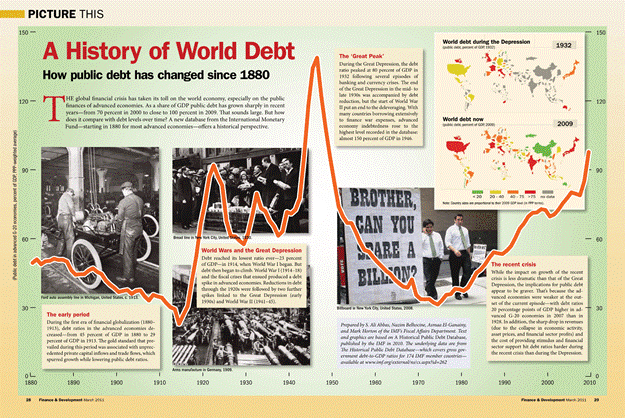
Before the fiat era, debt would only increase due to war, as you can see with the peaks corresponding to the two world wars in the above image. Now, debt increases permanently, perpetually. This is why governments will not willingly abandon a fiat system, but it is driving the very inequality they claim to care so much about, along with the regulations passed by the same governments.
It gets even more ridiculous when you consider that governments and the economists who serve their interests, claim tax increases are how you deal with inequality. They claim these will only affect the wealthy but in reality these always affect the middle class the most.
So yes, inequality is a problem, but the cause of that problem is government. Regulations allow them to fix market outcomes for their friends in the private sector, while monetary manipulation allows them to transfer resources from taxpayers through debt and from working class and middle class consumers through inflation. This is also why you need to own the right kinds of assets, it’s not just for retirement, it is the only way to avoid the inflation tax.
Mpiyakhe Dhlamini is a libertarian, writer, programmer and an Associate of the Free Market Foundation.

Inequality is a natural and necessary biological, social and economic phenomenon. Inequality of opportunity, determined by the state, that hampers an individual from escaping poverty, is a sin. Simple and not complicated.