


Written By: Charl Heydenrych
The mark of a confident democracy is not its ability to silence its most radical voices, but its capacity to tolerate their noise.
Recently, British Prime Minister Keir Starmer took a hard line, suggesting that those who chant “Globalize the Intifada” should face the full weight of criminal prosecution. While the desire to protect citizens from fear is noble, the path of criminalizing political slogans, no matter how jarring or historically fraught, is a dangerous retreat from the principles of free expression.
Drawing the Hard Line: Words are Not Violence
The defence of radical free speech is not a defence of pacifism toward crime. We must be uncompromisingly clear: physical harm, or the direct, immediate incitement to it, must be dealt with harshly. If a person stands before a crowd and points to a specific individual or a specific building and says “attack him,” or “burn that” they have crossed the line from speech into conduct. The law should fall on them like a hammer.
But a slogan chanted by thousands in a city square or a stadium is not a tactical order. It is a scream of political frustration. When we begin to treat “offensive” or “threatening-sounding” speech as if it were the same as a physical assault, we degrade the very meaning of violence. Words can hurt feelings, they can cause deep communal anxiety, and they can be profoundly offensive, but they do not actually break bones.
The defence of individual liberty rests upon a singular, unwavering pillar: the absolute freedom of expression. To compromise on this right is to invite the slow decay of a free society, yet the architecture of liberty is not a license for chaos. It is bound by a rigid ethical framework. This fundamental is expressed in the Non-Aggression Principle (NAP), or as the South African thinker Trevor Watkins more precisely framed it, the Harm Consent Principle (HCP). Under this doctrine, any action that initiates physical force, trespass, or damage to another’s person or property without their consent is a moral transgression.
The paradox of a free society is that it must tolerate the most offensive or radical speech to remain free, while simultaneously maintaining a zero-tolerance policy for physical aggression. Speech is the mechanism by which we negotiate our existence without resorting to clubs and stones. When we attempt to police the “offensiveness” of words, we remove the safety valve of society. However, the moment that speech transitions into the initiation of physical harm, the boundary of the HCP has been crossed.
Consider the controversial endurance of political slogans and songs. In the South African context, the chant “Kill the Boer” is frequently cited as a flashpoint. Within a framework of absolute free speech, the performance of a song, no matter how historically charged or emotionally abrasive, must be protected. To ban it is to grant the state the power to decide which cultural expressions are valid. Similarly, the slogan “Internationalize the Intifada” represents a radical political position. If we are to be consistent defenders of liberty, we must accept that people have the right to utter words that others find abhorrent.
However, the distinction between a vocalized sentiment and a physical act is where the “stridency” of the defence must shift into a strident condemnation of violence. The HCP dictates that while you may sing, shout, or protest, you have no right to touch a hair on another person’s head or a brick of their house.
To illustrate the necessity of this distinction, imagine a scenario where a group of radicals sit in a room and say, “let’s” decide how to strike back at our perceived enemies. If their conclusion is to “kill” the discourse or even to express a hateful desire toward “a” specific group, the NAP suggests that until a physical initiation occurs, the speech remains protected. Even if their dialogue targets a “few” individuals or generalizes their vitriol toward “blacks” or any other racial or religious group, the intervention of the state should only occur at the threshold of physical action.
This is a hard pill for many to swallow, but it is the only way to prevent the state from becoming a thought-police. Yet, we must be equally firm in our response to actual transgressions. The moment a protest turns into the “senseless” destruction of property or the “actual use of violence,” it ceases to be an exercise of rights and becomes a criminal enterprise. There is no “free speech” defence for arson, assault, or the looting of businesses.
Violence linked to racial or religious nature is particularly corrosive because it seeks to punish individuals for unchosen characteristics, violating the very essence of individual sovereignty. The HCP demands that we treat every person as an island of private property. To invade that island, whether through physical harm to the body or the destruction of the fruits of one’s labour, is the ultimate sin in a free society.
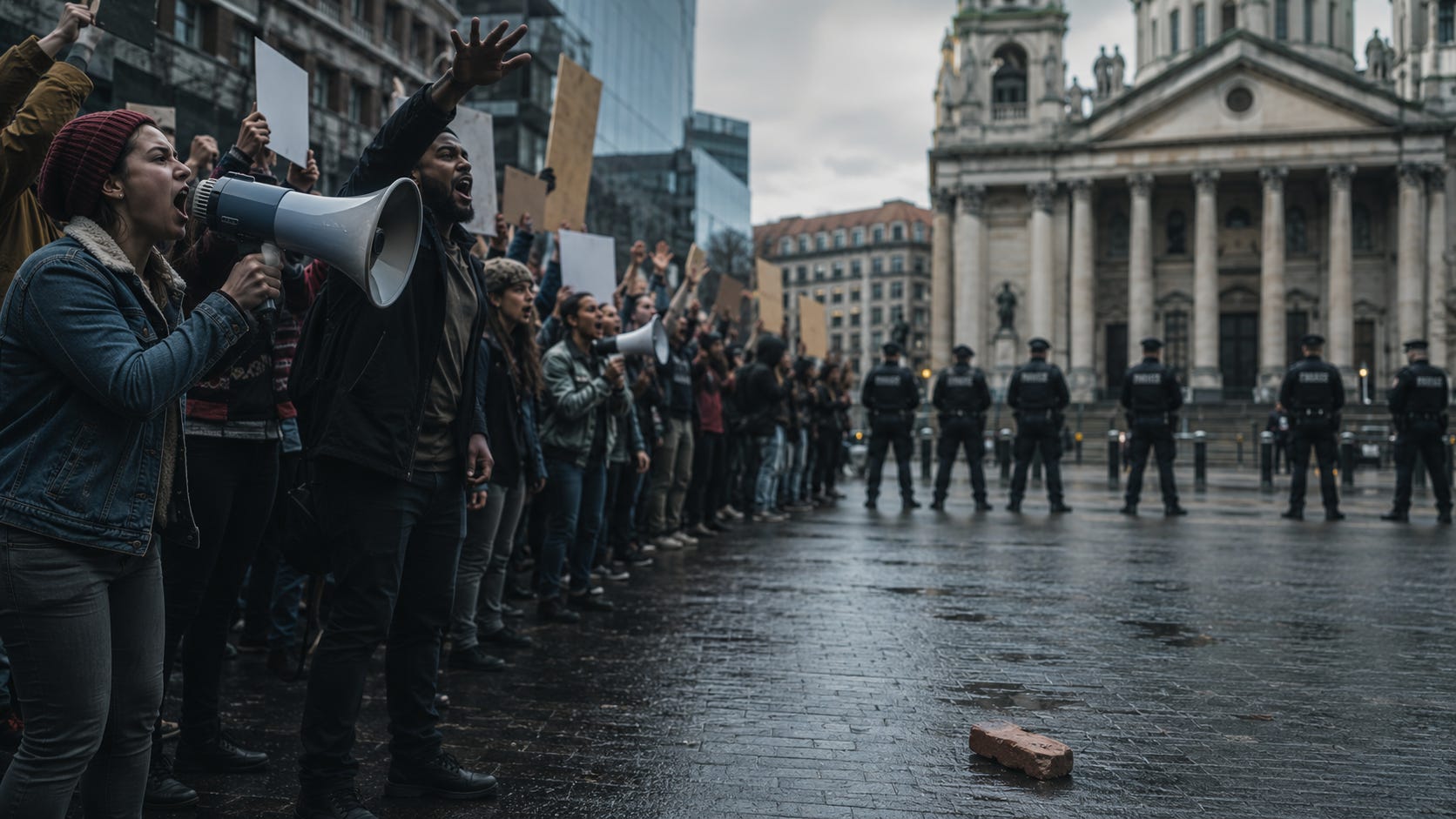
The defence of slogans like “Kill the Boer” or “Internationalize the Intifada” is not an endorsement of their content; it is an endorsement of a system that prefers words over war. But that system only functions if we are ruthless in our condemnation of the first person to swing a fist or throw a brick. We must protect the right to be offensive, but we must also demand the absolute security of the individual from the aggression of the mob. Liberty requires a thick skin for words and a steel shield against violence.
Charl Heydenrych is a retired human resources practitioner and a libertarian.
Well written, the decline of Britain in this regard is particularly sad for me because I am an anglophile. I hope they find their way back to the values that make their culture the best example to follow for South Africa.
A quality discourse ... Your "Liberty requires a thick skin for words and a steel shield against violence." sums it up well ... 👍👌