


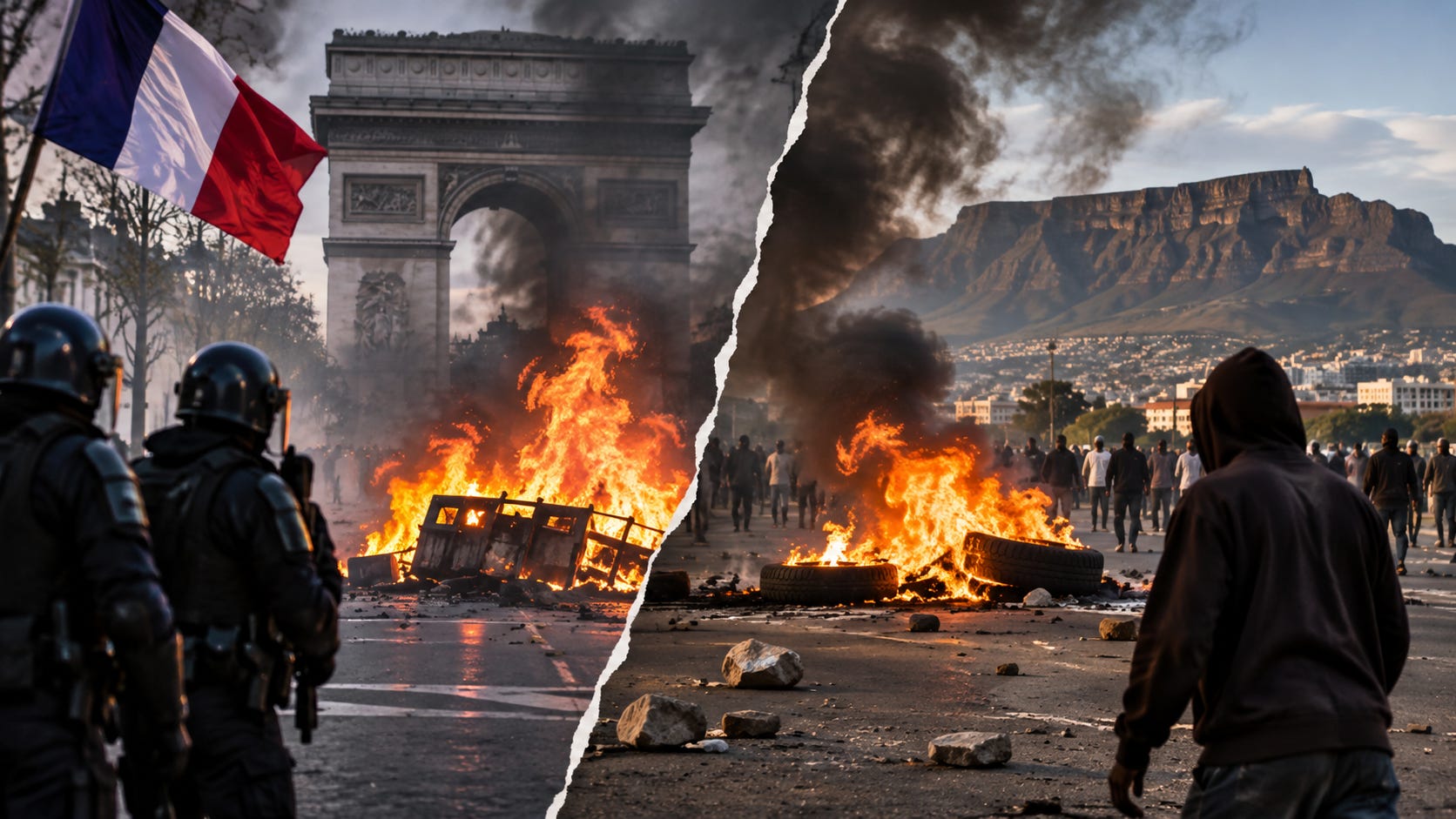
The violence and destruction that recently erupted in Paris and spread across France and into numerous other European cities have caused a tremendous international stir. In South Africa, my observation, based on social media comments, is that reactions, as usual, fall into two broad camps.
The first camp believes that Western values and Western civilisation are under serious threat, perhaps even rapidly approaching the point of no return. This makes members of the “Western camp” in South Africa deeply saddened and concerned. Although they have lived in Africa for many generations, Western values and what they have come to know as Western civilisation remain close to their hearts. This does not make them any less African, for they are deeply rooted in African soil, so much so that some have named themselves after Africa and become known as Afrikaners.
The second camp, it seems to me, almost takes pleasure in the events unfolding in Europe. Its members believe that these events will bring a welcome end to the historical attitude of European superiority, which looked down upon everything that was not Western. This attitude dates back centuries, when Europeans sailed to explore and discover other continents, encountering local populations whom they regarded as “barbarians” because they differed from Europeans in almost every respect.
This even led European nations to believe that it was their duty to uplift these supposed “barbarians” by annexing their territories as colonies and governing them for decades, expecting subservience from the local populations. This generated resentment that was passed down from generation to generation and now appears to produce a degree of satisfaction among members of the second camp when they witness signs of the decline of Europe’s Western culture.
It is largely pointless to try to determine which camp is right, because these positions are rooted in deeply held personal values. They represent ideological preferences that are difficult, if not impossible, to change through persuasion.
However, let us set these divergent ideological convictions aside for the moment and compare what is happening in Europe with South African realities.
What is driving unrest in Europe?
What does the media identify as the root causes of recent events in Europe? The following factors are not listed in any particular order of importance.
Firstly, youth unemployment and declining living standards. Young people feel excluded from stable employment opportunities, are burdened by high living costs and feel alienated from traditional political processes. School-going youth also believe that education is underfunded, leaving them even less prepared to enter the labour market.
Secondly, the failure of public service delivery and the consequent questioning of state legitimacy. There is a growing perception that the state has abandoned the social contract between itself and its citizens. People across European countries are increasingly protesting against deteriorating public services, including dilapidated schools, overburdened healthcare systems and austerity-driven budget cuts.
Thirdly, the cost-of-living crisis. Recent unrest in European cities, from Paris to Madrid and Lisbon, has been fuelled by rising prices for essential goods, unaffordable energy bills and increasingly unaffordable housing.
Fourthly, the perception of a two-tier society. In many European cities, there is a growing belief that the elite flourish while working-class communities and outlying suburban areas are neglected. This fuels resentment towards national governments.
There are certainly other causes, some of which mainstream media outlets and liberal governments often prefer to ignore.
Europe’s immigration policies have resulted in a substantial influx of foreigners whose cultures differ from traditional Western culture. Assimilation has proved difficult for many of the cultural and religious groups that have settled in Europe.
Since Europeans have offered little or no resistance to the dilution of their own cultures, owing to what I regard as excessive tolerance, newcomers have begun to exploit these perceived weaknesses to impose their own views and values on their European host countries.
Violent uprisings offer valuable opportunities to accelerate this process. Even legitimate public grievances can therefore be exploited to advance the broader objective of establishing distinct cultural identities and political influence within European states.
Underlying economic weaknesses in Europe also contribute to these processes of decline. European economic growth has long fallen far below what it could and should achieve. Large public debt burdens and extensive, increasingly unaffordable social welfare programmes place further pressure on state finances.
Excessive state support can also dampen productivity by discouraging private initiative and entrepreneurship.
The parallels with South Africa
Let us return to South Africa. Do readers recognise the similarities with Europe, particularly in the context of my two-camp analogy?
Firstly, youth unemployment exceeds 60% in South Africa. Young people find themselves excluded from stable employment opportunities, burdened by high living costs and alienated from traditional political processes, which they increasingly regard as ineffective in bringing about meaningful change. Educational outcomes in South Africa, particularly among poorer communities, are extremely poor, leaving young people even less prepared to enter an already constrained labour market.
Secondly, the failure of public service delivery and the consequent questioning of state legitimacy. There is a growing perception that the state has abandoned the social contract between itself and its citizens. South Africans are increasingly protesting against deteriorating public services, including crumbling municipal infrastructure, dilapidated schools, an overwhelmed and inadequate public healthcare system, and grossly deficient crime prevention.
Thirdly, the cost-of-living crisis. Unrest in South Africa is also increasingly being fuelled by the rising costs of essential goods, unaffordable electricity, a growing housing shortage among low-income families and continuously increasing transport costs.
Fourthly, the perception of a two-tier society. In South Africa, there is a growing belief that the ANC elite flourish while ordinary citizens are neglected. This fuels anger towards the national government. One of the few counterweights that has so far prevented widespread nationwide civil unrest is the social grant system, which supports approximately 26 million citizens every month. However, there can be little doubt that this burden is unsustainable in an economy that is not growing and has a continuously shrinking tax base. The state’s continued accumulation of debt is anything but a sustainable solution. There inevitably comes a time of reckoning when debt pushes a country over the precipice, beyond the so-called “debt cliff”.
Fifthly, South Africa’s immigration crisis cannot be ignored. The rise of movements such as March and March in 2026, together with subsequent unrest in urban centres such as Durban and Soweto, points to a weakening of the state’s monopoly on violence. Rather than maintaining law and order, the state has largely become a spectator. When citizens take policing into their own hands, the state’s inability to maintain order and protect human rights within its borders represents a serious failure to fulfil its constitutional and international obligations.
Why South Africa faces greater risks
When we compare Europe’s situation directly with that of South Africa, we find many disturbing similarities. However, South Africa also faces ominous trends that could result in upheavals far exceeding those currently experienced in Europe.
Europe generally has strong social safety nets. Many European countries are welfare states, providing unemployment benefits and universal healthcare that cushion economic instability and help maintain relative prosperity. South Africa, by contrast, has a social grant system supporting millions of people, but these grants generally leave recipients at or below the absolute poverty line.
European states generally possess sufficient institutional capacity and well-equipped law enforcement agencies to restore order relatively quickly, provided their governments have the political will to act. This political will was clearly lacking during the initial stages of unrest in France.
In South Africa, however, law enforcement agencies are frequently overburdened and understaffed, creating a security vacuum during periods of large-scale unrest.
The July 2021 unrest in Durban and elsewhere in KwaZulu-Natal demonstrated this weakness. More recently, the March and March campaign created the impression that civilian groups, rather than the South African state, were in control during a serious national crisis. Members of the South African National Defence Force even had to be deployed in Durban and other parts of KwaZulu-Natal.
In Europe, poverty is largely relative, meaning that low incomes are measured against comparatively high national standards of living. In South Africa, absolute poverty and food insecurity remain widespread realities.
Violent crime rates in Europe are also comparatively low. South Africa’s extraordinarily high levels of violent crime mean that widespread unrest has the potential to become considerably more deadly, resulting in far greater loss of life.
Conclusion
Youth exclusion, unaffordable living costs, deteriorating public services and growing distrust of political leadership are common factors currently disrupting European nations. These same conditions also have the potential to cause major disruption in South Africa, possibly on a much greater scale.
Both Europe and South Africa are struggling with immigration-related challenges. However, South Africa’s extreme inequalities in income and wealth distribution make Europe’s disparities appear comparatively modest.
Because South Africa has a much higher baseline of poverty, weaker state capacity and greater structural inequality, the risk of a rapid descent into destructive unrest is inherently greater than in Europe.
Europe’s protests reflect a social contract that is eroding, while South Africa’s unrest reflects a social contract that has never adequately served the majority of its citizens.
What is currently happening in Europe may be geographically thousands of kilometres removed from South Africa, but the underlying social, political and economic causes of unrest and violence in both regions show remarkable similarities.
We must also remember that within South Africa’s borders exists the “Western camp” referred to in my introduction. Its members have lived in Africa for many generations, yet Western values and the civilisation associated with them remain close to their hearts.
This does not make them any less African. They are deeply rooted in African soil, so much so that some have named themselves after Africa and become known as Afrikaners.
It is therefore difficult to escape the conclusion that events unfolding in Europe could eventually have similar consequences for members of South Africa’s own Western-oriented communities, particularly those who view Europe’s present turmoil with concern rather than satisfaction.
The challenges facing Europe are not merely distant events for South Africans to observe. They are warnings of what could happen here, potentially with far more devastating consequences.
Piet du Plessis is a retiree with extensive experience in applied socio-economic development. He describes himself as a liberated Afrikaner who has moved beyond self-flagellation and believes in openly embracing and expressing his cultural pride and values.
