


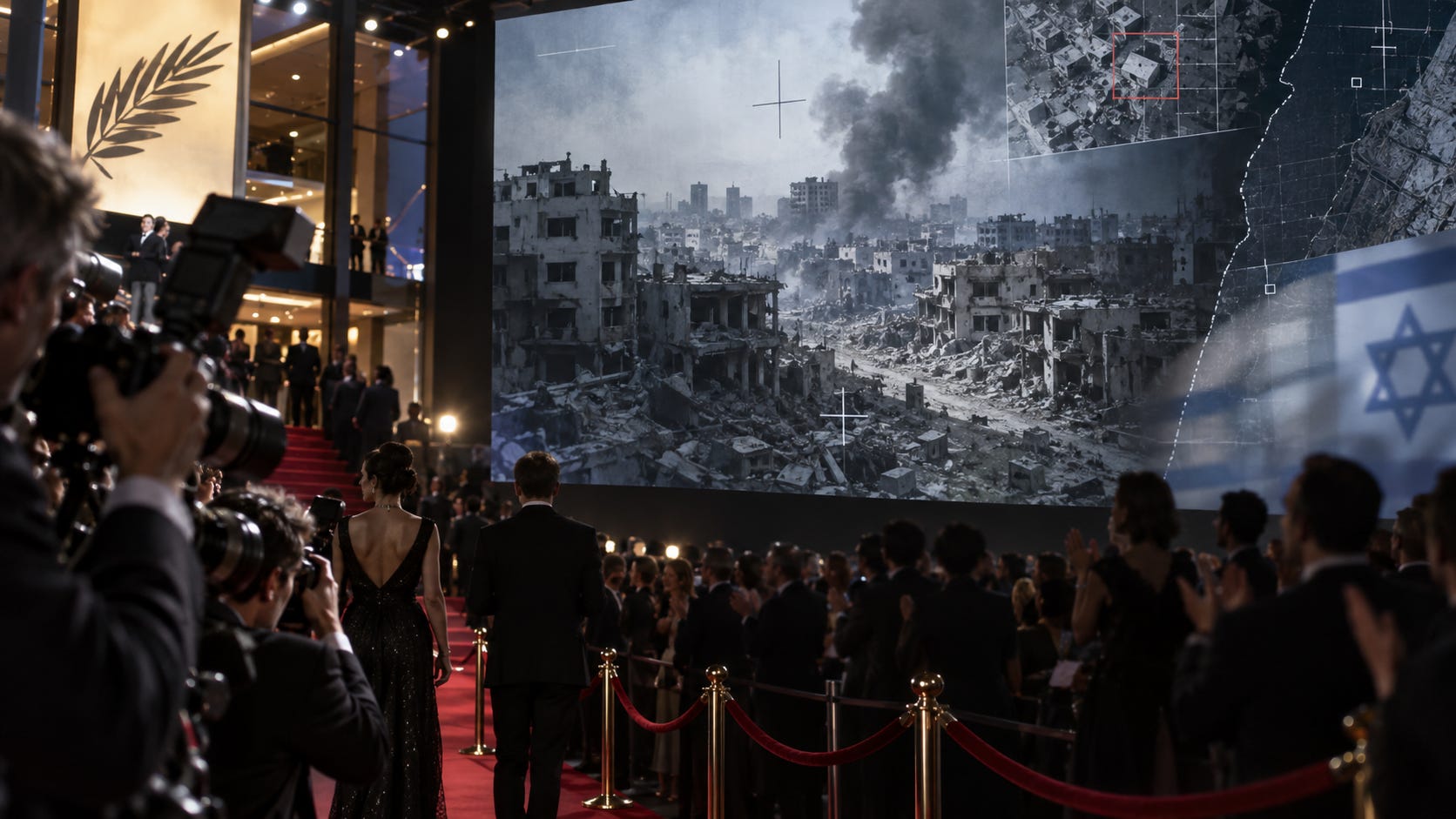
The war in Gaza was once again at the centre of attention at yet another prestigious film festival.
First there was a group of celebrities accusing the Cannes Film Festival in 2025 of not being sufficiently anti-Israel - sorry, “pro-Palestinian” - in condemning the “genocide” in Gaza. Then the Toronto Film Festival pulled and then, after some pressure, reinstated The Road Between Us: The Ultimate Rescue, a documentary about the 7 October Massacre.
Now, we have the Venice International Film Festival, which took place over the first two weeks of September, where the virulently anti-Israel documentary NAZA received a whopping 25-minute standing ovation and won the Special Jury Prize.
This came after Susan Sarandon took the stage at the same festival to proclaim that she had been cancelled for her pro-Palestinian views while promoting her latest film.
NAZA is the latest anti-Israel hit piece by Israeli filmmakers Yuval Abraham and Rachel Szor, two of the filmmakers behind the Oscar-winning and equally controversial No Other Land. No Other Land presented a notoriously one-sided view of the Israeli-Palestinian conflict in the West Bank; their latest, which is backed by The Guardian, a newspaper not exactly known for its own neutrality on the matter, presents a similarly one-sided view of the Israel-Hamas war in Gaza.
Well, allegedly.
To be upfront about this, I have not seen NAZA, as it literally just premièred in Venice and the chance of it actually reaching these shores is, like most documentaries, a total crapshoot.
But just because I couldn’t in good conscience actually review it doesn’t mean that I can’t or won’t respond to some of its most egregious claims that have already been widely reported on.
After all, considering the viewing figures of these sorts of documentaries, I can all but guarantee that most of the reactions to it, both pro and con, will come from reports about the film rather than the film itself.
NAZA and Its Claims
So, with these disclaimers out of the way, what exactly is the primary claim being made by the film?
In short, through a series of interviews conducted with 24 alleged military figures in the Israeli Defence Force and Israeli intelligence, all shot in silhouette and with their voices distorted to preserve their anonymity - and credibility - Abraham and Szor have apparently woven together a narrative of how the Israeli military actively targeted Palestinian civilians throughout the war in Gaza.
According to reports, the following charges lie at the heart of their case against Israel:
Israel mapped out the entirety of Gaza, including its civilian infrastructure, and used that as a basis for military operations.
The IDF used AI to calculate how many civilians would be killed in each major military operation.
The ratios they came up with were completely “disproportionate” and would range between a couple of dozen civilians for one militant to hundreds of civilians for a single high-ranking Hamas operative.
Israel went out of its way to make Gaza uninhabitable by destroying most of the civilian architecture in Gaza.
There were instances of individual soldiers shooting at Palestinian civilians.
Some IDF officials and soldiers, as well as politicians, celebrated the deaths of innocent civilians.
These alleged claims, and the very thing that rather undermines them, can actually be summarised by the film’s title.
NAZA is an acronym for the Hebrew phrase Nezek Agavi, which means “collateral damage”, and particularly refers to the expected loss of civilian life in an attack against a military target. It is the basis of that commonly misunderstood term, “proportionality”.
Disproving Genocide
Obviously, if any individual Israeli soldiers celebrated the deaths of civilians, it is utterly disgraceful and indefensible, even if driven by grief. And if any Israeli soldiers intentionally murdered Palestinian civilians, then they should be subject to full criminal charges.
But individual cases - and this is based apparently on only two of the 24 figures interviewed - do not prove anything systemic or even remotely widespread.
Similarly, just because some politicians have undoubtedly said some absolutely risible things about Palestinians, that does not mean they set IDF policy, especially in the heat of war.
What’s really odd about the film, though, is that it does the exact opposite of what many of its supporters are claiming, and perhaps even what its filmmakers intended: it fully proves that Israel did not commit genocide during the war.
Israel’s actions are marked here as somehow nefarious, but what they actually show is that rather than indiscriminately killing civilians, Israel complied fully with international law by creating proportionality protocols and mapping out Gaza’s infrastructure to go specifically after militants, not civilians.
These are not the actions of a military engaged in the systematic murder of an entire people, but in urban warfare.
And it is still absolutely horrific. Of course it is.
The very idea of weighing how many civilian lives you are willing to sacrifice to take out a single military target should absolutely freeze your blood. The fact remains, though, that it is far more moral than the alternative, and is used in every war, and most especially in every urban war, which Gaza isn’t just an example of, but is probably the most extreme example of in modern history.
It is, however, crucial to understand what proportionality is and what it isn’t.
This is what actual military experts explain it to be: proportionality is not dictated simply by how many civilians will die versus how many militants, but by how many civilians would be considered an acceptable cost for the advantage of taking down a particular military target.
As such, a top military target like Hamas leader Yahya Sinwar may come with a proportionality ratio of, say, 500 to 1 - which is a number that I believe the film claims - whereas 15 low-level targets may not even justify a 1:1 response.
It is also absolutely crucial to understand that these numbers are an “upper limit” on so-called “acceptable” losses, but are seldom reflected in practice, as armies are still called on to minimise civilian deaths to the best of their ability.
Which Israel clearly does, because had the IDF actually stuck to these theoretical ratios, the number of dead in Gaza wouldn’t be the 3% that both Israel and Hamas agree it to be, but something closer to 303%.
Further, the fact that 80% of Gaza’s infrastructure was reduced to rubble but “only” - and I can’t stress those quotation marks enough - 3% of its total population, including tens of thousands of militants, died proves that not only was a genocide not committed, but that these proportionality estimates are statistics necessary for fighting a war rather than a reflection of actual deaths during wartime.
Again, none of this changes how mind-bogglingly awful it all is.
And being outraged by it and believing that humanity should have moved far beyond the need for such evil arithmetic is a totally legitimate and fully correct response.
But “proportionality” remains the only even remotely moral way to fight an urban war, and most especially an urban war of the sort that Israel was fighting.
Context Is Everything
If there is one thing you can rely on when it comes to the harshest haters of Israel, it is that they will present the conflict with as little context as they possibly can. At least anything beyond “Israel has been committing a Nakba against the Palestinians for a hundred years”, or some variation of the same.
And when it comes to the Gaza war, the biggest piece of context that they either ignore, minimise, justify, or contort is Hamas and its barbaric actions not just over the past three years, but since its founding decades ago.
Further, the film makes a big deal of Israel increasing the “proportionality equation” during the early parts of the war; that it allowed for more civilian deaths for each military target.
But this is very specifically because Israel’s entire defence infrastructure had been thrown into complete turmoil by the October 7 attacks.
Its military leaders, especially, had no idea whether October 7 was only the opening salvo of a series of pogroms by both Hamas and Hezbollah, who started firing rockets into Israel on 8 October, and were in a desperate rush to take out as much of Hamas’ military leadership as possible.
This changes the equation considerably from an eventual threat to a clear and present danger.
Which is why it may have been “proportional” in this case to hunt down the top Hamas brass when they were at home at night with their families rather than when they were hunkering down in the hundreds of miles of tunnels that they built exclusively for the use of their fighters.
In other situations, the arithmetic may well have been completely different.
Indeed, as the war progressed and the IDF had a better idea of what they were facing, the number of “acceptable” casualties dropped significantly - yet another fact that is apparently ignored completely by the documentary.
As was Hamas’ weaving of its entire terror network through the enclave’s civilian infrastructure.
These factors are, again, crucial to understanding Israel’s tactics, including its destruction of most of the buildings in Gaza, which was further exacerbated by the fact that Hamas booby-trapped these buildings and lay in wait for Israeli soldiers by using their “home field” to their advantage.
Israel may well have done things wrong throughout the war - I’d be surprised if they didn’t - but judging their actions without fully reckoning with Hamas, October 7, and the actual conditions under which the IDF fought is beyond disingenuous.
And all too typical of the anti-Israel movement.
Embarrassing Responses
Finally, a quick thought about the responses to the film, both positive and negative.
On the latter front, once again, the Israeli government has utterly embarrassed itself in its response.
Not just by blindly denying everything in the film, while leaving everyone else to actually answer the charges brought and explain their wider context, but by daring to trample over freedom of the press and freedom of speech by suggesting that Abraham and Szor should be stripped of their citizenship.
Fortunately, there is a significant gulf between these callow politicians and the highly qualified people who ran the actual war. The IDF’s wish to see the actual film so that it could directly respond to the criticisms within is just one tiny example of that.
As for that absurd 25-minute standing ovation at Venice, it’s worth noting that over recent years, the applause for films shown at these festivals has become something of an embarrassing joke, as they have reached a point where even mediocre movies receive ludicrously long standing ovations.
Mix that trend with an almost unprecedented opportunity for rooms of people who know less than nothing about Israel/Palestine to virtue signal about the latest activist fad, and it’s frankly a wonder that they stopped at only 25 minutes.
This is a serious film, no matter how wrong it may be, that deserves a serious response. And it has very much received one.
Just please pay no attention to the inane, knee-jerk celebrations or condemnations made by the world’s loudest and most obnoxious voices.
Ilan Preskovsky is a Johannesburg-based freelance writer, who has covered everything from international politics to Jewish culture/ religion to film and TV reviews. His work has been featured online on the likes of News24, Popverse and BizNews, and in print in Business Day, Jewish Life Magazine and the Star, among others.

Makes me sick...