


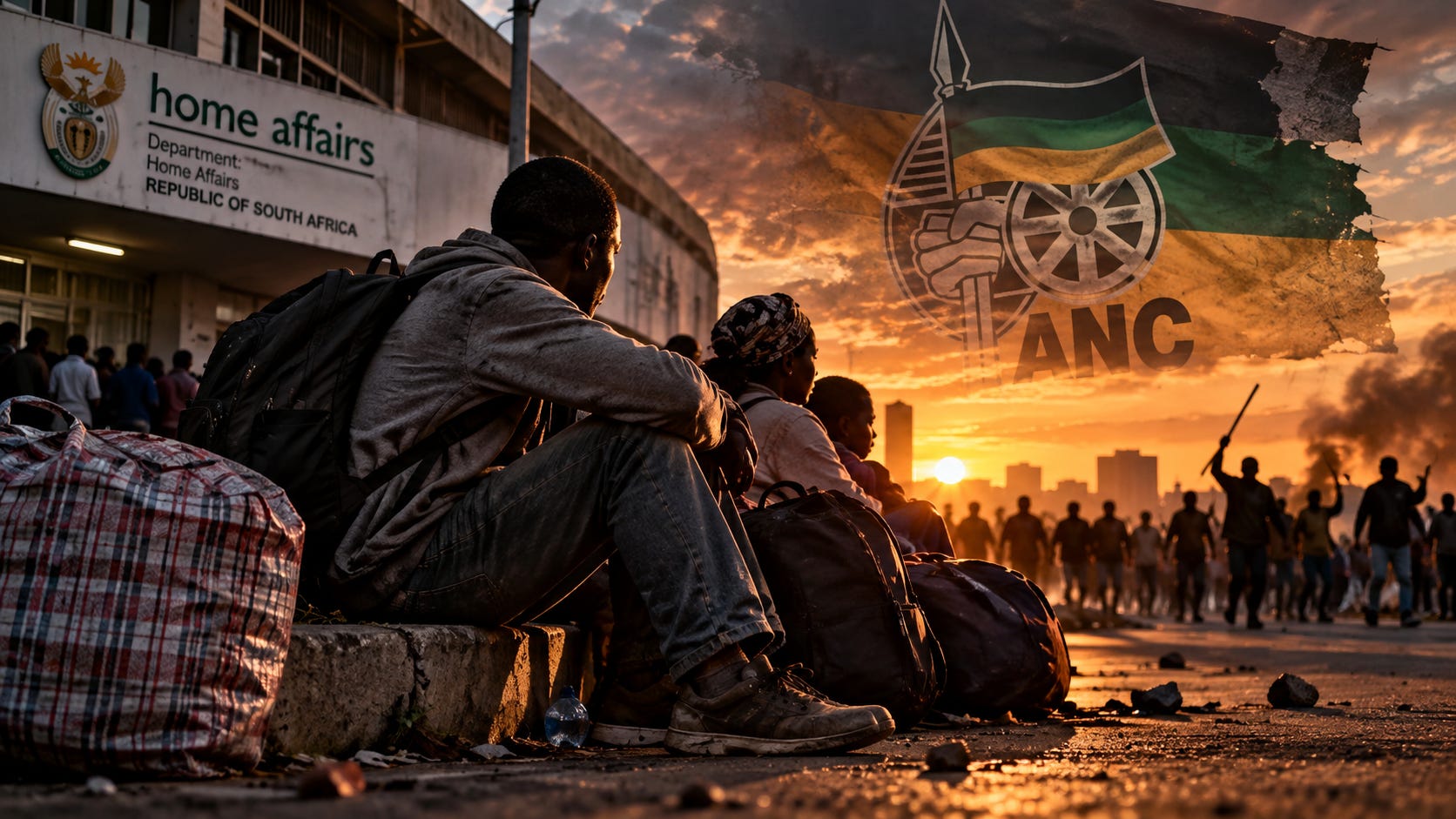
By treating illegal immigration with decades of passive tolerance, institutional inefficiency, and periodic token crackdowns, the ANC-in-government created a human crisis: inviting vulnerable individuals to build lives in South Africa, only to leave them unprotected when societal tensions boiled over into vigilante violence.
Let’s face it: the ANC-in-government’s 30-year policy toward illegal immigrants was not one of compassionate tolerance, but of calculated neglect, a structural cruelty that tacitly permitted millions to integrate, only to abandon them to violent vigilante justice when public frustration exploded.
Decades of Institutional Inertia
For over three decades, the Department of Home Affairs (DHA) operated under systemic backlogs, corruption, and porous border management. Rather than enforcing strict border controls or establishing workable, legal pathways for regional migration, the government permitted undocumented migrants to settle, work, and build families.
False Sense of Security
This long-term passive tolerance created a de facto sanctuary environment. Immigrants integrated into townships and local economies, believing they were tolerated by the state, exposing them to catastrophic risk when policy shifts or popular sentiment soured.
Governance by Reaction and Half-Hearted Measures
Historical evidence, from the 2008 and 2015 xenophobic outbreaks to Operation Dudula and recent violence against immigrants in Durban and Soweto, shows a consistent pattern: the government remained largely passive until public anger turned violent.
Post-outbreak responses, such as sporadic raids, temporary task teams, short-lived border deployments, and even army deployments in urban areas, served primarily as political theatre to placate domestic voters, rather than long-term policy solutions.
Once international headlines faded, enforcement reverted to passive tolerance, resetting the violent cycle.
Rise of Vigilantism
The emergence of movements like March and March in 2026 and the subsequent unrest in urban centres like Durban and Soweto demonstrate a complete breakdown of the state’s monopoly on violence.
The state has largely become a spectator. When citizens take policing into their own hands, the state’s failure to maintain order and protect human rights within its borders becomes an omission of its constitutional and international duties.
International Moralising vs. Domestic Inaction
The government frequently takes strong moral stances in international forums, such as the United Nations or the International Court of Justice, regarding human rights abuses elsewhere, while failing to protect vulnerable populations within its own sovereign territory.
This contrast underscores the double standards and ethical inconsistency between external ANC-in-government human rights advocacy and its internal governance failures.
The ANC-in-Government’s Case Against Israel
The ANC-in-government’s case against Israel was rich, given that under international human rights law, such as the African Charter on Human and Peoples’ Rights, states have a positive obligation to protect the right to life and right to security of person for all individuals within their jurisdiction, regardless of legal status.
A government violates its international obligations not only by committing direct acts of violence, but also by failing to exercise due diligence to prevent, investigate, and punish private acts of violence (vigilantism).
Cruelty by Default
By engineering a system of perceived impunity for illegal immigrants over more than 30 years of ANC rule in South Africa, and failing to enforce order during predictable outbreaks, the state is contributorily negligent in the resulting human rights violations which regularly took place over decades.
It boils down to severe cruelty against human beings.
Piet du Plessis is a retiree with a long history of applied socio-economic development. A liberated Afrikaner who has moved beyond self-flagellation, he believes that he has been freed to live out his cultural pride and values, and to proclaim them openly when appropriate.
