


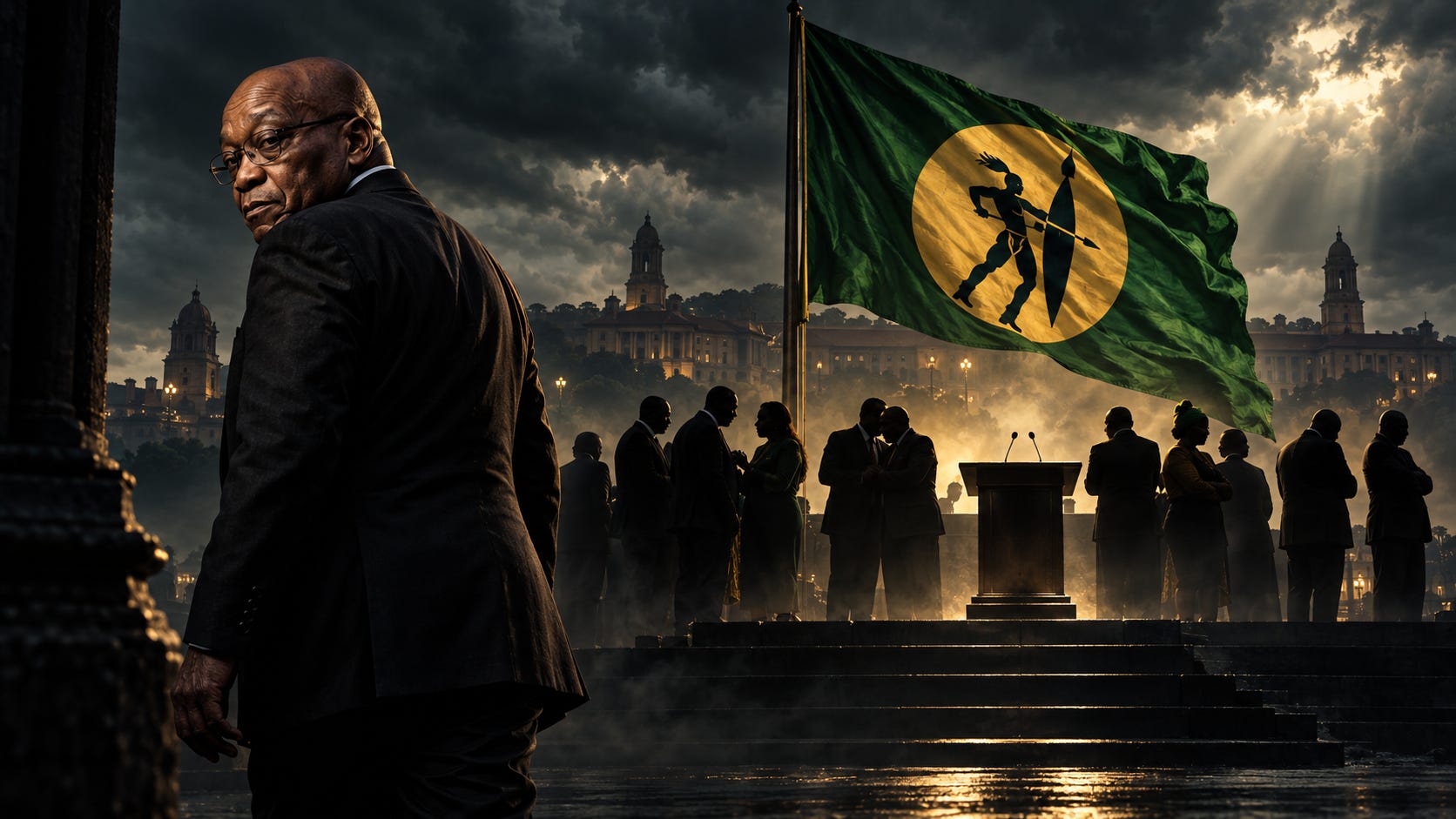
“When Jacob Zuma passes on, becomes senile, or withdraws from the formal political arena, the MK Party (MK) will disintegrate and eventually become politically irrelevant.”
This is a common view among political commentators when they are asked to speculate about the future of the MK.
I held this view a year ago. But after much reflection since, I have come to think that the party’s future is not quite so straightforward.
It is true that Zuma, a charismatic, populist figure who is perceived by many of his supporters as a victim of persecution by a corrupt political establishment, is arguably the MK’s main organising principle, or at least one of its most important ones. There is, therefore, merit to the view that his withdrawal from the formal political arena could significantly weaken it.
However, Zuma is not the MK’s only organising principle, and this is where my newfound doubt about its presumed future comes in.
The interests holding the MK together
In his paper on the outcomes of the 2024 national and provincial elections, Joel Netshitenzhe, Executive Director of the Mapungubwe Institute for Strategic Reflection (MISTRA), correctly identifies the MK as a coalition of the so-called radical economic transformation (RET) faction that lost control of the state when the African National Congress’s (ANC) “New Dawn” faction assumed power after 2017.
The RET faction mainly consists of politicians associated with Zuma’s presidency and their various patronage networks. They are united by their grievances against the faction that currently controls the state and a shared objective to dislodge it, reclaim power, and resume enriching themselves at the public’s expense.
Even with Zuma out of the picture, the faction could remain united and leverage the MK as a political vehicle to regain control of the state, particularly its security apparatus, while redirecting public procurement to serve the interests of its patronage networks.
There would certainly be a leadership vacuum that could exacerbate instability within the party and trigger a power struggle that could ultimately lead to its disintegration. Nevertheless, the RET faction’s shared interests could prove strong enough to sustain its unity in the absence of the big man.
If the latter happens, the faction could either reunite with an even weaker ANC or continue positioning the MK to inherit one of the ANC’s most prized assets: its crown jewel of liberation politics.
The enduring power of liberation politics
I am not as convinced as Build One South Africa (BOSA) leader Mmusi Maimane that South Africa has entered an era of post-liberation politics. While the ANC may be in a terrible position electorally, it still occupies a space that no other political party occupies in the country’s formal political arena.
Whether one likes it or not, the ANC is the liberation movement. It is still viewed, fairly or unfairly, by its supporters - including those who have defected to the MK or stopped voting altogether - as the most reliable political vehicle for advancing the liberation of those who have suffered injustices in the past and continue to live in poverty.
Liberation politics remains a relevant factor - among several others - in shaping voter behaviour in South Africa. Anyone who wishes to challenge this argument must account for why the ANC’s electoral decline has not meaningfully improved the electoral prospects of opposition politics, even with the Government of National Unity (GNU) in place.
If the RET faction could continue using the iconography of the original uMkhonto we Sizwe paramilitary while coupling it with the rhetoric that the ANC has abandoned the liberation struggle and joined the same corrupt political establishment that has persecuted a genuine “freedom fighter” like Zuma, it could maintain the MK’s existing support base and potentially win over more of what remains of the ANC’s support base.
By combining liberation politics with right-wing populism, the RET faction could grow the party even further.
Right-wing populism is on the rise in South Africa, and under Zuma, the MK has already tapped into growing anti-immigrant sentiment by accusing the corrupt political establishment of deliberately disenfranchising “natives” by flooding the country with immigrants.
If the RET faction could combine anti-immigrant rhetoric with the language of liberation, it could further reinforce the party’s perceived image as a genuine vehicle of liberation challenging a corrupt political establishment that has betrayed the natives.
The Economic Freedom Fighters (EFF), with its insistence on reducing anti-immigrant sentiment to xenophobia, could lose more of its voters to the MK and inadvertently strengthen the latter’s claim to be the crown jewel of liberation politics.
Beyond Zuma?
The question, therefore, is not simply whether the MK can survive without Zuma, but whether the political forces sustaining it can outlive the man who brought them together. His departure would undoubtedly test the party’s cohesion, but it would not necessarily spell its demise.
The RET faction has interests that extend beyond Zuma, while liberation politics and right-wing populism could continue to provide the party with a political constituency. Whether these forces prove strong enough to sustain the MK without its founding figure remains to be seen.
Ayanda Sakhile Zulu holds a BSocSci in Political Studies from the University of Pretoria and is a Policy Officer at the Free Market Foundation.

A far better analysis than any of the others on the same topic which I have read. One thing I think you have left out, however, Ayanda: the Zulu connection. I find it difficult to not think of the MKP as specifically and heavilly Zulu-oriented. Not exclusively, of course, but of such importance that not mentioning it is incomprehensible to me. It is akin to writing about Orania and not mentioning the overwhelming Afrikaner connection. Perhaps you thought it goes without saying for South African readers, but for readers outside South Africa it may not be possible to make that specific — very important — connection...