


BOSA leader Mmusi Maimane remains adamant that South Africa’s political future lies in building what he calls a “radical centre”.
According to Maimane this political project is “radical” because it rejects a strict adherence to ideology. It is “centrist” because it seeks to unite South Africans from all backgrounds in the centre behind a common vision of building a better South Africa for all.
On the face of it, this project is noble if one considers the country’s dark history. And I doubt that many South Africans take issue with the idea of unity, at least in theory.
And yet a frank question that needs to be posed to Maimane and others is why this project of building a centre has had no real electoral success since the first democratic election in 1994?
Every political party, from AGANG to GOOD, Rise Mzansi and BOSA itself, that has campaigned on a platform of building this centre has failed to establish any real political footprint in the country. The DA, being the only exception in terms of electoral support, ultimately failed, according to Maimane, to become the vehicle through which he could build a centre.
And while Maimane maintains that the DA’s rejection of centrism is the reason he left the party in October 2019, the DA has arguably not shifted towards the right, even as the long-standing battle for its ideological soul continues.
The centre that isn’t
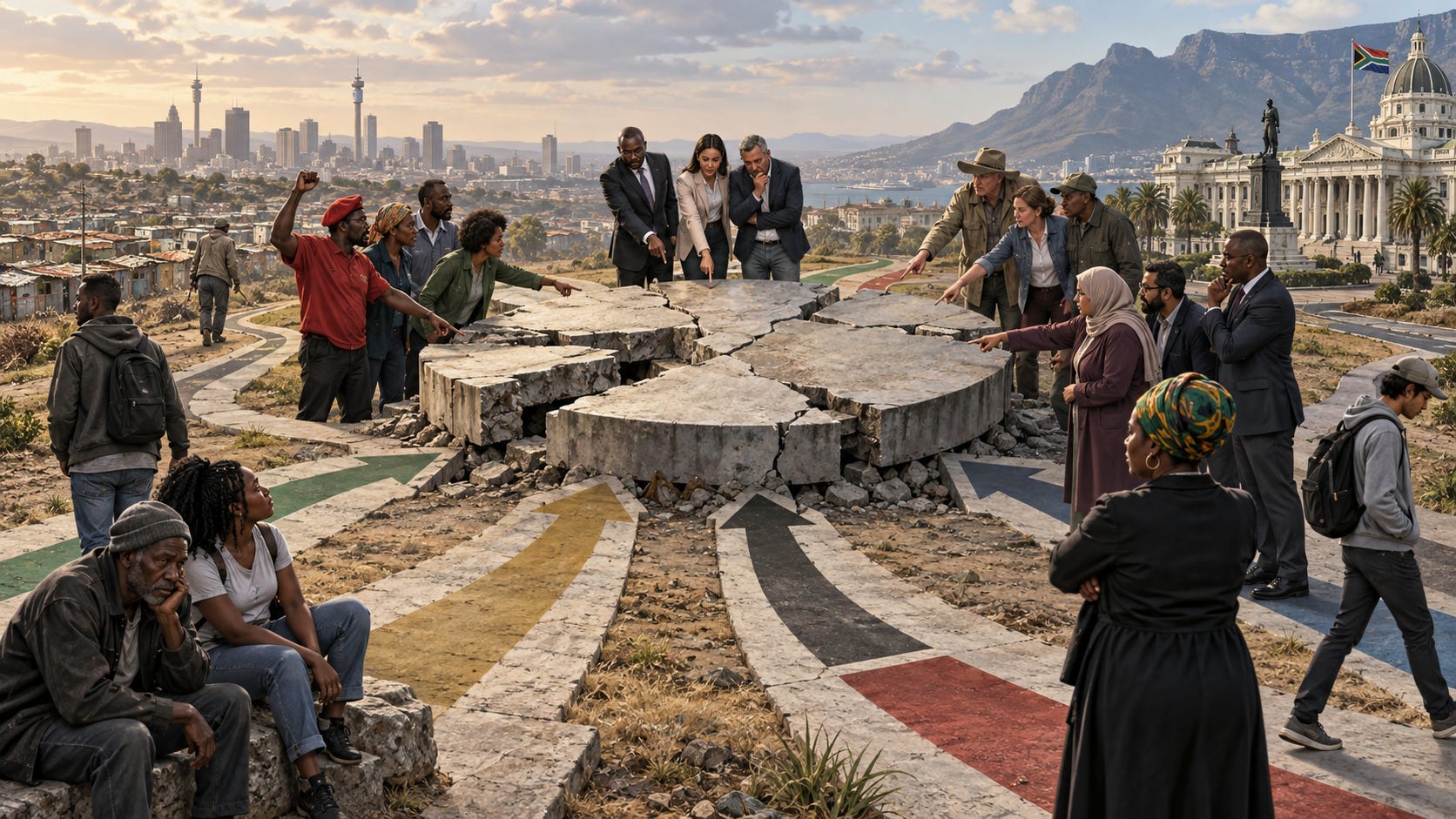
The trouble with what Maimane and others term centrism is that it rests on very questionable assumptions about South Africa as a country.
The first assumption is that there is an objectively identifiable political centre with substantive political content, that this centre represents a morally superior political position, and that those who fall outside of it necessarily occupy the fringes of the political spectrum.
This is simply not true.
While there are a number of political parties that reject extremism in favour of moderatism, these parties have very different conceptions of what constitutes the political centre. These conceptions themselves have ideological underpinnings that inform how these parties assess the supposed centrism of other parties.
A centre, if it is to exist in any substantive and objective sense, does not require complete uniformity. It does, however, require some level of political consensus on what principally constitutes it and where its boundaries lie. No such consensus exists in South Africa, despite what polling results may suggest and what vague, vibes-based sloganeering about pragmatism may imply.
When it comes to concrete questions of policy, there are real differences.
The DA, for instance - in line with the constitutional imperative of redress - supports means-based redress as a way of addressing the injustices of the past. In line with its classical liberal tradition and commitment to non-racialism, it does not support race law and maintains that past injustice can be addressed by a restrained state that allows a market-driven economy to operate largely unencumbered by state interference.
It would be difficult to find anyone in the DA who does not regard its policy agenda as centrist and as a position around which most South Africans should rally. Even black DA voters, who are routinely portrayed as either self-hating or ignorant, certainly do not see themselves as occupying the fringes of the political spectrum or as holding excessively ideological political convictions.
And yet BOSA, Rise Mzansi and GOOD have, if not directly, then certainly implicitly, argued that the DA is in fact right-wing, anti-transformation, race-blind and committed to protecting white privilege at the expense of the black majority.
In their view, what South Africa requires is a capable state that engages in social engineering and plays a far more meaningful role in the economy. They see no contradiction between race law and their conception of non-racialism because they believe the country can only transcend race by continuing to make it relevant to questions of public policy.
Their policy agenda lies at the centre in their own estimation, and they also do not see themselves as extremists operating on the fringes of the political spectrum. And yet from the perspective of the DA, the very positions they regard as centrist bear parallels with aspects of the racial nationalism espoused by the ANC and the EFF.
I could give more examples including ActionSA, the VF Plus and the IFP, all of which regard themselves as advancing a centrist project rather than operating on the political fringes. They, too, are labelled “right-wing” by the self-described centrists in BOSA, Rise Mzansi and GOOD on account of some of their policy positions.
But the point about there being no centre in any substantive and objective sense should by now be clear.
What really exists are political parties that are broadly moderate in their outlook but disagree fundamentally about what constitutes the political centre and where its boundaries lie.
The voters who aren’t there
The second assumption, which flows directly from the first, is that a centrist constituency corresponding to this “objective” centre exists in South Africa and can be mobilised if only the right centrist political vehicle is created.
If the electoral outcomes of the past 32 years are anything to go by, South Africans who have participated in elections have not been rallying behind a shared conception of centrism. They have, in the main, voted for the racial nationalism of the ANC, which has found expression in the EFF and the MK Party, as well as for the DA and a range of smaller political parties.
The parties that have explicitly sought to occupy the supposed centre have failed to attract anything approaching serious levels of electoral support.
The reasons for this are obviously layered and contested, and they fall outside the scope of this piece. But I do want to submit that ideology - whether operating consciously or unconsciously - should not be understated in the conversation about voter behaviour, particularly when considering the behaviour of those South Africans who have actually turned out to vote.
The fact that voters may be moderate in their outlook does not mean that their political choices are devoid of ideological content. Ideology can inform political judgement without announcing itself as ideology to those making the judgement.
What, then, of the biggest “party” in South Africa - the party of those who do not vote at all? Surely, it too may form part of this centrist constituency.
What is known, at least from polling results, is that these South Africans are generally not extremists. They are, by and large, moderate and do not want to drive their fellow compatriots into the sea.
But even if they are “centrist”, why have they consistently declined to turn out to vote? Why have they remained outside the electoral process for so long? And can it really be inferred that they are centrist simply because they appear to be moderate? There is a distinction between centrism as a coherent political project and moderatism as a disposition towards political questions.
What guarantee is there, then, that another centrist political vehicle will suddenly energise them to vote? What makes political analyst Prince Mashele so confident that his project is sufficiently distinct from those that have come before it to succeed where they have failed? I do not wish to overstate my case here, but the global trends are clear: in many democracies around the world, most people – particularly young people – do not turn out to vote.
This is usually attributed to apathy, and there may be some merit to that explanation. But room should be left open for the possibility that there are other reasons for political disengagement that are not yet fully appreciated. There should be no hasty assumption that the answer to political disengagement is simply another centrist political vehicle.
What this does not mean
Does all of this mean that I am against centrism? That I hate moderation, compromise and the idea of uniting South Africans?
Certainly not.
It does, however, mean that I have become increasingly sceptical of the way the centrist project is presented in South African politics. I am sceptical of the assumption that there is an objectively identifiable centre, that there is a constituency which naturally corresponds to it, and that what is required is simply another political vehicle capable of mobilising that constituency.
After all, if the centre is as obvious and politically compelling as some of its proponents suggest, we should perhaps have seen more evidence of it by now.
Ayanda Sakhile Zulu holds a BSocSci in Political Studies from the University of Pretoria and is a Policy Officer at the Free Market Foundation.
