


It’s a tough time right now to be a Jew. That’s a statement that’s demonstrably true, but it’s one that can’t be made without a whole slew of caveats if I am to have any hope of not having a veritable cavalcade of keyboard warriors jumping down my throat.
So, yes, it’s also a tough time to be a Palestinian. And it’s a tough time to be trans. Or working class. Or Iranian. Or a person at all really. And certainly, the Jews of 2026 still have it a lot less tough than the Jews of, say, Eastern Europe in the 20th century or Spain in the 15th or England in the 13th.
But the very fact that I have to list those caveats in the first place is precisely the problem. Since Hamas’ brutal invasion of southern Israel on 7 October 2023, Jews worldwide have been on the defensive; reeling from the explosion of antisemitism that erupted worldwide from the worst massacre of Jews since the Holocaust.
And yes, that includes those “as a Jews” who will denounce and vilify their own people just to make them look like they’re on the right side of history. What is that, after all, if not a defensive measure?
This is not about “playing the victim” and certainly Jews have survived this long precisely by not allowing ourselves to be defined by victimisation, but it’s impossible to ignore the hypocrisy. In an era when every minority is a protected class and every microaggression an aggravated assault, it is only the Jews that constantly have to qualify every act of antisemitism and it is only the Jews that “don’t count” as a minority in the eyes of the “woke” left.
Author, comedian and proud (secular) Jew, David Baddiel, coined the term “Jews don’t count”, incidentally, in a brilliant book of the same name... and he wrote and published it before the world-altering events of 7 October!
The result of all this isn’t just actual antisemitic attacks of varying degrees of violence, but a pervading sense of being gaslit en masse, compounded by the feeling of no one having our back - at least not against antisemites who share their same political hue.
The Emptiest Barrels...
In truth, though, while the former is undeniable, as Jews, especially Zionist Jews (the vast majority of diaspora Jewry) are constantly called on to doubt even the most obvious and apparent hatred directed towards them, it’s very much not true that we don’t have those who stand with us.
Hell, it’s entirely possible that there are more people that stand with us than against us – it’s just that they tend not to be the ones holding the loudspeakers.
And yet, there are certainly exceptions to this. Anti-Israel sentiment runs rampant in celebrity activism and lines are constantly crossed either into outright antisemitism or into exactly the sort of equivocations that I’ve been talking about, there are those who stand tall and proud against Jew-hatred.
Many of these have been Jews like David Schwimmer (Friends), Emmanuelle Chriqui (Entourage) and Debra Messing (Will and Grace), but there have been non-Jewish celebrities too who have stood up firmly against Jew hate and demonization of the Jewish state, including Nathaniel Buzolic (The Vampire Diaries), Patricia Heaton (Everybody Loves Raymond), and Andy Buckley (The Office).
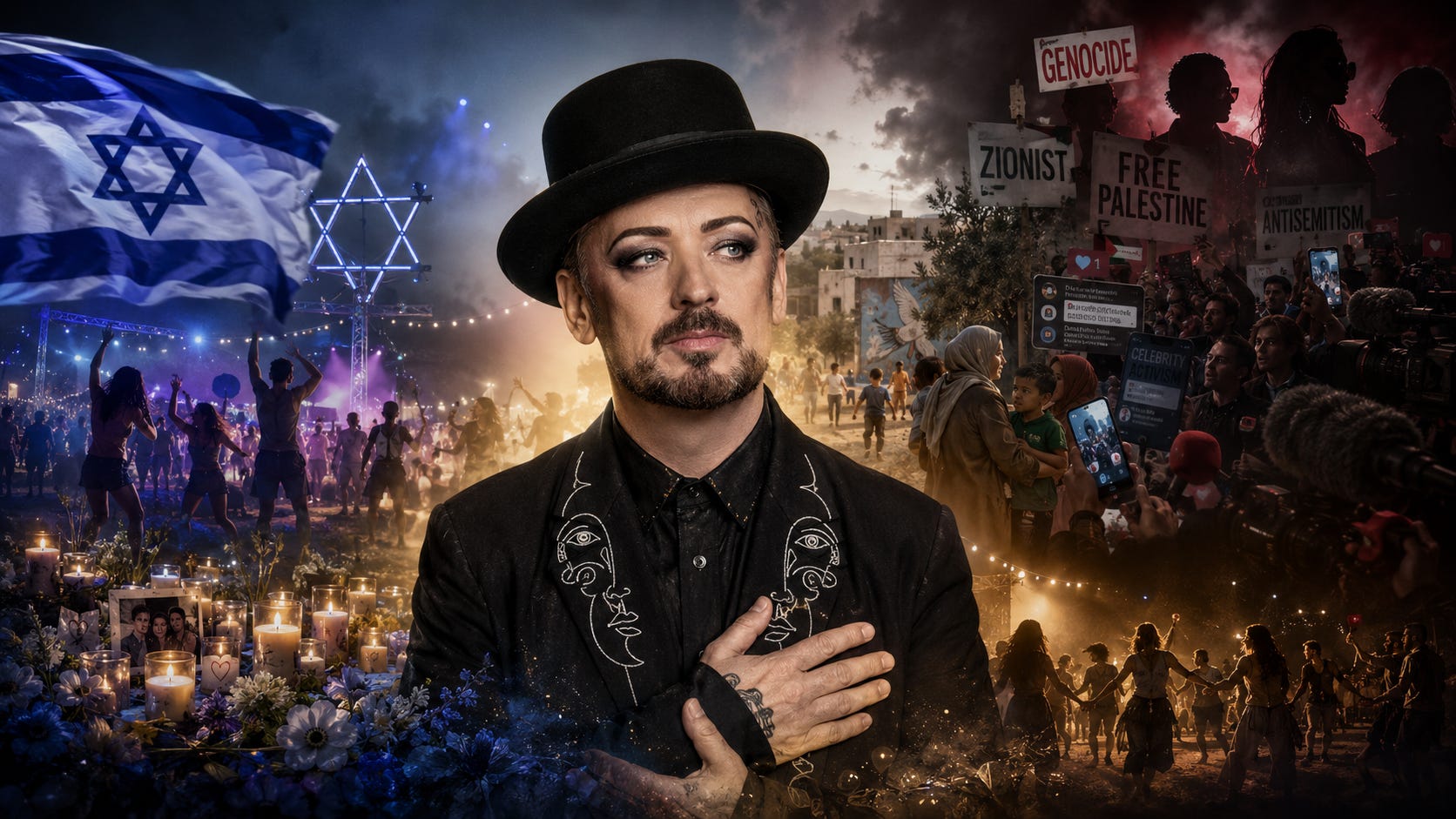
Perhaps the most high profile of the latter group in recent weeks, though, is ‘80s pop icon and The Voice judge, Boy George, who first made it very clear in public statements that he would not abandon his Jewish friends to the antisemitic mob and then went on to release a song in commemoration of October 7th that focused especially on those hundreds of young people murdered at the Nova Festival, titled, appropriately, “We Will Dance Again.”
What’s notable here isn’t just that Boy George did this while fully anticipating the inevitable backlash (including ultimately withdrawing from a West End production of Jesus Christ Superstar), but that he demonstrated exactly how to show support for a people without demonizing another and without professing to understand a complex situation more than he actually does.
If only the “pro-Palestinian” (really, anti-Israel) side would learn from his example.
Love vs Hate
This is what Boy George had to say in an interview with UK newspaper, the Telegraph, earlier this year about his support for Jews, especially in the wake of a spate of antisemitic incidents that have rocked the British Jewish community:
“Over the years it’s been a really personal thing. It doesn’t mean that I don’t have compassion for Palestinians, it doesn’t mean that I agree with what’s going on in Israel, but I am always going to defend the people that I love. I have a lot of Jewish friends and there would never be a situation where I’d turn my back on them.”
Note not just what’s said in this quote but what’s not: he is both able to show support for Jews without necessarily supporting the actual policies of the Israeli government, and show compassion for the Palestinian people at the same time. There’s no political grandstanding, just simple humanity rooted in love and support and personal connection.
And lest you think that this is just about diaspora Jewry and not about Israel, one needs only look at the lyrics of We Will Dance Again. The song, which was controversially created through the use of AI (hey, no one’s perfect) takes its title from a mantra of resilience adopted by Israelis in the wake of the 7 October attacks; one that is framed very specifically around the massacre at the Nova festival.
Here, George does get more political. The song literally opens with the verse: “You say genocide, I say war / When you’re attacked, that’s what the army’s for / Does it get ugly? You bet it does / When I know you wanna kill every last one of us,” and he directly calls out the “pro-Palestinian” crowd when he sings, “You condemn the Jews, with selective memory / Musicians holding flags, mouthing like sheep / Propaganda fuelled by the internet feels so weak.”
The question, obviously, has to be asked: is he overstepping the line here in the way that so many “pro-Palestinian” activists are by opining on a complicated political situation with simple slogans? Am I just being a hypocrite for condemning the hateful “anti-Zionist” rhetoric employed by everyone from Vanessa Redgrave to Mark Ruffalo, but excusing Boy George for doing the same from the opposite direction just because he’s on “my side”?
I don’t think so. And the reason I don’t, gets to the very heart of my problem with so much pro-Palestinian activism. It’s the reason why I put “pro-Palestine” in quotation marks and prefer to call the movement what it is: anti-Israel.
How To Be an Ally
Before getting into the stark difference between George’s message and that of the anti-Israel movement, one thing worth pointing out is that on a most basic level, We Will Dance Again is a protest song; one that follows a long established tradition in folk and popular music, which uses the medium of song to talk about the pressing issues of the time.
Protest songs have always been blunt, emotionally charged vehicles for what are usually simple messages. So, if Boy George comes across as polemical in the song, and doesn’t delve into the complex history of the region, well, that’s very much in line with every protest song from This Land is Your Land through Masters of War through The Streets of Minneapolis.
There is a massive, qualitative difference between writing a protest song and using your celebrity to lecture people about things that you either don’t properly understand or that you oversimplify to suit your political agenda: be it ending an awards speech by shouting “free Palestine!” or lecturing mere mortals about the wonders of socialism just after cashing a 20 million dollar pay check for your work in a single movie.
Again, note the massive difference between the polemical passion of We Will Dance Again and the compassionate but humble response that George gives in his Telegraph interview.
More than just the medium, though, is the difference between Boy George’s message and that of most of the anti-Israel movement. While George defends Israel for daring to fight back against a foreign army (that’s what Hamas is, at minimum) that massacred, tortured, raped and kidnapped hundreds of its citizens or foreign nationals within its borders, and calls out the explosion of antisemitism worldwide that followed in its wake, he does so in a way that neither excuses Israel when it does go beyond its remit of defence nor when it fails to live up to its liberal-democratic ideals.
He also certainly doesn’t vilify all Palestinians, Arabs and/or Muslims, let alone questions the Palestinian right to self-determination and never presents himself as anything like a geopolitical expert.
Can we really say the same about the majority of the “pro-Palestinian” movement - at least its loudest component - and its attitude towards “Zionists” and the “Zionist Entity”? I think unfortunately not.
I am grateful, above all else, to Boy George for his unshakeable, proud support for the Jewish people, but I’m also grateful for his showing the world how to be an “ally”; how to stand with a people without demonizing another. I can only hope that, AI-assisted or not, his vitally important message doesn’t fall on deaf ears.
Ilan Preskovsky is a Johannesburg-based freelance writer, who has covered everything from international politics to Jewish culture/ religion to film and TV reviews. His work has been featured online on the likes of News24, Popverse and BizNews, and in print in Business Day, Jewish Life Magazine and the Star, among others.
