


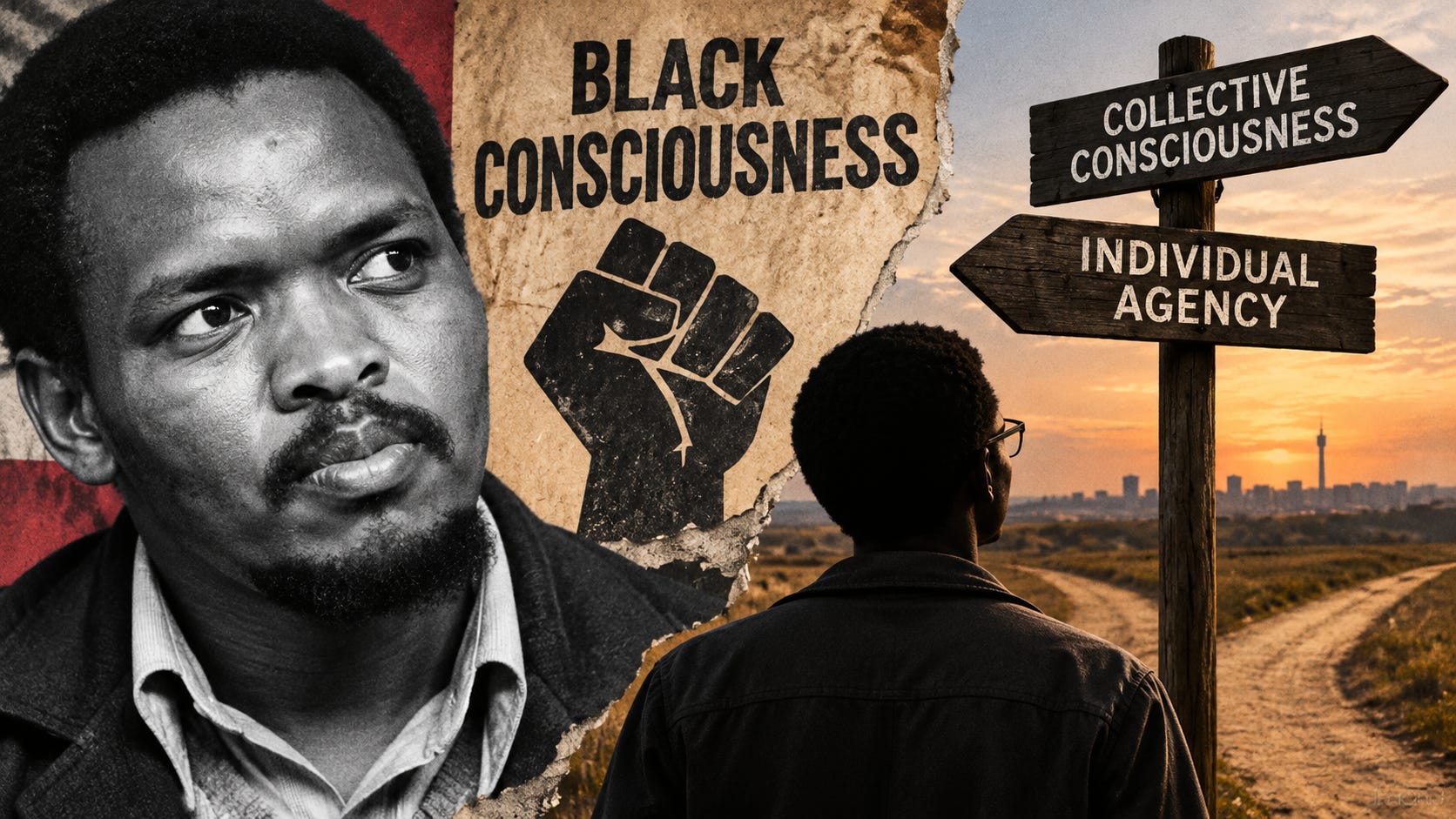
Does Black Consciousness have room for black agency?
At the outset, a BC adherent, or anyone familiar with Steve Biko’s writings, might be heard retorting:
“Of course. How can you even ask that? Reclaiming black agency is at the centre of Black Consciousness. Biko was calling on blacks to stop being spectators in a game in which they had a stake. To recognise their personhood, exercise their agency and define freedom on their own terms, rather than on terms set by white liberals.”
This response is not without merit. But it does warrant a counter-question.
If Biko genuinely believed in the agency of all blacks, why did he describe some of them as “non-whites”? Why did he characterise these non-whites as people who had yet to attain genuine consciousness and recognise their position as members of an oppressed group in a white, racist society?
Why did he inadvertently provide the lexicon that many black leftists have since developed with colourful labels, ranging from “house negro” to “clever black”?
The answer is not difficult for those who have read Biko’s writings beyond a superficial understanding of them. His point, in very simple terms, was that black liberals were politically unconscious victims of a deeply racist, white society founded on the culture and worldview of a white minority.
They had not embraced liberalism (a white ideology, in his estimation) through their own independent reasoning. Instead, they had structurally internalised it by virtue of living in a deeply racist society.
Notice how this thinking bears parallels with Marxism. Because the hegemonic idea in a capitalist system is capitalism, the workers who openly support capitalism are necessarily politically unconscious victims who have structurally internalised the dominant worldview of their society.
They are not rational individuals who have arrived at their support for capitalism through independent reasoning. Rather, they are unconscious victims who have yet to attain genuine consciousness and recognise their position as members of an oppressed proletariat.
Needless to say, there are grains of truth in Biko’s thinking, especially if you consider it in the context in which he wrote. Blacks could hardly be expected to escape the development of an inferiority complex in a society that constantly taught them that their race was a marker of inferiority. More broadly, none of us develop our views and political convictions in a vacuum.
My commitment to liberalism has not emerged out of thin air. It must, at least in part, be understood in the context of my upbringing, religious beliefs, education and the broader society of which I am a part.
What doesn’t neatly follow from this concession, however, is that independent reasoning has played no role in the formation of my political convictions. What doesn’t follow is that I am politically unconscious, that I haven’t considered liberalism intellectually, that I haven’t evaluated it against other ideologies and independently concluded that it offers the best model for individual freedom and human flourishing.
I certainly have engaged intellectually with liberalism. I am politically conscious, and I have exercised my agency in arriving at my political convictions.
Agency is something we all possess as individuals. It is obviously neither absolute nor detached from the world around us. It is embedded in social contexts, but it remains real and informs our capacity for independent reasoning, judgement and action. It is not simply erased by the social circumstances in which we find ourselves.
We possess the capacity to exercise our agency within the social contexts we inhabit. We are not merely passive products of our environments, whose views and political convictions are determined entirely by the prevailing ideas, values and circumstances of the societies in which we live.
While liberalism affirms the agency of all individuals, Black Consciousness has little room for the agency of black liberals who do not fully agree with its political propositions. Even those who do not oppose its call for black nationalism and self-determination, but rather the socialist thinking that underpins it, are labelled “neo-liberals” and other such things.
Black Consciousness has, in this sense, created a rather perverse intellectual basis for the policing of black identity. Any black person who deviates from it, even partly, or from positions that have since been developed from it, is regarded as not being truly black.
Perhaps one of the greatest ironies, however, is that the socialism that underpins it is itself a “white ideology”.
Ayanda Sakhile Zulu holds a BSocSci in Political Studies from the University of Pretoria and is a Policy Officer at the Free Market Foundation.
