


(First published in OntLaer in Afrikaans on 25 June 2026)
When Afrikaners with their aspiration to determine their own destiny are accused of yearning for the days of apartheid — which often happens — it is sheer wilfulness and/or ignorance. Or, more often, a combination of the two. In truth, Afrikaners with their freedom aspirations were ahead of their time.
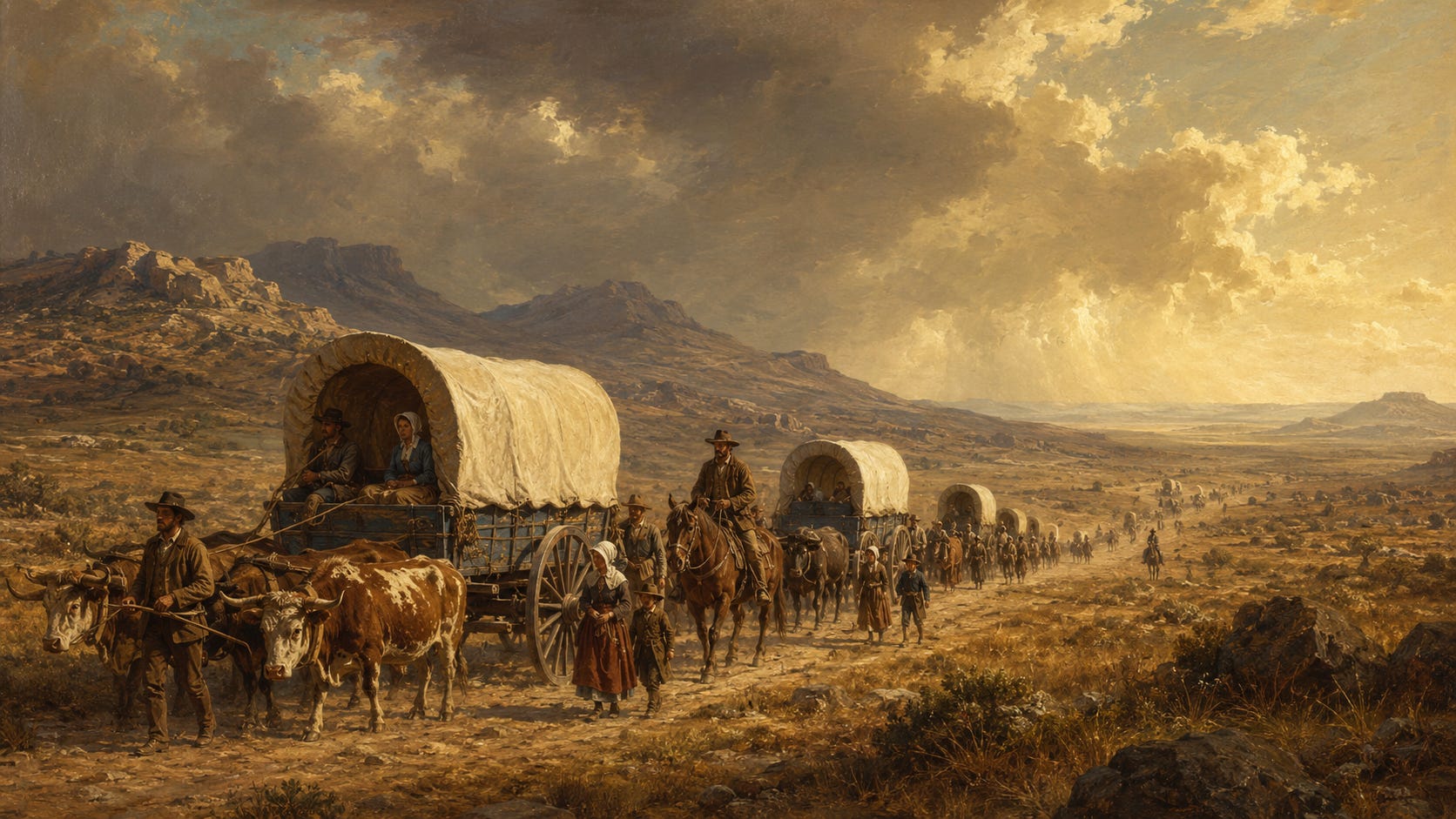
The mid-1830s marked the beginning of the Afrikaners’ Great Trek. That is how old their aspiration for self-determination is — an aspiration they felt so strongly about that they ventured from the Cape into the unknown interior with only what they could load into ox-wagons and onto pack animals, or drive on the hoof.
The outcome of the Great Trek is well known: Afrikaners succeeded, at tremendous sacrifice, in establishing their own republics; fought a bloody war against the mighty British Empire; occupied a decade-long subordinate position under British colonial power; eventually succeeded in 1961 in establishing once again an independent republic of their own within the total territorial boundaries of South Africa; and then voluntarily surrendered that Afrikaner-controlled republic to a multicultural Government of National Unity (GNU), which rapidly turned into an ANC-dominated hegemonic state when the (first) GNU dissolved in 1997.
Modern Pioneers
The Afrikaners’ age-old aspiration for self-determination is therefore indisputable. What can, however, be contested is the political discourse that seeks to characterise Afrikaners’ aspiration for cultural freedom as something narrow-minded, as if Afrikaner thinking on the subject is out of step with thinking elsewhere in the world. This is simply untrue.
In fact, it can be stated with confidence that Afrikaners did pioneering work in the field of self-determination. It can also be demonstrated that Afrikaner thinking on self-determination is in step with the thinking of major contemporary international thinkers on the subject — thinking that is direction-giving and that testifies to Afrikaners’ rational aspiration for an order that offers a healthy counterpole to the failing world trend of unrestricted globalism and hyperliberalism.
Patrick Deneen (Why Liberalism Failed, 2018, and Regime Change: Toward a Postliberal Future, 2023) is an American professor of political science at the University of Notre Dame. He is regarded as one of the most important architects of postliberalism, on the basis of his research into how the elite impose a universal, progressive culture on nations and look down on the traditions of ordinary people. He therefore calls for the restoration of traditional institutions that protect the ordinary person; institutions erected by the community itself and that can serve as a shield against a hostile, ideological elite.
Deneen points to a massive paradox: the more the individual is “liberated” from his community, the weaker that individual becomes as a human being. Without the protection of a strong local culture or family, the lonely, atomised individual is powerless. Who then fills that void? The state. A larger and more draconian state is then required to hold society together artificially. The above reasoning is a plea for a new kind of alliance, in which populist energy is linked to intellectual leadership in order to reclaim or erect institutions.
Afrikaners are in good, modern, international company when they link their historical drive for freedom — populist energy, according to Deneen — in the present juncture to intellectual leadership such as that provided, for example, by the Solidarity Movement. This is done in order to establish institutions that look after the average Afrikaner and serve as a shield against the forces of the ANC government, which looks after only the interests of a small group of elite cadres.
Afrikaners are ahead of their time and long ago already opened the window onto the global intellectual discourse — a new perspective. The Afrikaner’s struggle for self-determination is not a backward, local anomaly. It is the practical cutting edge of the new worldwide intellectual revolution against the failure of hyperliberalism and globalism. The rise of New Right and postliberal intellectual thinkers in the West is changing the rules of the game internationally.
We see New Right awakenings in America and large parts of Europe. The Afrikaner’s aspirations come from afar and are, and always were, postliberal. It is to the Afrikaner’s credit that they were ahead of their time. America and Europe have only recently begun to catch up with what the Afrikaner has pursued for a very long period — and is once again in the process of realising through the building of their own postliberal institutions, which protect ordinary Afrikaners by serving as a shield against a hostile, ideological elite in the post-1994 era in South Africa.
Ethnopluralism and its Targets
According to the modern French philosophers Alain de Benoist and Charles Champetier (Manifesto for a European Renaissance — 1999), true diversity does not mean a global, grey melting pot in which everyone is made uniform. It means that every unique group has the right to preserve its own identity in its own historical space — what they call ethnopluralism.
This philosophical framework finds a remarkable continental echo in a recent analysis by the platform Alternative Afrikaner, which exposes the globalist assault on traditional identities within the African context:
“The globalists want to get at the African tribes. The Afrikaner tribe stands in the way. In 1975, in a country that most Westerners would not be able to find on a map, a Marxist president stood before his newly independent nation and uttered a sentence that would define the ideological architecture of an entire continent for decades. Samora Machel, the first president of Mozambique, paraphrased the French revolutionary Robespierre and told his people: ‘For the nation to live, the tribe must die.’
This statement is remarkable not for its poetry, but for its precision. It was not a slogan improvised for a crowd. It was a doctrinal position, derived directly from Marxist-Leninist state-building theory, tested in the Soviet Union, exported to Asia, and now deployed with surgical intent across postcolonial Africa. The target was not merely political opposition. The target was identity itself. And if you carefully follow that thread — across continents and decades — you arrive at a conclusion that the mainstream narrative tries very hard to keep out of the public eye: the Afrikaners were never the end target. The Afrikaners were the obstacle.
The thesis is not complicated, but it requires patience and evidence. Here it is unequivocally: collectivist and globalist ideological frameworks — whether Marxist-Leninist in origin or liberal-internationalist in practice — have always understood that the Western order rests on two structural pillars.
The first is the vertical pillar: God, faith, the transcendent authority above the state. The second is the horizontal pillar: family, community, kinship, tribe — the bonds of belonging that precede and outlast any government. If you remove the vertical pillar, the individual loses the moral architecture that resists state influence. If you remove the horizontal pillar, the individual loses the social architecture that makes resistance possible. Remove both, and you have an atomised population with no higher loyalty than the state, and no communal solidarity to challenge it.”
Within this continental framework the position of the Afrikaner is thoroughly rewritten. Alternative Afrikaner points out that the Afrikaner is not merely a European remnant, but an indigenous African tribe with its own language, culture and history of anti-imperial resistance.
Why do the global elite find this redefinition intolerable? Because, if the Afrikaner is a tribe, he is entitled to minority protection and cultural self-determination under international law.
As Alternative Afrikaner points out, the Afrikaner is not the end target — he is the test. If the globalist and new technocratic powers can break the Afrikaner tribe’s institutions, language and memory, the blueprint is established to destroy the autonomy of every other traditional African tribe — Zulus, Xhosas, and so on — in favour of a central, malleable melting-pot state as the ANC wants it.
The choice for tradition, own institutions and tribal identity is not a backward glance at the past; it is the highest form of modern resilience. Graça Machel, wife of the late Samora Machel and later the spouse of the late Nelson Mandela, later turned her first husband’s draconian statement on its head by saying:
“The stronger the roots are, the better the tree is able to withstand winds and external shocks.”
Afrikaners need not feel intellectually inferior — they are the vanguard of a new, global postliberal world.
Piet is a retiree with a long history of applied socio-economic development. A liberated Afrikaner who has moved beyond self-flagellation and believes that he has been freed to live out his cultural pride and values, and to proclaim them openly when appropriate.

Excellent essay Piet. The crisis brought about by Soros and globalist/Marxist autocratic attacks on western identity is cleanly depicted in your accurate report on Afrikaner self-determination.
I was terrified of the Afrikaner world of 1960's South Africa, and unnerved by the silent but weighty world of the Zulu nation hidden by apartheid
As the years went by I fell in love with both these tribes, and today I see South African identity as a powerful amalgam of western Afrikaner and black cultures.
If we can only loose the racist apartheid of the ANC, managed by a completely criminal amoral state.
Rassie and Siya did it, and repeat the formula for those too dull to observe the power of our various cultures, welded together by our lived African experiences.
Our tribal identity does not prohibit our abiding pride in our national identity. The principles of Ubuntu align with remarkable accuracy to western ideals evolved through the enlightenment. Ubuntu has as much to teach us as the Declaration of Independence.
Thanks for your thoughts.