


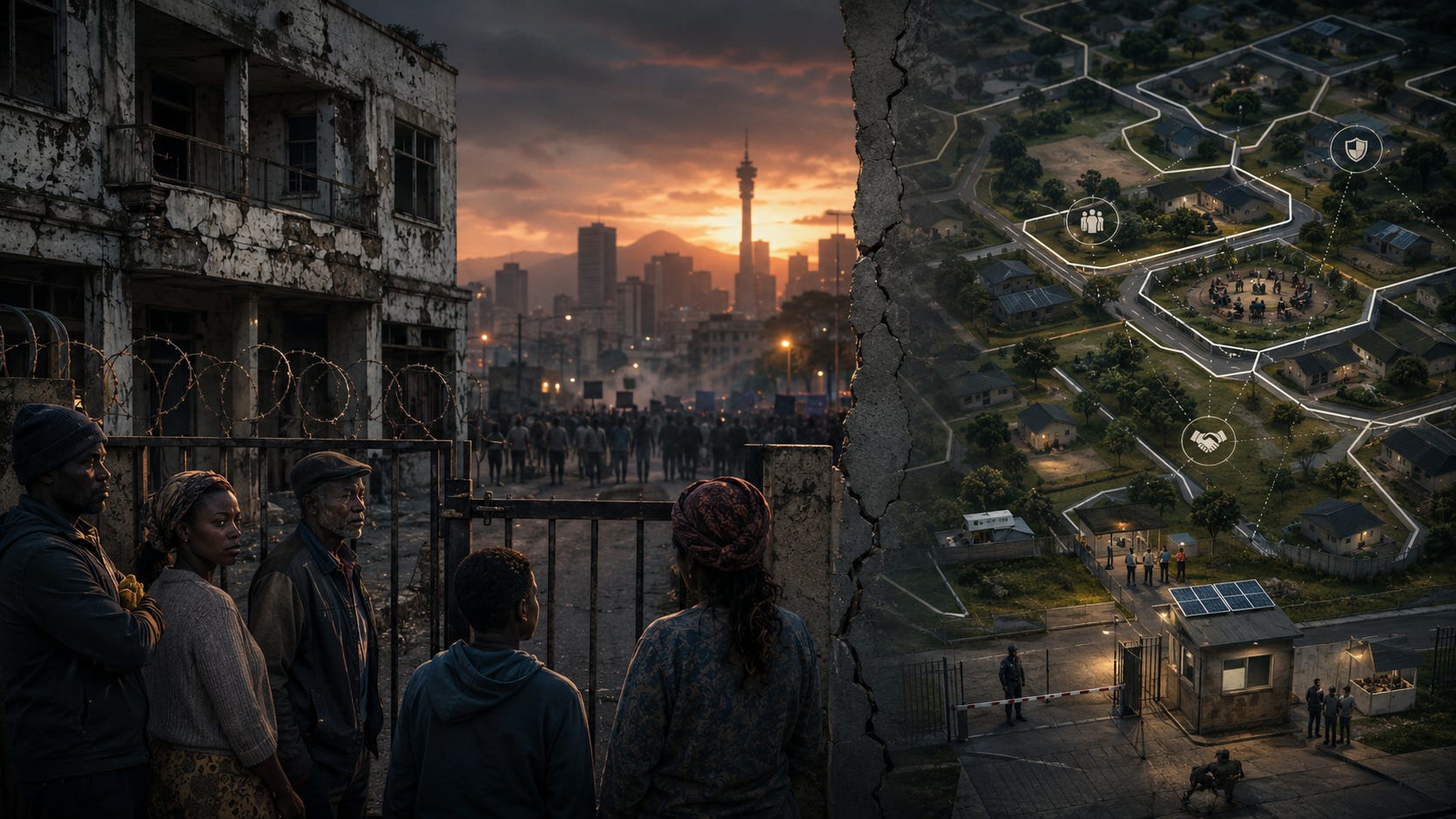
The frontier has moved from Blood River to the business meeting room, but the terror remains identical.
Today is June 30, the “Abahambe” deadline, and across South Africa’s suburbs, towns and cities, a deafening silence has settled over the Afrikaner collective. It is a quiet born, not of indifference, but of a deeply cynical realisation. As columns of men carrying traditional weapons march through the concrete canyons of Johannesburg and Durban chanting Mabahambe (“They must go”), the tremble in the gated estates is palpable.
The fear is not just that they are next in line after the Asian shopkeepers; the deeper, more corrosive dread is the knowledge of their own complicity. For decades, the descendants of the pioneers quietly built their economic ecosystem reliant on the very undocumented workforce now being hunted. They benefitted financially by being able to exploit the vulnerable.
They too have traded the harsh, self-reliant “God of the 16th of December” for the gods of the weekend braai, sports gambling, luxury double-cabs, and cheap labour. Having outsourced their morality to the bottom line, they now find themselves completely defenceless, knowing full well that when the current scapegoats are purged, the mob will logically turn its gaze toward the remaining enclaves of capital.
But the current centralised state offers no salvation. The centralised government’s response to the Abahambe crisis is a predictable lukewarm mix of a R600 million security platter and hollow warnings. The state cannot protect its borders, its own citizens, or the economy because the entire mechanism of the centralised republic is designed for self-enrichment and plunder, not protection. The current trajectory points directly toward a scorched-earth populism where the mob and the state eventually merge to devour the productive minority.
The solution: Radical free-market devolution
If there is a future to be salvaged from this grim reality, it will not be found in pleading with Pretoria or hiding behind increasingly fragile electric fences. The only viable antidote to this impending collapse is the total, radical devolution of South Africa into a decentralised set of free-market and other cantons and autonomous corporate territories and charter areas with varying degrees of autonomy.
True security cannot rely on a failed state structure. Instead, South Africa must be legally and structurally broken down into independent economic jurisdictions. These units need to be relatively sovereign cantons functioning strictly on contractual law and free-market absolutism. Some may reject this “balkanisation” of the country but that resistance will come from those feeding off the current broken system.
Privatised sovereign borders: In such a devolved system, communities and private syndicates purchase the right to govern their own spaces. Citizenship is replaced by a service-level agreement. If a canton requires migrant labour to pick its crops or build its infrastructure, it issues private, contract-backed work visas, assuming full financial and security liability for those individuals. The national state’s broken immigration system becomes entirely irrelevant.
The death of national taxation: Wealth generated within a specific enclave stays essentially within that enclave. Without the financial life-support of productive enclaves, the bloated centralised bureaucracy in Pretoria starves, stripping demagogues of the state apparatus they use to threaten minorities.
Contractual law enforcement: Security is completely separated from political whims. Instead of a compromised national police force, protection is managed by heavily armed, corporate security entities bound by strict commercial contracts. The mob does not march into an area where law enforcement is driven by corporate profit margins and liability clauses.
The Afrikaner, the Zulu, the merchant, and the labourer do not need to love each other, nor do they need to share a national identity. The illusion of the “Rainbow Nation” was always a sentimental trap. A radical free-market devolution acknowledges that human relationships are inherently transactional. By replacing volatile political friction with cold, hard contractual alignment, South Africa can transform an impending ethnic flashpoint into a highly functional network of competitive, self-governing havens with different ethnic, philosophic, economic and tax structures. The above solution is not new it is in fact being introduced by stealth in many communities. I believe we should be more open about this approach in our discussions about our future.
If the collective psyche wishes to stop trembling, it must stop hiding behind the curtains of a dying Republic. The future belongs to those who strip away the romanticism of the state and rebuild security on the unyielding foundation of the free competitive market. The process may be messy, the end however may result the elusive “better life for all”.
--
This video provides context, showing the direct impact of the anti-immigration movement on communities in South Africa: South Africa protests 30 June deadline triggers fear and repatriation – BBC Africa.
Charl Heydenrych is a retired human resources practitioner and a libertarian.
Charl, I can associate with so much of what you wrote. Much of the same thinking is reflected in my own writings. Our current dead horse, or badly injured horse ("unitary" state), can continue to be flagged alongside the enclaves or other independent/semi-independent units you envisage. It can be done by those who think they can get a dead horse or seriousy injured one to show proper life again by flogging it, or by some other wishful thinking method. Good luck to them.